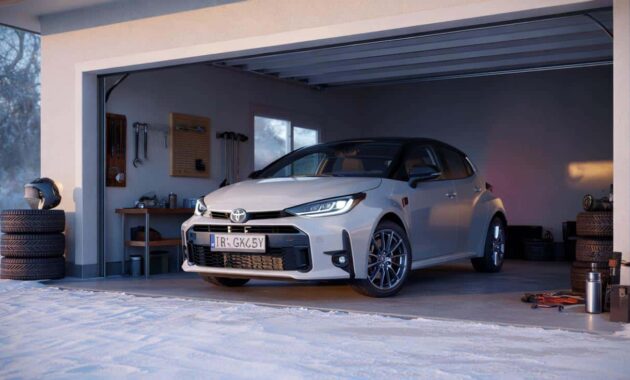
The guy in the neighboring garage doesn’t look up the first time you fire it. The cold three-cylinder coughs once, then spins into a tight, metallic idle that sounds more Monte Carlo than middle suburb. Your breath fogs in front of you. You blip the throttle. The little Toyota squats, the exhaust cracks off the concrete walls, and suddenly the boring row of doors and storage boxes feels like a rally service park at 6 a.m.
You glance at the badge on the tailgate and smile.
Because this is no ordinary Corolla.
The day Toyota quietly parked a rally car in your driveway
Toyota didn’t shout about it with neon ads or celebrity influencers. It just rolled out a squat, wide-arched hatchback that looked like it had escaped from a WRC service tent and pretended to be a normal road car. Under the skin, though, the GR Yaris and its big brother, the GR Corolla, are *anything but normal*.
Short wheelbase. Turbo three-cylinder. All-wheel drive. Manual gearbox. It feels like someone in Toyota’s motorsport department got drunk on nostalgia and corporate budget spreadsheets, and somehow didn’t get stopped.
Talk to owners and you hear the same story. One London-based photographer tells me he test-drove a GR Yaris “for content” and ended up signing paperwork on the spot. He’d been commuting in a hybrid SUV, doomscrolling rally clips on Instagram, and suddenly there was a car that felt like those grainy Group A videos had grown number plates.
He now spends his weekends hunting B-roads like they’re special stages. Not at insane speeds, but with that same ritual: early alarm, thermos of coffee, tyres warmed gently before the first real pull. His friends laugh at the wing and the flared arches. Then he tosses them the passenger seat and they come back speaking faster.
There’s logic under the madness. Toyota spent real money on bespoke bits we aren’t supposed to get anymore: a specific body shell with a lower roof, wider track, stiffer chassis; a rally-derived AWD system with active torque split; serious cooling and brakes. This is the opposite of a marketing “GR-line” sticker pack.
It’s a homologation spirit car in an era that had basically outlawed them through cost, emissions and corporate risk-aversion. And that’s why enthusiasts are losing it. Because **this is the kind of car every hot-hatch kid secretly drew in the margins of their school notebook**.
How Toyota turned bedroom posters into a factory-built toy
On paper, the recipe sounds almost too simple. Take a compact hatch. Drop in the world’s most powerful production three-cylinder. Add a six-speed manual, all-wheel drive with selectable modes, and hardware that doesn’t feel like it came from the corporate parts bin. Then tune the whole package not for lap times, but for feel.
➡️ Leeds police arrest California woman in multi state credit card fraud investigation
➡️ Boeing Secures US Air Force Deal to Build Four More MH-139A Helicopters
➡️ Your Dog Doesn’t Yawn Just Because It’s Tired: Here’s Why, According to Vets
➡️ 10 times faster than a conventional missile: Japan’s new weapon boasts a range of over 300 km
➡️ I’m a vet and this is what I tell clients who sleep with their dog
➡️ How to refresh tired garden furniture with wood stain before autumn rain sets in and protect it
Twist the mode dial and the GR’s brain reshuffles torque like a crew chief changing notes mid-stage. In “Track”, power flows 50:50 front to rear. In “Sport”, more goes to the back, giving you the kind of playful rotation that makes roundabouts feel suspiciously like hairpins.
Of course, the fantasy comes with a price tag. These aren’t cheap toys, especially once you add the circuit pack or performance options, and that’s before you start thinking about tyres, insurance, or the “oh, I guess I need better brake fluid now” rabbit hole. Let’s be honest: nobody really daily-drives one of these cars exactly the way the brochure suggests, every single day.
Most owners I spoke with have a quiet ritual. Monday to Friday, the car behaves: school runs, grocery stop, dull highway miles. Then one evening the week has been too long, the roads are finally empty, and the little Toyota suddenly remembers where it came from.
There’s a reason this formula tugs at something deeper than horsepower spreadsheets. A rally-style road car promises access. Not access to fame or trophies, but to that raw sensation of controlling grip on a scruffy piece of tarmac. You don’t need a racetrack or a dedicated trailer. You need the keys, a halfway decent backroad, and 45 minutes where nobody is asking you to answer an email.
That’s the quiet genius of Toyota’s move. **The company didn’t just build another fast car; it built a legal loophole into everyday life**, a street-parked excuse to slip away and play rally driver before dinner.
Turning your garage into a tiny rally base (without ruining your life)
If you’re tempted to sign that finance agreement, start by treating the car like what it really is: a piece of lightly domesticated motorsport hardware. That means thinking less about vinyl wraps and more about the boring but crucial basics. Tyres, alignment, fluids, and regular checks will do more for your fun than any oversized wing.
Start simple. A good set of road-biased performance tyres, slightly more aggressive brake pads, and a proper alignment tuned for your local roads. Suddenly the car feels sharper, cleaner on turn-in, more talkative through the steering wheel. Small, well-chosen steps turn the GR from “fast hatch” into “mini stage weapon” without sacrificing reliability.
The biggest trap is trying to build a full race car in a daily-life shell. Strip the interior, fit rock-hard coilovers, shout about every mod on social media… then discover your back hates you and your partner refuses to get in. We’ve all been there, that moment when the thing you love crosses the line into “too much” for everyone else.
You don’t have to go that far. Keep the cabin mostly stock, stay realistic with ride height, and think about noise as much as power. You want a crackling, eager soundtrack, not a 6 a.m. neighbour complaint every time you leave for work. Respect the dual role: part rally toy, part responsible, tax-paying citizen.
Owning a GR Yaris or GR Corolla is less about numbers and more about permission. Permission to hang on to analog joy in a world marching quietly towards electric crossovers and self-driving commutes.
- Start with maintenance, not madnessOil, tyres, brakes, alignment. Sort these before thinking about power upgrades.
- Keep one foot in daily lifeChoose mods you can live with every day, not just on your dream mountain road.
- Invest in driver trainingA day of coaching on a wet handling circuit often transforms your confidence more than any bolt-on part.
- Find “your” roadsEarly mornings, familiar routes, low traffic. The car feels better when the setting is right.
- Remember why you bought itNot to impress strangers online, but to give yourself a private slice of rally feeling on demand.
The quiet rebellion parked in front of your house
Stand across the street and look at one of these Toyotas in profile. It’s squat, almost hunched, like it’s about to launch even when it’s switched off. Yet it’s still just a hatchback. It carries shopping, folds its rear seats, sits in the same space as any rental econobox. That’s the double life you’re really buying.
You can play responsible adult Monday to Friday and still keep a set of winter rally tyres stacked in the corner of the garage, a torque wrench hanging on the wall, and a dog-eared notebook of fuel stops and backroad discoveries.
For some people, the next few years will be all about the leap to electric and autonomous tech. For others, this feels like the last call for a certain kind of analogue magic. The GR family is not just another model range, it’s a question with keys: How much joy are you willing to authorize in your own life? How much space will you carve out for pointless, grinning, uselessly wonderful drives?
One day these cars will be rare auction darlings, the sort of thing people whisper about in comments sections. Right now, they’re still sitting under showroom lights, smelling of plastic and promise, quietly waiting for someone to sign on the dotted line and turn a normal garage into a small, personal rally HQ.
| Key point | Detail | Value for the reader |
|---|---|---|
| Homologation spirit in a modern shell | Bespoke chassis, AWD system, rally-derived hardware | Helps you understand why the GR cars feel so special compared with regular hot hatches |
| Upgrade the basics first | Tyres, brakes, alignment, fluids before power mods | Maximizes fun and safety without blowing your budget or comfort |
| Liveable rally fantasy | Dual role as daily driver and weekend stage toy | Shows how to enjoy the car fully without wrecking your routine or relationships |
FAQ:
- Is the GR Yaris or GR Corolla actually practical for daily use?Yes, as long as you accept a firmer ride, slightly higher running costs, and a bit more noise than a regular hatchback. It still has usable rear seats, a proper boot, and modern safety tech.
- Do you need rally driving skills to enjoy these cars?No. They’re surprisingly friendly at normal speeds, and the AWD system gives a lot of confidence. A basic performance driving course is a smart investment if you want to explore their limits safely.
- Will owning one be very expensive?Purchase price and insurance are higher than a standard Corolla or Yaris, and tyres/brakes cost more. Careful maintenance and sensible mods keep it manageable for many enthusiasts.
- Is tuning the engine safe?Mild, reputable tunes with supporting upgrades (cooling, fuelling, monitoring) are usually fine, but heavy power increases can stress components. Many owners find the stock car already feels wild on real roads.
- Will cars like this still exist in a few years?Hard to say. Emissions rules and electrification are tightening, which is exactly why many see the current GR models as a rare, maybe last, chance to own a brand-new, factory-built rally-style road car.
Originally posted 2026-03-10 09:01:00.