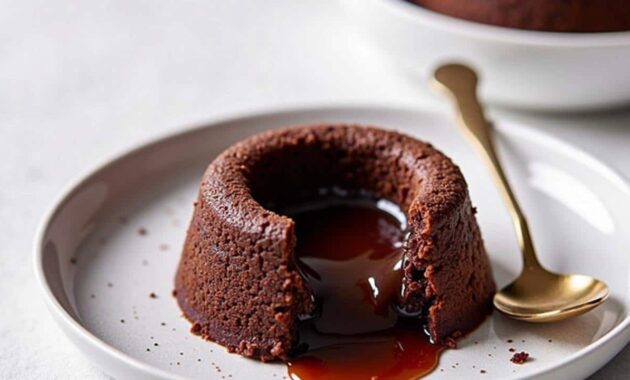
Across French kitchens and late-night UK flat shares alike, one dessert keeps coming back whenever friends turn up unannounced: the molten chocolate cake. Simple ingredients, a hot oven and a bit of timing are all it asks for, yet the payoff is a flowing centre that feels restaurant-level, even on a Tuesday night.
Why molten chocolate cake still feels like a tiny magic trick
The charm of a molten chocolate cake — or “coulant au chocolat” — lies in the moment the spoon breaks the surface. A thin, set crust gives way to a liquid heart, somewhere between sauce and ganache. It’s not a brownie, not quite a fondant, and definitely not a basic sponge.
The whole game is about contrast: crisp edges, soft crumb, and a lava-like middle that runs onto the plate.
This contrast is what makes the dessert feel indulgent even though the base recipe is straightforward: dark chocolate, butter, sugar, eggs, flour. No specialist kit, no ten-step process, no chef tricks. Just heat, watchfulness and a decent bar of chocolate.
The core formula: what you actually need
Key ingredients for a quick, reliable result
- Dark chocolate with around 60–70% cocoa for a deep, grown-up flavour
- Butter to bring richness and structure to the batter
- Sugar to balance bitterness and help the crust form
- Whole eggs for body, moisture and that tender, almost custardy texture
- A small amount of flour to hold everything together without drying it out
Home cooks in France often use roughly 120 g of dark chocolate, 100 g of butter, about 150 g of sugar, three eggs and 50 g of flour for four individual ramekins. That ratio gives enough structure so the cakes stand up on their own, while the centre stays liquid.
Think of this dessert as a dense chocolate cream trapped in a very thin cake shell, rather than a cake with a runny accident in the middle.
From bowl to oven in minutes
The method leans on speed. The chocolate is chopped small and melted gently with the butter, often in the microwave in 30‑second bursts. Once smooth, sugar and whole eggs are whisked in, then flour is folded through until the batter looks glossy and uniform.
Ramekins get a generous coat of butter and a dusting of flour so the cakes release easily. The batter is poured in, leaving a little room at the top. From there, timing is everything: around six minutes in a very hot oven for individual portions, adjusting slightly based on your particular oven and ramekin size.
The timing trick: how not to overbake it
Molten cakes sit on a tightrope between too raw and fully set. That window can be as small as one minute, which is why even confident bakers keep a close eye on them.
➡️ A 7.1-magnitude earthquake strikes offshore, less than 100 km from the coast
➡️ The quick grilled vegetable marinade that transforms ordinary vegetables
➡️ Why placing half a lemon in the oven while it’s warm helps remove baked-on smells
➡️ Breaking the speed limit to overtake: the rule almost no one really knows
➡️ No bleach or ammonia needed: the simple painter-approved method to eliminate damp at home for good
Visually, you’re aiming for firm sides, a lightly puffed top, and a centre that still looks a touch darker and softer.
How to tell if yours is ready
- The top looks dry and matte, not shiny like batter.
- The edges pull very slightly away from the ramekin.
- A toothpick poked near the rim comes out clean, but in the centre it comes out with thick, molten batter.
If you’re using a fan oven, the heat circulates more aggressively, so many cooks drop the temperature by 20 °C and start checking at the five‑minute mark. Once you’ve made the recipe once or twice, you’ll know exactly how your oven behaves.
Smart shortcuts: making it work on a busy night
Preparing ahead without losing the lava effect
For weeknights or last‑minute guests, the batter can be mixed several hours in advance and kept in the fridge. Some hosts fill the ramekins and chill them, then slide them directly into a hot oven when people are finishing their main course.
The colder the batter, the slightly longer the bake — often one extra minute is enough.
Another tactic is to keep a bag of “emergency” dark chocolate in the cupboard. The recipe is forgiving enough that you can scale it down to just two ramekins or up to six with little fuss, as long as the ratio of ingredients stays consistent.
Handling, serving and that stressful moment of unmoulding
Unmoulding makes many home cooks nervous, and with reason: if the cake sticks even a little, the delicate shell can tear and the centre empties out before it reaches the plate. Thoroughly greased and floured ramekins reduce that risk dramatically.
- Run a thin knife around the edge immediately after baking.
- Let the cakes stand for about one minute so the outside firms slightly.
- Place a dessert plate on top, flip in one confident motion, then lift the ramekin straight up.
Plenty of people skip unmoulding entirely and bring the ramekins straight to the table. Served that way with a scoop of ice cream on top, the lava effect stays, and there is zero drama.
Nutrition: what this dessert actually brings
No one eats a molten chocolate cake as a health move, yet some readers like to know roughly what’s in each portion. Based on a classic recipe, a single serving of about 80–85 g looks something like this:
| Nutrient | Per portion (~83 g) | Per 100 g |
|---|---|---|
| Carbohydrates | 31.8 g | 38.3 g |
| Fat | 21.4 g | 25.8 g |
| Saturated fat | 12.9 g | 15.5 g |
| Protein | 5 g | 6 g |
| Fibre | 1.5 g | 1.8 g |
| Sugars | 23.7 g | 28.6 g |
This is very much a treat dessert: rich, sweet, satisfying, and best enjoyed occasionally, not nightly.
Some cooks cut the sugar to 50–100 g for a more intense chocolate taste, which suits darker chocolate fans but can surprise guests used to sweeter desserts.
Variations that push the recipe further
Little twists that change the mood
- A pinch of flaky sea salt in the batter to sharpen the flavour of the chocolate.
- A few white chocolate chips stirred through for a sweeter contrast in each spoonful.
- A soft caramel cube hidden in the centre for a double‑lava effect once baked.
- Ground hazelnuts replacing part of the flour for a nutty, praliné-style edge.
- A spoonful of plain yoghurt folded into the batter for a slightly lighter, softer crumb.
Beyond that, flavours like orange zest, instant espresso powder or a splash of dark rum slot naturally into the mix. Each keeps the core structure while nudging the taste in a new direction.
Trying a slightly lighter approach
Those watching their intake tend to adjust, not abandon, the recipe. Smaller portions in espresso cups, less sugar, or serving with a tart fruit salad rather than extra cream change the overall experience without losing the molten centre.
In practice, cutting portion size and frequency often has more impact than aggressive substitutions that compromise texture.
Practical tips, pitfalls and how this dessert fits your routine
For beginners, the main risks are overbaking, using very low‑quality chocolate, or baking in flimsy silicone moulds that don’t conduct heat properly. Ceramic or glass ramekins usually bring better, more even results and a crispier outer layer.
A realistic way to integrate this recipe into everyday life is as a “plan B” dessert: batter prepped in the fridge on a Friday afternoon, then baked in six minutes if friends end up staying late, or left untouched if nobody fancies it. That flexibility makes it less of an indulgent impulse and more of a controlled treat.
There is also a social side. Because each cake is individual, guests can choose add‑ons: vanilla ice cream, pouring cream, a quick homemade custard, or just fresh berries. Serving the same base with different toppings turns one simple recipe into a dessert bar, with very little extra effort from the cook.
Originally posted 2026-03-09 05:56:00.