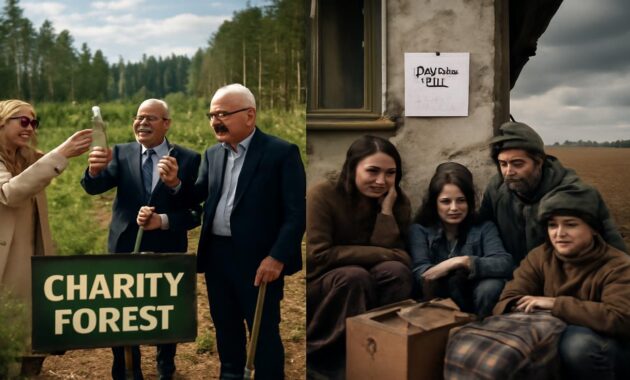
The frost came early the year the last dairy cows left the valley. It crept down from the moors, pale and glittering, settling on the empty concrete pads where the milking parlors used to hum at four in the morning. In the half-light, the land looked almost peaceful—until you saw the for-sale signs hammered into the hedgerows, and the glossy billboard at the crossroads: a billionaire’s smiling face beside the words, “Rewilding for Tomorrow.” Beneath it, in smaller print almost too tiny to read, were the letters that mattered most to the people who still lived here: “Former Agricultural Estate. Now a Climate Forest Partnership.”
That billboard went up the same week the new eco-tax bills landed in every rural mailbox. Bright white envelopes. Heavy paper. Government seal. “Carbon Responsibility Statement.” A phrase so smooth it almost sounded kind, until you turned the page and saw the numbers.
The Year the Green Bills Turned Red
The first thing you notice, listening to people around the valley, is the color they talk about when they talk about climate policy. It isn’t green. It’s red—ink red, bank warning-letter red. Every conversation folds into numbers sooner or later.
Take Martin, who runs what’s left of his family’s sheep farm on a north-facing slope the wind never stops testing. He used to worry about feed prices and lamb mortality. Now he worries about something new: “emissions liability.” He spreads the letter on the kitchen table, between a jar of cold tea and a chipped mug, as though maybe if we both stare at it long enough, it will blink first.
“They tell me,” he says, tapping the page with one blunt finger, “that my flock is worse for the planet than the private jet that landed at the old airstrip last month. You explain that to me.”
On paper, the logic is slick and airtight—like the brochure that came with the bill. Agriculture, especially livestock, makes up a significant share of emissions. Governments, desperate to meet climate targets they’ve promised on international stages, have discovered a tidy lever: tax the emissions directly. Call it a climate levy, a sustainability adjustment, or an eco-tax; the effect is the same. A new line on the bill. A new hole in the farm budget.
In the city, where most voters live, it sounds fair. Polling suggests people want polluters to pay. In theory, so does Martin. He’s not blind to the changing climate. He’s watched freak summer hail flatten his barley, watched winter rains turn the footpaths into rivers. But sitting at his table, you can see how easily fairness twists when it meets the uneven ground of the real world.
“I don’t own a factory,” he says. “I don’t fly. I fix everything twice before I buy new. And yet somehow, I’m the one with the ‘high emissions profile.’” He smiles without humor. “Meanwhile, that lot up the road plant some trees where my cousin used to grow potatoes, and everyone claps.”
The Price of Breathing Rural Air
Travel far enough from the valley, and the story looks different. On a glossy stage at an international climate summit, a billionaire philanthropist gestures toward a slide of his new “charity forest.” Former farmland, bought at what was described as “market rate” but felt like desperation from the sellers’ side. Thousands of hectares now draped in sapling rows, drones buzzing overhead to monitor “carbon capture performance.”
The audience claps as the numbers appear: projected tons of carbon sequestered, millions in pledged donations, the company’s name stamped in small, clean font at the bottom corner of every slide. A neat solution, presented in the language of win-win. Rural decay turned into global virtue.
Back home, the language is different. People talk about the new “green border” around their villages. About the access tracks that are suddenly private. About how the land that once grew food and held families now grows offsets and holds investments.
Listen to the valley’s school bus route, and you hear the climate crisis in reverse. Fewer stops. Fewer kids. Some families have moved to the outskirts of mid-sized towns where the public transit is better and heating bills a little lower. Others are gone altogether—swallowed by debt or relocation schemes that offered buyouts for “emissions-heavy operations.”
In town hall meetings, officials from the capital arrive with slides and careful smiles. They explain that eco-taxes are “technology-neutral price signals” that will “drive innovation and adaptation.” They talk about “just transitions” and “rural resilience funds.” Someone always asks why the new taxes hit home heating oil but barely graze private aviation fuel. The officials shuffle their notes. There are complexities, they say. International treaties. Global markets. Competing interests.
No one ever says the quiet part aloud: that some forms of emissions belong to people with lawyers and lobbyists, and some belong to people with leaky barns and aging tractors.
The Rural Family Budget Under Eco-Tax Pressure
To understand how those pressures land, you don’t need a modeling report. You need a single month’s ledger from a rural household. Consider an average family in a remote valley—two adults, two kids, one elderly parent, running a small mixed farm and living in an old stone house that leaks heat like a sieve.
| Household Item | Before Eco-Tax | After Eco-Tax |
|---|---|---|
| Diesel for tractor and deliveries | $280 / month | $410 / month |
| Heating oil for home | $190 / month | $295 / month |
| Electricity (incl. green surcharge) | $120 / month | $165 / month |
| Livestock emissions fee | $0 | $150 / month |
| Fertilizer eco-levy | $0 | $75 / month |
| Total Climate-Linked Costs | $590 / month | $1,095 / month |
An extra five hundred dollars a month might sound survivable in a city salary world. On a farm where the profit margin was already the thickness of a grass blade, it’s the difference between patching a roof and letting the damp in. Between replacing tires and driving on bald ones. Between staying, and taking the first buyout offered by a rewilding fund.
Charity Forests on Someone Else’s Yesterday
Drive past the old Simmons place—at least, that’s what people still call it here, though the Simmons family left last spring—and you’ll find the first of the “charity forests.” On paper, they’re miracles of modern environmental accounting. Each hectare carries a carefully calculated carbon value. Plant trees here, and a cement plant or airline there gets to claim a smaller footprint. Money moves. Numbers shift. The atmosphere, allegedly, breathes a little easier.
On the ground, the first thing you notice is the silence. No tractor engines. No cattle lowing. Just wind through numbered plastic tree guards. A drone buzzes over, clicking photos to feed a database somewhere, proving that the saplings are alive and working off their carbon debt.
The billionaire who bought this land does not live here. He arrived once by helicopter, stepping out in a jacket that screamed “country” the way a costume screams “theater.” He shook hands. Posed with a spade and a sapling before the cameras. Spoke solemnly about legacy, stewardship, and “giving back to the regions most affected by climate change.”
He did not mention that the Simmons family had sold because their eco-tax bill arrived the same week their feed supplier announced a new “climate surcharge,” and the bank refused to extend their credit line unless they presented a “transition plan” that replaced half their cattle with hypothetical startup investments.
“They say it’s charity,” mutters Karen, who lives in the last farmhouse before the new forest begins. She stares at the neat lines of still, dark soil where once barley chased the wind in shimmering waves. “But whose charity is it, exactly, when you buy up what people were forced to give up?”
In the city, glossy magazines run spreads about “visionary eco-investment.” There are drone shots of emerald squares stitched into brown and gold farmland. Aerial poetry. Carbon capture as land art. Foundations fund school trips so urban kids can plant a tree “in honor of the planet.” Their small hands push saplings into earth that once held the hoofprints of cows whose methane is now coded in policy documents as environmental sin.
Meanwhile, in the valley, people watch the slow, creeping quiet as more land shifts into environmental portfolios. With every farm that sells, another lay-by fills with parked contractor trucks, unloading seedlings and plastic tubes. The local mechanic, who used to fix balers and milk pumps, now spends his days on chainsaws and quad bikes for the forestry crews.
Who Profits When Carbon Grows on Trees?
The core of the story isn’t that planting trees is wrong. The planet needs them—vast, thriving forests, not just in name but in tangled, living reality. The problem is who gets to own those trees, whose land they grow on, and what is quietly erased in the process.
Carbon has become a currency, and like all currencies, it’s flowing toward those who already know how to bend systems to their will. Large landowners and corporate investors can afford the consultants who calculate their “offset potential,” the lawyers who thread them through loopholes, the lobbyists who ensure that new rules don’t touch their private airfields, only their “philanthropic landscapes.”
Rural families, on the other hand, are being asked to pay more for every liter of fuel, every ton of feed, every kilowatt of power. They are told to “modernize” and “adapt,” but the subsidies that might help them switch to renewables or regenerative methods are slow, tangled in bureaucracy, and often structured in ways that favor bigger operations with spare capital and spare time for grant applications.
In theory, eco-taxes are supposed to make polluters pay. In practice, they are starting to look like a transfer mechanism: siphoning wealth and land from small-scale producers to those who can rebrand themselves as climate saviors.
Consider the asymmetry: a billionaire funds a “charity forest” and receives both tax advantages and tradable carbon credits that can offset emissions elsewhere in his empire. The families who once farmed that land receive, at best, a one-time payout and a polite paragraph about “supporting their transition.” Then their story vanishes from the spreadsheet.
The Sound of an Empty Barn
If you want to feel the climate crisis in your bones, stand in an empty barn on a wet autumn afternoon. Listen to the hollow drip of rain through a roof no one will repair. Smell the faint memory of hay and animals and diesel, fading into cold concrete dust.
In valleys like this across the world, barns are going quiet. Not because people don’t care about the land, but because the mathematics of caring have been turned against them. Each policy was written, somewhere else, with good intentions and incomplete maps. Someone drew a line around the idea of “rural” and filled it with assumption.
Assumption: that farmers are well-off landowners rather than debt-heavy, cash-poor workers of their own small empires of mud.
Assumption: that electric tractors will simply roll off assembly lines into fields that currently barely afford fuel.
Assumption: that families can just “move to green jobs” in regions where the only new jobs are seasonal tree-planting contracts for rewilding schemes owned by people they will never meet.
“They tell us we’re necessary,” says Lena, who runs a small organic vegetable operation and co-op store. “We’re ‘stewards of the landscape.’ They put us in brochures about local resilience. But when the bills come due, we’re just line items. We’re the ones they squeeze, because we don’t have anywhere else to go.”
She opens her laptop and pulls up an email from a national supermarket chain. A new sustainability standard, it says, will require her to pay for extra audits and certifications to continue selling through them. That cost will land entirely on her side of the ledger. Meanwhile, the chain releases a press statement about its “commitment to small producers.”
Outside her window, on the ridge, the new charity forest casts a lengthening shadow as the sun rolls west. She nods toward it with her chin. “He plants trees for free,” she says of the billionaire. “I pay extra to prove I’m allowed to grow carrots.”
Imagining Fairer Futures in a Warming World
It doesn’t have to be like this. The climate crisis is as real in this valley as anywhere else: in the cracked riverbeds after a dry spring, in the freak storms, in the shifting arrival of birds and insects. The need to cut emissions is not a question. The question is who gets crushed under the urgency badge, and who gets rich from it.
There are other models, whispered in corners of policy forums and shouted in community halls. Models where eco-taxes are structured progressively, hitting luxury emissions—yachts, supercars, private jets—first and hardest. Models where the revenue from those taxes flows directly into rural households as rebates, grants for on-farm renewables, support for soil-friendly practices that lock carbon into the ground instead of the sky.
There are visions where “charity forests” are community-owned and managed, where the carbon credits belong to the people who live with the trees, not to an investor who drops in once a decade for a photo shoot. Where the old barns are retrofitted with solar panels and battery walls instead of ivy and nostalgia.
There’s a version of this valley where the sound of an empty barn is replaced by the hum of new work: repairing electric machinery, hosting agroforestry workshops, pressing apples in a cooperative cider mill powered by a micro-hydro wheel in the river. Where eco-taxes still exist, but they are scalpels, not sledgehammers.
Getting there would mean naming the profiteering clearly. It would mean following the money from every new “green initiative” all the way back to the balance sheets. It would mean insisting that climate policy start with protecting the people who already feed us and care for the land, rather than offering their lives as raw material for someone else’s sustainability report.
Rewriting the Story from the Ground Up
As dusk falls in the valley, the charity forest turns from the bright green of fresh leaves to a dim, uniform shadow. In the half-dark, it’s hard to see the lines between new saplings and old hedgerows. The land looks almost healed, if you don’t know what you’re listening for.
Down the lane, a light still burns in Martin’s kitchen. There’s a spreadsheet on the table, numbers marching in stubborn columns: fuel, feed, taxes, projected revenue. In the margin, he’s scribbled an idea: a direct-sale meat box scheme, cutting out the intermediaries. A neighbor has a plan for a community-owned biodigester. Someone else is reading up on agroforestry—trees on farms, not instead of them.
None of it will be enough, on its own, to counterbalance the weight of a system that currently rewards those who can turn land into an abstract commodity and emissions into opportunity. But stories start small. So do revolutions in how we think about value.
Imagine, for a moment, a climate summit panel that starts not with a billionaire’s foundation but with a farmer’s ledger. With a rural kid’s bus route. With the sound of an empty barn and the price of heating oil in a stone house. Imagine eco-taxes drawn up by people who have stood ankle-deep in floodwater in their own kitchens, not just in projections.
The climate crisis will change everything. That much is already certain. The question is who we allow to write the next chapters: profiteers who see disaster as a portfolio category, or communities who see the land as a living commons, not a carbon calculator.
In the valley, the frost retreats by mid-morning, leaving the fields shining and soaked. Out in the charity forest, plastic tree guards glint in the low sun. On the remaining farms, tractors cough awake. Somewhere between those two worlds, there is still a narrow track where real climate action and real justice might walk side by side.
Whether we find it depends, in part, on whether we are willing to call out the celebration for what it is: a party thrown by climate crisis profiteers, toasted with rural lives, dressed up as salvation.
Frequently Asked Questions
Are eco-taxes always bad for rural communities?
No. Eco-taxes can be a powerful tool to reduce emissions if they are designed fairly. The problem arises when they are applied uniformly without considering rural realities—long travel distances, lack of public transport, older housing stock, and thin farm margins. Well-designed systems can return revenue to rural households, fund cleaner technologies, and target luxury emissions first.
Is planting “charity forests” on former farmland necessarily harmful?
Not always. Restoring forests and ecosystems is vital for climate stability and biodiversity. The harm comes when land is bought under financial pressure, local people lose control, food production is displaced without planning, and the carbon and financial benefits flow mainly to distant owners rather than the community that lives with the trees.
Can farmers be part of the climate solution instead of being taxed out?
Absolutely. Farmers can store carbon in soils, manage diverse landscapes, restore wetlands, and integrate trees into working farms. With the right support—fair prices, transition grants, access to technology, and recognition of their ecological work—they can be frontline climate allies rather than collateral damage.
What would a fairer eco-tax system look like?
A fair system would tax emissions progressively, with higher rates on luxury and avoidable emissions (like private jets and superyachts) and protections or rebates for essential rural energy use. It would earmark revenue to help households and farmers transition to cleaner options and reward practices that genuinely reduce emissions and restore ecosystems.
How can ordinary people support rural communities facing eco-tax pressures?
People can support by buying from local producers, joining or forming food co-ops, backing policies that protect small farms and progressive climate measures, and challenging greenwashing by large corporations. Listening to rural voices in climate debates—rather than assuming what they need—may be the most important step of all.