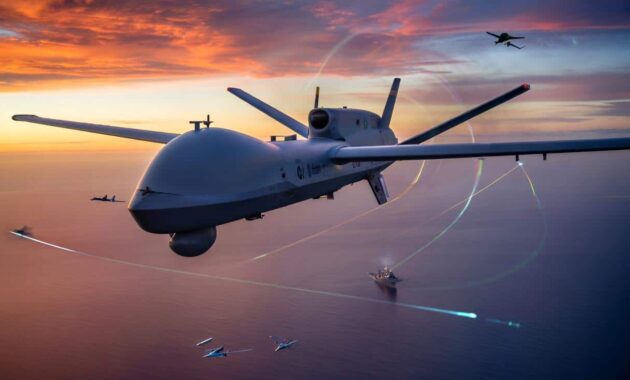
Behind the scenes, defence giants are working to turn the MQ-9B SkyGuardian into a flying radar node, extending the eyes and ears of air forces without placing a single pilot at risk. The move could reshape how airspace is monitored, patrolled, and defended in contested regions.
Mq-9b steps up from hunter to guardian
The MQ-9 family is best known for intelligence, surveillance, and strike missions. It usually flies long, lonely orbits, streaming video and sensor data back to operators on the ground. That image is now evolving.
General Atomics Aeronautical Systems, the US manufacturer of the MQ-9B, is partnering with Swedish defence company Saab to bolt an Airborne Early Warning and Control (AEW&C) capability onto the drone. In practical terms, the aircraft stops being just a sensor platform and starts acting like a miniature AWACS-style asset.
The MQ-9B is being turned into a radar-carrying sentinel, capable of spotting threats and feeding data directly into wider air defence networks.
AEW&C systems traditionally sit on large manned aircraft, such as the E-3 Sentry or the Saab 340/Erieye. These platforms are expensive, manpower-heavy, and limited in number. Pushing some of that mission set onto a high-endurance drone could free up crewed aircraft for the most demanding operations while putting lower-cost assets on routine or risky patrols.
How airborne early warning on a drone actually works
AEW&C revolves around powerful radar and advanced data processing, not just a big airframe. For the MQ-9B, Saab is expected to adapt its existing radar pedigree, such as the Erieye family of active electronically scanned array (AESA) radars, into a configuration that fits the drone’s size and power limits.
The concept is straightforward: the MQ-9B carries a radar able to survey large volumes of airspace, detect targets early, and track many of them at once. Sensors collect raw data, onboard processors clean it up, and the aircraft beams a clear picture of the skies to operators or command centres via secure datalinks.
From missile launches to fast jets and hostile drones, the AEW&C-equipped MQ-9B is designed to spot trouble before it reaches friendly forces.
The new configuration is being pitched as a “sixth sense” for air forces. Instead of just following individual targets with an electro‑optical camera, the aircraft could build a radar-based map of aerial activity across hundreds of kilometres.
➡️ Nose-in-a-dish’ reveals why the common cold hits some people harder than others
Networking: the secret weapon behind the upgrade
Radar is only half the story. The drone’s value increases dramatically once it connects that data to other aircraft, ships and ground units.
The MQ-9B already supports line-of-sight data links to nearby assets and satellite communications for operations far beyond the local horizon. With AEW&C added, those links become the backbone for modern “sensor-to-shooter” chains: one platform spots, another platform fires.
- The MQ-9B detects an incoming missile at long range.
- It classifies and tracks the target in real time.
- Data is pushed over secure links to fighters, surface-to-air missile batteries, or naval vessels.
- Whichever asset is best positioned can respond, guided by the drone’s radar picture.
This kind of layered connectivity fits with broader NATO and allied efforts to create distributed, resilient air defence architectures. Instead of a handful of high-value AWACS aircraft orchestrating everything, multiple unmanned nodes help share the load.
What threats can the mq-9b aew&c see?
The AEW&C package is being aimed at a spectrum of modern threats. Air forces are increasingly dealing with cluttered skies, where cheap drones, cruise missiles, and traditional fighters can appear in the same area at once.
The upgraded MQ-9B is expected to help with:
- Guided missiles: Early detection of cruise missiles or anti-ship weapons skimming at low altitude.
- Hostile drones: Tracking swarms or individual unmanned aircraft that might be too small or low to spot easily from the ground.
- Fighter jets and bombers: Monitoring long-range intrusions or probing flights near national borders.
- Maritime targets: Depending on radar mode, supporting wide-area surveillance over coastal waters.
The real power lies in simultaneous tracking, where the MQ-9B maintains a picture of many targets at once instead of chasing just one.
This multi-target ability is central to AEW&C operations. In a crisis, commanders need to understand not only that an aircraft is approaching, but how many, from which directions, and how they are manoeuvring.
Why put aew&c on a drone at all?
For budget-constrained air forces, crewed AEW&C aircraft represent a major investment. They need highly trained crews, complex support infrastructure, and extensive maintenance. Numbers are usually small, which limits coverage.
A drone-based solution offers some clear advantages:
| Aspect | Crewed AEW&C aircraft | MQ-9B AEW&C concept |
|---|---|---|
| Risk to personnel | High if operating near contested airspace | No onboard crew, lower political and human risk |
| Operating cost | High fuel, crew, and maintenance burden | Lower fuel burn and smaller support footprint |
| Endurance | Typically 8–12 hours on station | More than 24 hours in favourable conditions |
| Fleet numbers | Limited, usually single digits | Potential for higher numbers at lower unit cost |
By sending drones to patrol high-threat areas or fly “dull” long-endurance missions, air forces can preserve their manned AEW&C fleets for situations where human judgement in the cabin truly matters.
Implications for future air combat
Turning a drone into a flying radar post fits a broader move toward distributed operations. Rather than relying on a few large, obvious targets in the sky, forces are breaking capability into smaller parts and spreading those across many platforms.
The MQ-9B AEW&C vision aligns with concepts such as “loyal wingmen” and collaborative combat aircraft, where multiple unmanned and manned systems share data and roles dynamically. A high-end fighter might carry weapons and stealth, while a more affordable drone provides far-reaching radar coverage.
When drones become the radar, fighters can stay emission-silent and hidden, relying on offboard sensors to guide their moves.
This shift also complicates an adversary’s planning. Knocking out a single AWACS aircraft can blind a force. Facing a web of drones and ground-based sensors, the same tactic no longer guarantees success.
Key terms worth unpacking
AEW&C (airborne early warning and control) refers to aircraft equipped with powerful radar and command systems that detect aircraft or missiles at long range and direct friendly forces. They act as aerial command posts, sharing target information and coordinating intercepts.
AESA radar (active electronically scanned array) is a type of radar made up of many small transmit/receive modules. It steers beams electronically rather than physically moving the antenna. That allows fast target switching, multiple beams, and modes such as air, maritime, and ground surveillance from the same hardware.
Possible scenarios and risks
In a Baltic or Indo-Pacific scenario, an MQ-9B equipped with AEW&C could orbit well outside enemy missile range yet still watch key corridors. As tensions rise, it would feed a near-real-time picture of air movements to allied command centres. Fighters on quick reaction alert could be scrambled with better situational awareness from the outset.
There are, of course, vulnerabilities. The MQ-9B is not a stealth platform. In high-end conflict against a technologically advanced opponent, it would need to operate with care, protected by distance, altitude, or escorts. The data links that make the concept so powerful also become tempting targets for jamming and cyber interference.
At the same time, the benefits are hard to ignore: more persistent coverage, lower cost per flight hour, and the ability to field additional “eyes in the sky” without recruiting extra aircrew. As defence budgets face pressure and airspaces grow more crowded, turning the MQ-9B into a radar-carrying guardian is likely to stay high on procurement wish lists.