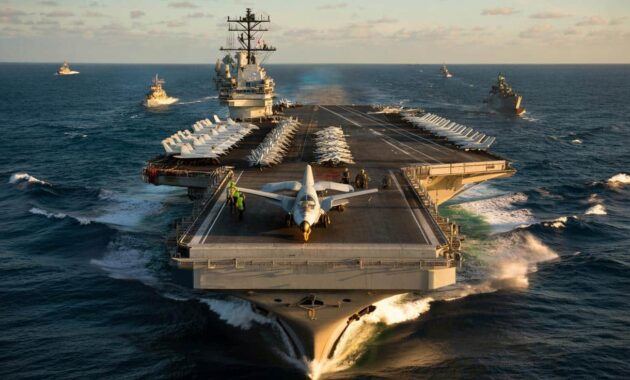
This behemoth is not a cruise ship or a tanker, but a floating airbase whose size rivals skyscrapers and whose power reshapes naval strategy.
The floating city that projects power
An aircraft carrier is, at its core, a warship built around one key idea: launch and recover aircraft from the middle of the sea. Rather than relying on distant airfields, a carrier brings the runway to the conflict zone.
The flight deck forms a long, flat platform where jets take off and land. Below it lies a maze of hangars, workshops, operations rooms, living quarters and medical facilities. On the largest carriers, this turns the ship into a genuine floating town, with thousands of people on board, each with a precise role.
The concept dates back more than a century. In 1910, a U.S. pilot conducted one of the first experimental take‑offs from a warship, using the cruiser USS Birmingham as a makeshift platform. From that improvised deck to today’s nuclear‑powered giants, the evolution has been relentless.
The modern carrier is both a mobile airbase and a political signal: when it arrives offshore, every regional actor pays attention.
Carriers allow governments to send fighter jets, helicopters and surveillance aircraft close to a crisis area without asking permission to use foreign bases. That flexibility explains why so few ships attract as much money, attention and controversy.
The largest aircraft carrier on Earth
In the long-running contest of naval hardware, the current size champion comes from the United States. Since the late 2010s, one ship has stood out for its sheer dimensions and technological ambition: the USS Gerald R. Ford (CVN‑78).
Built by the American defence contractor Northrop Grumman, the carrier is the lead ship of a new generation. After more than ten years in construction, it was finally delivered in 2017 and named after Gerald Ford, the 38th president of the United States, who served from 1974 to 1977.
The price tag is striking: around 13 billion dollars for the ship alone, not counting the aircraft. In return, the U.S. Navy received a nuclear-powered vessel that sets records in several categories.
At 337 metres long and about 78 metres wide, the USS Gerald R. Ford is slightly longer than the Eiffel Tower is tall, and weighs around 100,000 tonnes.
➡️ Chinese Fleet Sails Into Contested Waters as US Aircraft Carrier Approaches
➡️ Inheritance : the new law arriving in March completely reshapes rules for all heirs
➡️ The reason some plants recover quickly after storms while others never do
That mass does not make it sluggish. The Ford can reach roughly 30 knots, or about 55 km/h, enough to keep up with the fastest warship groups. Despite the bulk, it is designed to manoeuvre well enough to handle tight operations in busy waters.
A population bigger than many towns
The scale of the ship is not measured only in steel and nuclear reactors. It is also measured in people. When fully loaded, the USS Gerald R. Ford can carry close to 4,500 crew members and air wing personnel.
On board, there are pilots, mechanics, radar operators, cooks, medics, engineers, cyber specialists, firefighters and more. The ship functions like a small municipality, with its own hospital, power plant, postal system and even a kind of internal public transport through its network of lifts and passageways.
- Around 4,500 people at full complement
- Multiple canteens, gyms and recreation areas
- Dedicated medical and dental facilities
- Chaplains, counsellors and support services
For sailors, life on board means weeks or months without setting foot ashore, but also specialised training and a tight‑knit social environment. The ship operates 24 hours a day, with rotating watches that keep the reactors, radar, engines and flight deck running without interruption.
How many aircraft can the Gerald R. Ford carry?
The core mission of the ship is to operate aircraft. On that front, the Ford class is designed to be dense. In full configuration, the carrier can embark close to 90 aircraft, including fighter jets, helicopters and unmanned systems.
Close to 90 aircraft can be embarked on the USS Gerald R. Ford, forming a mixed air wing of fighters, surveillance planes, helicopters and drones.
The exact mix changes depending on the mission. A typical American carrier air wing might include:
- Multirole fighter jets for air defence and strikes
- Early warning aircraft with radar dishes on top
- Helicopters for anti‑submarine warfare and search‑and‑rescue
- Logistics aircraft and drones for reconnaissance
Compared with this, the French Navy’s flagship, the Charles de Gaulle, is more modest in scale. The French carrier usually sails with around 1,900 personnel and about 40 aircraft, including Rafale Marine fighters, E‑2C Hawkeye surveillance planes and several helicopter types such as Dauphin Pedro and Caïman Marine.
A quick comparison of giants
| Carrier | Country | Length | Approx. crew | Aircraft capacity |
|---|---|---|---|---|
| USS Gerald R. Ford (CVN‑78) | United States | 337 m | ~4,500 | ~90 |
| Charles de Gaulle | France | 261 m | ~1,900 | ~40 |
This gap in capacity reflects broader strategic choices. The United States relies heavily on carrier strike groups to project power across the globe, while France uses its single carrier as a high-end but more limited tool within coalitions.
Why size matters at sea
Building such a large carrier is not just an ego project. Size brings specific advantages. A longer deck allows more simultaneous aircraft operations. Wider hangars mean more maintenance space. Greater displacement gives the ship better stability in rough seas, which directly affects the safety and tempo of flight operations.
The nuclear propulsion of the Gerald R. Ford also changes the game. Two powerful reactors give the carrier the ability to sail for years without refuelling, with refits scheduled roughly every couple of decades. That autonomy extends its operational reach and frees it from dependence on vulnerable fuel tankers.
The Ford’s size and nuclear power allow the U.S. Navy to keep a high‑intensity airbase at sea for long periods, far from home ports.
There are trade‑offs. Larger carriers cost more to build, upgrade and protect. They also become high‑value targets in any conflict, requiring a whole escort group of destroyers, frigates, submarines and supply ships.
Key terms that shape carrier debates
Several technical expressions often appear in conversations about carriers:
- Knots: A speed unit used at sea. One knot equals about 1.85 km/h.
- Displacement: The weight of the volume of water a ship pushes aside, usually expressed in tonnes. It is a standard way to describe ship size.
- Air wing: The full collection of aircraft assigned to a carrier, plus their pilots and maintenance teams.
- Catapult and arresting gear: Systems that help jets take off and land on short decks by accelerating them rapidly and then stopping them in a few dozen metres.
On the Gerald R. Ford, many of these systems are being modernised, such as the move from steam catapults to electromagnetic launchers. That shift aims to reduce maintenance and give more precise control over launches, especially for lighter drones.
Risks, scenarios and what a carrier visit really means
When a giant carrier group approaches a tense region, it sends a clear political signal. Long-range jets on deck mean that targets hundreds of kilometres inland can be reached in a matter of minutes. That can deter potential adversaries, reassure allies or, in some cases, raise tensions further.
Analysts often model scenarios in which the Ford-class carriers face advanced missiles, swarms of drones or submarine attacks. In these war games, protection becomes a layered effort: escorts deploy anti‑air missiles, submarines hunt hostile boats, and the carrier itself adjusts course and speed constantly to complicate enemy targeting.
There are also non‑combat uses. In major natural disasters near coastal areas, carriers have provided medical assistance, helicopter lift, fresh water and electricity. A ship that carries thousands of people and runs its own utilities can become a temporary lifeline when local infrastructure collapses.
For all their cost and controversy, aircraft carriers like the USS Gerald R. Ford remain central to how major powers think about oceans, air power and influence. At 337 metres and 100,000 tonnes, the current record-holder is not just a symbol of naval engineering, but a tool that shapes calculations from Washington to distant coastal capitals.