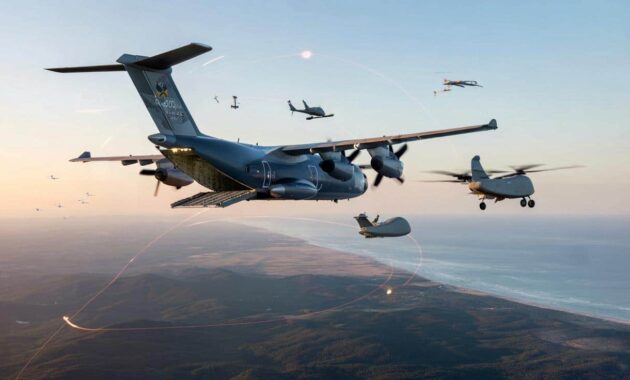
The Airbus A400M, long seen mainly as a workhorse airlifter, is now at the centre of an ambitious plan to turn it into a flying digital node and drone carrier, capable of orchestrating complex missions above a highly connected battlefield.
A transport plane that grew into a battlefield hub
The A400M’s early years were dominated by delays, cost rows and teething problems. That phase is largely behind it. The aircraft is now mature, widely used by European air forces, and Airbus is under pressure to keep it relevant as warfare changes.
The company and its customer nations have agreed on a roadmap of upgrades, grouped in successive “blocks” and standards. The current standard, known as SOC 3, should be completed around 2026. From there, the focus shifts from pure airlift performance to digital connectivity, data handling and unmanned systems.
The A400M is gradually shifting from heavy lifter to flying command post, data router and drone carrier.
In other words, the aircraft is being prepared for an era in which a transport plane does far more than just haul troops and pallets.
Block 0: laying the digital foundations
The first visible step is the so‑called “Block 0” package, negotiated with the OCCAR organisation, which manages cooperative defence programmes in Europe. This upgrade does not radically change the mission set, but it sets the scene.
- Stronger, more secure communications between the aircraft and other assets
- A modernised human–machine interface for the crew
- Full integration of the Link 16 tactical data link used by NATO forces
Link 16 gives the A400M a common digital language with fighters, helicopters, ground units and ships. That matters when decisions must be taken in seconds, based on data from multiple sensors.
Block 0 is about ensuring the aircraft can fit comfortably into this dense tactical network instead of operating on the sidelines as “just the transport”.
Block 1: turning the A400M into an airborne data hub
The next step, “Block 1”, goes much further into the digital realm. Airbus is working with several air forces to define what this should look like, but broad themes are emerging.
➡️ This is why cats lick their owners
➡️ I do this every Sunday”: my bathroom stays clean all week with almost no effort
➡️ China shows the world building fast is possible: it put up a 10-story building in just 29 hours
➡️ The quick trick of cleaning blender lids using baking soda
➡️ Why keep buying chocolate chips when this quick, budget-friendly recipe exists?
➡️ Why soaking potatoes in cold water before roasting changes everything about their texture
Block 1 aims to transform the A400M into a high‑bandwidth communications hub, able to move data as easily as it moves cargo.
High‑speed links and satellite connectivity
Airbus is planning multiple layers of connectivity for the A400M:
- High‑throughput line‑of‑sight data links for dense tactical environments
- New SATCOM options using geostationary satellites for global coverage
- Low‑Earth orbit SATCOM options for resilient, low‑latency links
At the heart of this will sit a central management system responsible for orchestrating all available links. That means automatically choosing the best path for each data stream, from chat messages and logistics updates to live video from drones.
The ambition is that an A400M circling near a contested area can act as a relay and router between ground troops, fighters, drones and higher command. This concept aligns with Europe’s push towards the Future Combat Air System (FCAS / SCAF) and its planned “combat cloud”, where assets constantly share information.
| Capability area | Today’s A400M | A400M with Block 1 |
|---|---|---|
| Data links | Standard tactical and satcom links | High‑bandwidth, multi‑link management and routing |
| Role on battlefield | Cargo and troop transport | Communications hub and coordination platform |
| Video/data relay | Limited | Real‑time distribution of data and video feeds |
The “mother aircraft” concept for drones
Beyond connectivity, Airbus sees the A400M as an ideal “mother ship” for unmanned aircraft. With its large cargo hold, ramp and long range, it can carry multiple so‑called “remote carriers” — drones designed to support manned platforms by scouting, jamming or striking.
The vision is an A400M that carries, launches and then coordinates swarms of unmanned systems from safe standoff distance.
Airbus has already conducted drop tests with experimental drones from the aircraft’s rear ramp. These tests aim to refine how drones are released, how quickly they can activate, and how they reconnect to controllers after deployment.
How an A400M drone mission could look
A typical scenario might unfold like this:
- The A400M takes off from a rear base with several remote carriers stored on pallets or launch racks.
- Once nearing the operation area, the crew opens the ramp and releases the drones at altitude.
- Onboard consoles allow operators to take control of the drones or hand them off to fighters or ground stations.
- The A400M uses its upgraded networks to share drone sensor data with other assets in near real time.
In high‑risk zones, this setup lets the manned aircraft remain outside the most dangerous airspace while still enabling effects — reconnaissance, decoys or electronic attacks — to be pushed closer to enemy defences.
Electronic warfare and self‑protection upgrades
Airbus also wants the A400M to serve as a platform for stand‑off electronic warfare. Instead of flying directly over hostile territory, it could stay at a distance and host jamming or signals intelligence payloads.
To survive in such roles, the aircraft must protect itself from modern threats, especially infrared‑guided missiles. One of the options under study is fitting DIRCM systems (Directed Infrared Counter Measures). These systems use a sensor to detect incoming missiles and a laser turret to blind or confuse the missile’s seeker head.
With DIRCM and new electronic warfare kits, a transport plane starts to edge closer to the role of a special mission aircraft.
The benefit for European air forces is straightforward: they can add new capabilities without designing an entirely new aircraft type, by reusing the A400M’s volume, power and endurance.
A water bomber kit for wildfires
The A400M’s evolution is not limited to combat functions. Airbus is also targeting civil protection. Forest fires are intensifying across southern Europe, and governments are short of large aerial firefighting capacity.
To address this, Airbus has been developing a roll‑on/roll‑off kit for retardant drops. The idea is simple: install a removable tank and release system in the cargo hold, without cutting into the airframe or permanently modifying the aircraft.
- Quick installation of the firefighting kit inside the cargo bay
- Retardant or water released through the rear ramp or dedicated outlets
- Return to standard transport role once the kit is removed
This approach lets nations use the same fleet of aircraft for military airlift during crises and for firefighting in summer, rather than maintaining a separate, dedicated fleet that sits idle for much of the year.
A strategic choice: upgrade instead of replace
All these tracks — connectivity, drones, electronic warfare, firefighting — point to a broader political and industrial decision. Rather than launching a successor to the A400M, Airbus and its customer countries want to push the current platform upmarket.
The A400M is being repositioned as a multi‑role asset: transporter, network node, drone carrier, possible jammer and seasonal water bomber.
That strategy suits tight defence budgets. Designing a new airframe from scratch would be hugely expensive. Upgrading an existing, already amortised aircraft spreads costs and risk, while giving air forces new tools in a shorter timeframe.
Key terms and concepts behind the upgrades
Several technical terms sit at the core of this evolution and shape how the aircraft will actually be used:
- Link 16: a secure tactical data link used widely across NATO, allowing different platforms to share tracks, messages and targeting data.
- Remote carrier: a type of drone designed to work with manned aircraft, carrying sensors or weapons and acting as an expendable extension of the main force.
- Combat cloud: a distributed network where every platform becomes both a sensor and a data node, constantly feeding and receiving information.
- DIRCM: a defensive system using directed infrared energy to confuse missile seekers, especially those homing on engine heat.
Understanding these terms helps clarify why a transport aircraft is being pulled into roles once reserved for high‑value specialist platforms.
Risks, benefits and future scenarios
The plan does carry risks. Packing more mission systems into the A400M raises complexity, training requirements and maintenance workloads. Air forces will need crews who can manage data links, unmanned systems and electronic warfare tools, not just logistics missions.
There is also the challenge of cyber security. As the aircraft becomes a data hub, it turns into a more attractive target for electronic attack and hacking. Protecting the integrity of the networks on board will be as crucial as shielding the airframe from missiles.
On the other hand, the benefits are clear. In a crisis, an upgraded A400M could fly into a region with minimal ground infrastructure and instantly provide:
- A relay point for troops’ radios and drones
- Extra electronic intelligence on enemy emitters
- Cargo and medical evacuation capacity
- Support to allied fighters by forwarding surveillance feeds
Such flexibility is exactly what European militaries are seeking as they confront more unpredictable crises, from high‑intensity conflict to climate‑driven disasters. The A400M, once criticised as a troubled project, is being reshaped into a platform designed to sit at the crossroads of those very different missions.
Originally posted 2026-03-09 00:36:00.