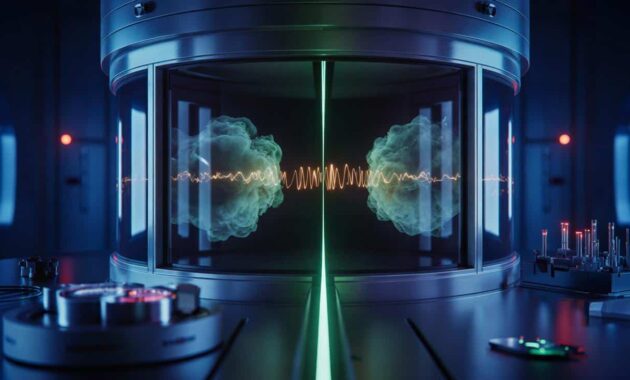
In a German lab, researchers have managed to coax an ultra-cold cloud of atoms into behaving like a key component of quantum electronics, using nothing more than a laser barrier and extreme refrigeration.
A quantum breakthrough hiding in a simple setup
On papier, the device sounds deceptively straightforward: two reservoirs, a barrier between them, and particles tunnelling across that barrier. In conventional electronics, that object is a Josephson junction, formed by two superconductors separated by a nanometre-thick insulator.
Josephson junctions sit at the heart of many quantum technologies. They underpin several designs of quantum computers, ultra-sensitive medical sensors such as SQUID magnetometers, and even the official definition of the volt used in metrology labs.
What the team at RPTU Kaiserslautern-Landau has done is rebuild the same physics, but with a completely different toolbox. No superconducting metal. No electrical current. No cryostat full of liquid helium. Just ultracold atoms, carefully arranged with light in a high-vacuum chamber, and a laser playing the role of the barrier.
Reproducing the behaviour of a Josephson junction using only atoms and light shows that the underlying quantum laws are truly universal.
What makes a Josephson junction so special?
A conventional Josephson junction connects two superconductors with a wafer-thin insulating layer. In that structure, pairs of electrons behave as a single quantum wave. They can tunnel through the barrier even when no voltage is applied, a counterintuitive effect known as the Josephson effect.
Things get even more interesting when the junction is driven by microwaves. As the high-frequency signal hits the junction, the current–voltage characteristics form plateaus, called Shapiro steps. Instead of a smooth sweep of voltage, the signal locks onto discrete levels that depend only on fundamental physical constants: the electron charge and Planck’s constant.
Metrology institutes use these quantised steps to define voltage standards. Because the steps trace back to basic constants, they are astonishingly stable over time and from one lab to another.
Why direct observation remains so hard
Inside a metal junction, all of this unfolds at scales of a few nanometres and at temperatures near absolute zero. The electrons live in a dense, opaque environment, buried in a solid. Probing individual particles or mapping their flow in real time is nearly impossible with current instruments.
➡️ They’re under 60 and already living with Alzheimer’s
➡️ This 7,000-year-old stone wall found off the coast of France may be the work of hunter-gatherers
➡️ Hairdresser reveals hard truth about short hair for women over 50 that many won’t want to hear
➡️ Bib Gourmand 2026: the Lyon addresses where you can eat well without blowing the budget
Physicists have turned to “quantum simulation” to get around this barrier. The idea is to create a different, more accessible system that obeys the same equations. If both systems respond identically under similar conditions, researchers gain confidence that they are seeing the same physics.
Quantum simulators trade the complexity of solid-state materials for clean, controllable clouds of atoms where every parameter can be tuned like a dial.
Inside the German experiment: atoms instead of electrons
Two condensates and a blade of laser light
The Kaiserslautern team worked at about –273.12 °C, only a fraction of a degree above absolute zero. At these temperatures, selected atoms merge into a single quantum state known as a Bose–Einstein condensate. The atoms behave less like individual marbles and more like a shared matter wave.
Researchers created two such condensates side by side inside a vacuum chamber. Then they used a narrow laser beam as an adjustable barrier between them – the optical counterpart of the insulating layer in a Josephson junction. By modulating the barrier periodically, they mimicked the effect of applying microwaves to an electrical junction.
As atoms tunneled back and forth between the two condensates, the team measured the flow and the resulting phase relationships. Crucially, they observed clear Shapiro steps in this atom-based system, the same hallmark seen in traditional superconducting junctions.
- Two atomic reservoirs: Bose–Einstein condensates playing the role of superconductors
- Laser barrier: optical replacement for the thin insulating layer
- Periodic modulation: stand-in for microwave drive in electronics
- Measured outcome: Shapiro steps, now appearing in an ultracold gas
A bridge between solid-state and atomic physics
The match between theory and experiment went down to fine details, according to the Science paper “Observation of Shapiro steps in an ultracold atomic Josephson junction”, published on 11 December 2025.
This tight agreement signals that the same mathematical description covers both electrons in solids and dilute atoms in a vacuum. For researchers, that bridge is powerful: they can study messy, strongly interacting materials using cleaner, slower atomic systems where every knob is accessible.
The experiment effectively builds a transparent Josephson junction: the quantum dynamics can be watched directly, particle by particle.
Atomtronics: circuitry built from matter waves
Physicists have started to give this emerging field a name: atomtronics. Instead of wires and semiconductor chips, atomtronic circuits use guided streams of ultracold atoms. The “current” is no longer electrical; it is a flow of matter waves.
The Kaiserslautern group now plans to go beyond a single junction. By linking several atomic Josephson junctions, they aim to assemble more complex circuits that mirror familiar electronic components. In principle, that could include atom-based analogues of SQUIDs, interferometers or even elements resembling qubits.
Unlike chips etched in silicon, these circuits are fully reconfigurable. Change the laser patterns, and the paths taken by atoms change too. The same hardware could emulate many different devices, much like reprogramming a field-programmable gate array, but with quantum matter instead of transistors.
Why this matters for quantum technology
Modern quantum processors depend heavily on Josephson junctions made from superconducting materials. Yet, many details of how coherence is lost, how microscopic defects behave, or how noise creeps in remain hard to pin down. In an atomic junction, those questions can be addressed more directly.
With ultracold atoms, researchers can watch quantum coherence evolve in real time, track how phase differences build up and see exactly when a system slips out of its delicate quantum regime. That kind of insight could inform the design of more robust superconducting qubits or new sensing architectures.
| System | Particles | Barrier | Typical use |
|---|---|---|---|
| Conventional Josephson junction | Cooper pairs (electrons) | Thin insulating layer in a solid | Quantum bits, voltage standards, sensors |
| Atomic Josephson junction | Ultracold atoms in a condensate | Focused laser beam | Quantum simulators, future atomtronic circuits |
Key concepts behind the experiment
For non-specialists, three ideas help make sense of this achievement.
Bose–Einstein condensate
A Bose–Einstein condensate is a state of matter where many atoms occupy the same quantum state and act collectively. Instead of each atom following its own path, the ensemble behaves like a single wave, which allows interference and tunnelling effects to appear on macroscopic scales.
Shapiro steps
Shapiro steps arise when an oscillating signal, such as microwaves, drives a Josephson junction. The phase of the quantum wave across the junction synchronises with the drive, locking the voltage into discrete rungs. These rungs form a kind of quantum staircase, each step corresponding to a well-defined relationship between frequency and voltage.
Quantum simulation
Quantum simulation uses one controlled quantum system to mimic another that is harder to access. In this case, ultracold atoms stand in for electrons in a solid. The benefit lies in tunability: interaction strength, geometry and external fields can all be tuned without impurities, crystal defects or fabrication quirks getting in the way.
What this could lead to next
Looking ahead, atomtronic junctions could act as testbeds for future quantum components. Researchers might, for instance, simulate networks of Josephson junctions that would be painful to prototype in superconducting hardware, or investigate exotic phases that only appear in strongly coupled arrays.
The same approach could help students and engineers gain intuition. Computer simulations often hide the messy details behind equations. An experiment where entire circuits are made of visible, imageable atoms gives a more tangible feel for coherence, tunnelling and quantum interference, which still challenge everyday intuition.
There are, of course, practical limits. Atomtronic devices need extreme cooling and vacuum systems, making them unlikely candidates for commercial laptops. Their strength lies elsewhere: as precision tools in research labs, as reference systems for metrology, and as platforms to test ideas before translating them into more conventional solid-state technology.
As the Kaiserslautern group and others connect more of these atomic components, a new kind of quantum circuitry is quietly taking shape – built not from etched silicon, but from sculpted light and clouds of matter colder than deep space.