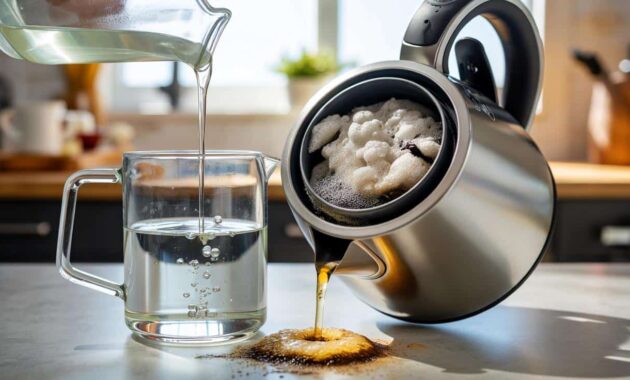
The kettle clicks off with that tiny, satisfied sigh, but when you open the lid, the romance ends. White crust clings to the metal, floating flakes swim on the surface, and suddenly your cozy tea moment looks… a bit gross. You rinse it, scrub with a sponge, even tap the sides as if that’ll scare the scale away. It doesn’t. It never does.
Then someone casually tells you, “Just use vinegar, it melts that stuff.” You pour some in, top with water, bring it to the boil – and fifteen minutes later the inside of your kettle looks almost new. No tools. No effort. Just a bottle from the back of the cupboard.
There’s a strange kind of everyday magic happening in that cloudy, sour-smelling water.
Why kettles crust up – and why vinegar hits them where it hurts
Hard water is the quiet saboteur of our kitchens. Every time you boil it, a tiny part of the dissolved minerals inside – mainly calcium and magnesium – gets left behind on the hot surfaces. Over days and weeks, those harmless minerals turn into that chalky, stubborn scale you see on the base and walls of your kettle. It looks cosmetic, but it slowly steals heat, energy, and even flavor from your drinks.
You don’t notice it growing. Then one morning you see a thick ring and wonder how on earth it got that bad so fast.
In some cities, this happens almost overnight. In London or parts of the US Midwest, for example, tap water is so “hard” that a brand-new kettle can start showing deposits in a week. People share photos online of their once-shiny steel completely frosted white in a month.
One reader told me she thought her kettle had “gone rusty” after six months. She was ready to throw it out. A splash of vinegar, one gentle boil, and the brownish scale lifted off in shreds. Underneath? The same stainless steel she’d bought, just hiding under a crust of minerals and tea tannins.
So why does vinegar work when plain water and scrubbing don’t? The secret is simple chemistry. Limescale is mostly calcium carbonate, a base. Household vinegar is a weak acid, usually acetic acid at around 5%. When the acid hits that mineral base, they react. The solid deposits slowly dissolve, turning into soluble salts, water, and carbon dioxide gas.
Those little streams of bubbles you see clinging to the scale when you heat the vinegar mix? That’s the reaction in action, quietly eating away the crust that your dish sponge can’t touch.
How to use vinegar on your kettle without ruining your morning
The simplest method starts with equal parts vinegar and water. Fill your empty, cooled kettle to about halfway with white vinegar, then top up to the usual minimum level with fresh water. Switch it on and let the mixture come to a full boil. When it clicks off, leave it to sit for 15–30 minutes.
When you come back, pour it out, then rinse the kettle thoroughly with cold water. Boil plain water once or twice after that and discard it, just to clear out the smell and any loose flakes. You’ll usually see the scale lifting in sheets, especially from the base.
➡️ Psychology says the rarest mental strength today isn’t resilience or grit
➡️ An Oat-Based Diet Cuts Cholesterol In Just Two Days
Some people like to leave the vinegar solution overnight for very heavy deposits. Others repeat a shorter cycle twice. Both are fine, as long as you keep an eye on plastic parts, decorative coatings, or rubber seals. Most modern kettles handle vinegar well, but they don’t love soaking in acid for days.
We’ve all been there, that moment when you lift the lid and realize you haven’t cleaned the kettle in… months. Don’t panic. Start with a standard vinegar boil, gently scrape what’s already loose with a wooden spoon, then do a second round. The point is not perfection in one go, it’s getting your kettle back into a healthy, usable state.
One common fear is that vinegar will “etch” the metal or leave the kettle smelling sour forever. A repair technician I spoke to laughed at that idea.
“Vinegar is actually kinder to kettles than half the mystery descalers out there,” he said. “Use it, rinse well, and your appliance will usually last longer. The real killer is ignoring scale for years.”
To keep things simple, many people follow a low-effort routine:
- Use white vinegar only (not flavored, not balsamic).
- Do one descaling boil every 4–8 weeks, depending on your water hardness.
- Always rinse and re-boil with plain water once before making drinks.
- Empty the kettle between uses to slow down mineral buildup.
- Wipe the spout and lid with a soft cloth after a vinegar cycle.
Beyond the fizz: what vinegar says about how we live with our stuff
There’s something oddly satisfying about watching years of neglect peel away in a single cleaning session. One cheap bottle from the cleaning aisle quietly solves a problem that makes people throw out perfectly working appliances. That tells you a lot about our relationship with “broken” things.
Let’s be honest: nobody really does this every single day. Most of us wait until the scale is embarrassing, then go hunting for a miracle fix. Vinegar just happens to be one of the very rare household miracles that actually deserves its reputation. *A simple acid, a bit of patience, and your kettle gets a second life instead of a trip to the bin.*
| Key point | Detail | Value for the reader |
|---|---|---|
| Vinegar dissolves limescale | Acetic acid reacts with calcium carbonate, turning solid deposits into soluble compounds and gas | Understand why a cheap, common product works as a powerful descaler |
| Simple home method | Boil a 50/50 vinegar–water mix, let it sit, then rinse and re-boil with plain water | Follow a clear, low-effort routine that restores kettles without special products |
| Routine care beats replacement | Descale every 4–8 weeks, especially in hard-water areas, and empty the kettle between uses | Extend the life of your kettle, reduce energy waste, and improve the taste of hot drinks |
FAQ:
- Can I use apple cider vinegar instead of white vinegar?Yes, it will still dissolve scale, but it may leave more smell and color; plain white vinegar is usually the cleanest option.
- Is vinegar safe for electric kettles with a heating element?For most models, yes; fill above the element, don’t submerge external parts, and rinse thoroughly afterward.
- How often should I descale my kettle with vinegar?In hard-water areas, every month is ideal; in softer-water regions, every 2–3 months is usually enough.
- What if the kettle still has scale after one vinegar boil?Repeat the process or let the solution sit longer, then gently loosen softened deposits with a non-metal utensil.
- Will vinegar make my tea or coffee taste weird?Not if you rinse and boil fresh water once or twice after descaling; that step usually clears any residual smell or taste.