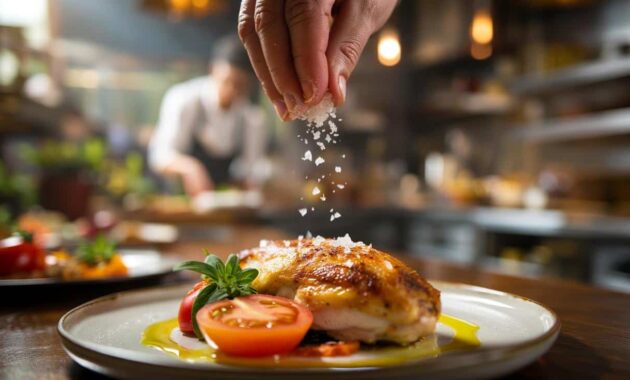
The first time you notice it, you’re probably just hungry and impatient. Your plate is finally ready, steam curling into the air, and the chef… stops. Pinches something between two fingers, raises his hand, and lets tiny crystals fall like glittering snow over the dish. The room smells of butter and charred lemon, you can hear plates clinking around you, and still he’s focused on those last grains of salt as if they’re the whole point.
You taste the dish and suddenly everything feels louder. The tomato is more tomato. The steak is more steak. Even the olive oil seems to step forward.
There’s a reason that last-second gesture feels almost ceremonial.
What finishing salt really does to your food
Watch a professional kitchen for ten minutes and you’ll notice a pattern. Cooks season during prep and cooking, yes, but the head chef almost always steps in at the pass and adds a final touch of salt. It’s fast, precise, almost casual.
On the plate though, that moment shows up as flavor fireworks. Your tongue meets those crunchy crystals before anything else, and there’s a quick, bright pop. The brain reads that as “wow, this is delicious” before it’s even had time to identify garlic, herbs, or butter.
There’s a small bistro in Paris where the chef finishes every plate of roast chicken with a pinch of flaky sea salt and nothing else. No fancy foam, no microgreens. Just bronzed skin, a little jus, and those pale shards scattered on top like broken glass.
Customers don’t walk out talking about sodium levels. They talk about how the skin crackled then melted, how the meat seemed juicier than any chicken they’d had at home. The same bird, roasted without that final sprinkle, feels flatter and oddly shy by comparison.
Here’s the quiet trick behind all that drama. Salt during cooking dissolves into the food, working from the inside out. It seasons evenly, softens proteins, pulls water around. Finishing salt mostly stays on the surface, so you get tiny flashes of salinity instead of a constant background hum.
Your tongue gets contrast: mild and intense, soft and crunchy, plain and powerful. That contrast is what makes dishes feel alive. *Without it, even well-cooked food can taste strangely one-dimensional.*
The craft of salting at the very last second
Chefs don’t grab just any salt for that final move. They reach for flaky or coarse crystals that are big enough to feel, but delicate enough to disappear in a bite or two. Think Maldon, fleur de sel, or a light smoked salt. The idea is texture and timing.
➡️ A study analyzed LED headlight power in cars, and the conclusion is what every driver already knows
➡️ If your laundry feels stiff, this common product might be the cause
They sprinkle from a bit of height so the salt spreads evenly, not in clumps. Over grilled fish, over chocolate tart, over sliced tomatoes that already taste of sunshine. The gesture is small, but it decides how your first bite lands.
At home, most of us throw the same fine table salt into everything and call it a day. Then we wonder why our steak doesn’t taste like the restaurant’s, even though we followed the recipe and bought decent meat. We’ve all been there, that moment when you stare at the pan and think, “What did I miss?”
One big difference: chefs rarely finish a dish with fine salt. It dissolves too fast, disappears into sauces, and gives no crunch. And when people try to fix under-seasoned food at the table by dumping more of it, the whole thing just ends up salty rather than more flavorful.
There’s science behind the magic, but chefs usually talk about it in much simpler terms.
“Salt is not just salty,” a London chef once told me. “Used right, it’s like turning the lights on in a dark room. The room is already there. You just finally see it.”
They use finishing salt to:
- Highlight specific bites (the edge of a steak, the top of a scallop, a slice of heirloom tomato).
- Add a crunch that disappears exactly when you want it to.
- Balance sweetness in desserts and richness in fatty dishes.
- Guide your first impression of every plate that leaves the kitchen.
One plain-truth sentence slips through here: **most home cooks underestimate how much that last two seconds of salting can change a dish.**
The quiet power of paying attention to the last detail
Once you start noticing finishing salt, you can’t unsee it. The sparkle on a brownie in a coffee shop. The crunch on a slice of focaccia. The little salty sting on top of burrata that somehow makes the cream taste even softer. You begin to realise that taste isn’t just about ingredients, it’s about sequence.
Salt first on the tongue, then fat, then acid, then aroma. That order shapes whether a dish feels flat or layered, timid or bold.
There’s also a subtle emotional piece. When a chef pauses to season at the last moment, they’re basically saying, “Someone is about to eat this. Right now. How do I want that first second to feel?” It’s a tiny act of care, repeated dozens of times a night.
At home, you can bring the same mindset without turning dinner into a performance. A quick breath, a small pinch of good salt, a glance at the plate. **That’s the difference between “food is ready” and “this is for you.”**
You don’t need a drawer full of exotic salts or a professional range. You need curiosity and maybe one small box of flaky salt on the counter instead of hidden in the pantry. Taste your food before and after that final pinch and notice what changes.
Maybe you’ll keep it just for special dinners. Let’s be honest: nobody really does this every single day. But once you feel how a few crystals can wake up eggs, soup, chocolate, even a ripe peach, it’s hard to go back to salting everything only in the pot.
| Key point | Detail | Value for the reader |
|---|---|---|
| Timing matters | Salt during cooking seasons inside, finishing salt hits the surface at the last moment | Helps you build deeper, more vibrant flavors at home |
| Texture counts | Flaky salt adds a quick crunch that dissolves in the bite | Makes simple dishes feel restaurant-level without complex recipes |
| Small change, big impact | Switching to a pinch of good finishing salt on the plate | Upgrades everyday meals with almost no extra effort |
FAQ:
- Question 1What’s the best type of salt to use as a finishing salt?
- Question 2Should I still salt my food while it’s cooking if I use finishing salt?
- Question 3Can I use regular table salt as a finishing salt?
- Question 4Why do some desserts have salt sprinkled on top?
- Question 5How much finishing salt should I add before serving?