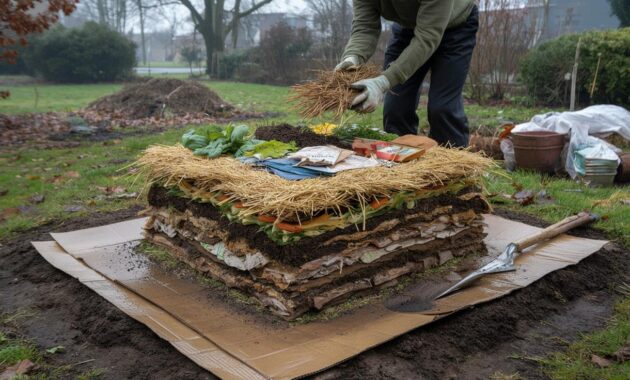
While most gardeners are still waiting for the thaw, a simple, low-effort technique can turn cardboard, peelings and autumn leftovers into a rich, spring-ready soil — without digging, tilling or expensive equipment.
What lasagna gardening really is
Lasagna gardening sounds like a social media trend, but it is a serious method borrowed from permaculture. The idea is disarmingly simple: instead of turning soil over with a spade, you build it up, layer by layer, directly on top of what you already have.
Lasagna gardening creates a slow, in-place compost heap that turns “waste” into fertile soil exactly where your crops will grow.
The technique mimics what happens on a forest floor. Leaves fall, twigs and plant remains pile up, animals leave droppings, rain washes everything down. Over time, all that organic matter breaks down into a dark, springy humus that feeds trees and plants for years.
By stacking layers in your garden bed, you speed up that natural process. You are not feeding the plants straight away. You are feeding the soil life — fungi, bacteria, earthworms — that will then feed the plants later.
Why winter is the hidden season for soil building
January or February rarely appear on gardening calendars as “prime time”. Yet this quiet period is ideal for starting a lasagna bed. Decomposition takes time. Winter rain, frost and thaw help materials settle and soften. Soil organisms slowly move upwards into the new layers.
If you start now, by the time April or May comes around, the heap you built will have sunk and transformed. What was once a patch of compact clay or tired lawn can become a loose, dark, living bed, ready for seedlings and young plants.
Step one: cardboard as a weed-killing foundation
The most surprising part for many beginners is the base. You do not start by digging. You start with cardboard.
Spread plain brown cardboard — no plastic coating, no glossy print — directly over the area you want to cultivate. Over grass, weeds or bare ground, it plays two key roles.
➡️ This surprising goat cheese is taking Michelin?starred restaurants by storm with its bold flavors
➡️ This creamy comfort recipe feels dependable
➡️ Crew of a U.S. Air Force C 5M Super Galaxy has declared an emergency over Pacific
The cardboard layer blocks light to exhaust existing weeds while feeding soil life with a big dose of carbon.
Deprived of light, even stubborn perennials like couch grass or bindweed weaken and die under the sheet. Their roots then decompose in place, releasing nutrients into the soil without any back-breaking removal.
Cardboard glue is usually starch-based, which earthworms happily eat. Once soaked, the card softens, allowing worms and other organisms to travel through it. They begin to connect your original soil with the new organic layers above.
Before laying it down, remove all tape, staples and plastic labels. Overlap the edges by at least 10–15 cm so no light can sneak through. Then drench the cardboard with water. It should be thoroughly wet so it sits snug against the ground and starts breaking down.
Balancing carbon and nitrogen: the key to good layers
After the cardboard comes the architecture of the lasagna itself. Success depends on alternating two families of materials: “browns” and “greens”. In composting terms, browns are rich in carbon, greens are rich in nitrogen.
A rough rule: build with about two parts brown material for every one part green to keep decomposition active and odour-free.
Brown materials: the structure of the bed
Browns are typically dry and fibrous. They decompose slowly and help hold water and air spaces in the bed. In winter, you can use:
- Straw or old hay
- Stored autumn leaves
- Shredded branches or wood chips
- A small amount of sawdust
- Non-glossy newspaper or shredded brown paper
These materials usually form the thickest layers, giving the bed height and structure.
Green materials: the engine of decomposition
Greens are moist and full of nitrogen, which fuels the microbes that break everything down. In the colder months, sources often come from the kitchen and leftover garden material:
- Vegetable peelings and trimmings
- Coffee grounds and paper filters
- Tea bags without plastic
- Leftover grass clippings from a late cut
- Fresh or well-rotted animal manure
Start with a loose, airy layer on top of the wet cardboard — small branches or straw work well — to avoid compaction. Then add a layer of green scraps, followed by a thicker brown layer. Repeat this pattern: green, brown, green, brown, like building a sandwich with several fillings.
The pile can easily reach 30–50 cm in height. That looks excessive at first, but the materials will compress and rot down. By spring, the volume often shrinks by half.
Turning your garden into a small-scale recycling hub
Lasagna gardening does something quietly radical: it turns your home into a micro recycling centre. Instead of bagging up organic waste and driving it to a tip, you keep that energy on site.
Kitchen scraps, fallen leaves and old potting soil stop being rubbish and become raw ingredients for next season’s harvest.
Winter kitchens produce plenty of peelings from citrus, squash, roots and cabbages. Used sensibly — especially citrus, which is best in moderate amounts — they are fuel for microbes, not a nuisance.
Garden leftovers join in: chopped-down perennial stems, the last armfuls of leaves from paths, even tired compost from containers. Old potting mix may look “dead”, but it still contains minerals and micro-organisms that help seed the new layers with life.
This approach also sidesteps one common frustration: the sense that you are constantly taking fertility away from your patch. Instead, everything cycles back, right under your feet.
The underground workforce that does the heavy lifting
Once you have built your lasagna bed and given it a good soak, the hardest work is done. The rest is invisible and continuous.
Earthworms, woodlice, springtails, beetles and armies of bacteria and fungi move in, drawn by food, moisture and shelter. Earthworms in particular shuttle up and down between the original soil and the upper layers, dragging organic matter deeper and casting it out again as rich, crumbly droppings.
The bed becomes a living factory, churning through waste and leaving behind a fine, fertile, well-aerated soil.
The act of decomposition releases a gentle warmth. In mid-winter that slight rise in temperature keeps biological activity ticking over when surrounding bare soil is almost dormant. Come early spring, this area often thaws and warms sooner, giving your plants a small but real head start.
Spring payoff: planting without digging
By April or May, the once bulky heap looks transformed. It has sunk, the individual layers blur together, and the surface feels soft and dark, with a smell close to woodland earth.
You rarely need a spade at this stage. For many crops, hands or a small trowel are enough to make a planting hole. If some larger bits of straw or peel are still visible near the surface, they can stay. For delicate seedlings, you can add a handful of fine compost into each hole, then let the surrounding lasagna continue breaking down as a slow-release mulch.
Compared to bare, tilled earth, lasagna beds tend to stay open and friable. They hold water yet drain freely, reducing both drought stress and waterlogging. Weed pressure also drops because many weed seeds were smothered under the original cardboard and upper layers.
| Aspect | Traditional dug bed | Lasagna bed |
|---|---|---|
| Initial effort | High (digging and turning soil) | Moderate (layering, no digging) |
| Weed control | Frequent weeding needed | Weeds largely suppressed by cardboard |
| Soil structure | Risk of compaction after rain | Loose, spongy and well aerated |
| Water use | More frequent watering | Better moisture retention |
| Use of waste | Often removed from garden | Reused as building material for soil |
Common questions, risks and small tweaks
Two worries crop up again and again: bad smells and pests. Both are usually linked to imbalance.
If your lasagna bed smells rotten or “sour”, it almost always means too much green material and not enough air. The fix is simple: add more browns such as straw or leaves, and avoid compacting the layers.
Rodents can be attracted if you bury large pieces of cooked food or meat, which this method does not require. Stick to plant-based scraps and manure. Cover fresh kitchen waste with a brown layer straight away to mask any scent.
On small balconies or inner-city plots, this method can be scaled down. Containers or raised beds can be filled gradually with mini-layers following the same pattern: a cardboard disc at the bottom, then alternating greens and browns. The physics are the same, just in a smaller frame.
How lasagna gardening fits into wider garden planning
For gardeners interested in “no-dig” approaches, lasagna beds are often a starting point rather than a one-off project. Once the first season is over, many simply add a fresh mulch of leaves, straw or compost each autumn, keeping disturbance to a minimum.
This way of gardening also combines well with crop rotation and polyculture. A rich, loose bed makes it easier to grow demanding crops like tomatoes or courgettes one year, then follow them with legumes or leafy greens the next, without major soil work in between.
There is also a subtle psychological shift. Instead of seeing winter as lost time, the season becomes a backstage preparation phase. While the surface looks quiet, a layered lasagna bed is already rehearsing next summer’s harvest, one earthworm mouthful at a time.