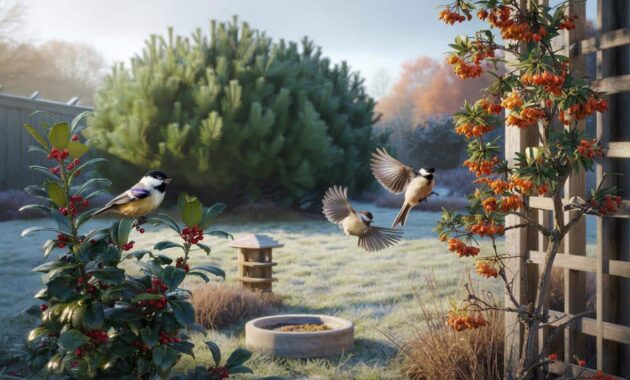
Some gardens feel busier once winter settles in.
I wanted that feeling to last past the first frost. So I experimented, pared back the planting list, and focused on what small birds actually need when daylight is short and hawks are hungry.
Why planting now changes winter for backyard birds
Winter squeezes birds from every side. Insects vanish. Seeds get buried. The wind strips away cover just when predators get bolder. Chickadees, blue tits and coal tits burn through calories quickly and roost low when nights bite hard. Dense shelter and reliable fruit bridge those tough hours between dawn and dusk.
Give small birds three things in winter: thick cover to vanish into, bright berries to raid, and an evergreen roof that slows the wind.
That’s the formula I used. Three plants, placed smartly, turned my feeder stopovers into all‑day visits. The trio below works across the UK and much of North America, with small adjustments for climate and soil.
The three plants that keep chickadees close
1. Holly that actually fruits (Ilex)
Holly looks like decoration to us. To birds, it’s a winter pantry with panic rooms. The key is berries. In the UK, go for English holly (Ilex aquifolium). In colder parts of the US and Canada, winterberry holly (Ilex verticillata) holds fruit beautifully after leaf drop. You’ll need a male pollinator within 15–50 feet to set fruit on female shrubs—nurseries label them clearly.
- Why birds use it: dense, spiky cover deters cats and hawks; berries persist into the leanest weeks.
- Where it fits: partial shade to sun, average soil, near a fence or shed to break wind.
- Pro tip: stagger two females and one male; birds feel safer when they can hop shrub to shrub.
2. Firethorn for a blazing food wall (Pyracantha)
Firethorn throws out heavy clusters of orange, red or yellow berries. The thorns are serious. That’s the point. Small birds slip through them; larger predators don’t. Train it flat against a wall or along an open trellis to make a living, fruiting barricade by your feeder route.
- Why birds use it: a tight lattice of twigs and thorns; fruit through midwinter; quick escape routes.
- Where it fits: sun to light shade, well‑drained soil, along a path you can watch from indoors.
- Pro tip: prune right after flowering if you must, or very lightly; heavy autumn cuts remove the berry show.
3. One sturdy conifer for a wind‑break roost
Evergreen needles change the microclimate. They cut wind, shed sleet and offer roosting spots that stay hidden. In the UK, Scots pine (Pinus sylvestris) is a strong choice. In the central and eastern US, eastern red cedar (Juniperus virginiana) doubles as a berry source. Even a compact spruce in a container helps on a balcony.
- Why birds use it: safe roosting at dusk; quick vertical escape; steady cover all year.
- Where it fits: sun, room to spread, ideally upwind of your main shrub layer to cast a calm zone.
- Pro tip: place the conifer 10–20 feet from the feeder so birds can stage, scan, and dart back.
Dense holly near the ground, a thorny fruit wall at mid‑height, and an evergreen canopy above. That’s your winter triad.
Placement and small‑garden tricks
Think in layers. Keep the holly closer to eye level. Let firethorn run along a fence so birds can zip sideways. Put the conifer upwind to break the chill and create a pocket of still air. In a tiny yard, use a narrow, columnar holly and a trellised pyracantha. On a balcony, swap the conifer for a dwarf spruce in a heavy pot and clip holly into a tall container.
➡️ EU pushes for stealth multirole light aircraft by next decade
➡️ Venom-proof frogs snatch and swallow live “murder hornets” in Japan
➡️ This country keeps breaking green records while Europe falls behind
- Distance matters: position your feeder 5–10 feet from cover—close enough for safety, far enough to spot ambushes.
- Sightlines help: birds prefer clear flight lanes to the cover, not a cluttered maze.
- Windows: angle feeders or apply strike‑deterrent dots if the view reflects trees.
Quick guide to the trio
| Plant | Main role | Bird behavior you’ll see | Best site |
|---|---|---|---|
| Holly (Ilex aquifolium or I. verticillata) | Berries + thorny refuge | Short hops, quick dives into cover, late‑winter berry raids | Partial shade to sun; pair male and female |
| Firethorn (Pyracantha) | Fruit wall + predator shield | Perching along a trellis, pecking clusters, alarm calls then melt into thorns | Sunny fence or wall, well‑drained soil |
| Conifer (Scots pine or eastern red cedar) | Roosting and wind break | Evening roosts, pre‑dawn staging, caching seeds in bark | Full sun, upwind edge of garden |
Maintenance that matters in the cold
- Water before the ground freezes so roots settle well; drought stress cuts berry set next year.
- Mulch 5–8 cm (2–3 inches) to stabilize soil temperature and shelter ground insects that birds forage.
- Hold the pruners: delay major cuts until late winter or after fruiting, or you’ll remove the winter buffet.
- Leave leaf litter under shrubs; it feeds the mini food web that supports winter foraging.
- Skip netting where possible; birds tangle easily. If you must protect fruit, use rigid caging and check daily.
Feeders, water and little safety upgrades
Plants do the heavy lifting, but a few add‑ons make the garden irresistible. Offer black‑oil sunflower seed and suet in cold snaps. Place feeders near, not inside, thick cover. Keep a shallow dish thawed; warm water beats ice every time. If cats roam, a 1.8–2 m fence topper or a simple roller deters leaps toward your shrub line.
A heated birdbath plus the holly–firethorn–conifer triangle turns a quick visit into a daily circuit.
What to plant if you can’t find the exact trio
Swap holly for native cotoneaster in milder UK zones or for American winterberry where soils run wet. Replace firethorn with rowan or crabapple for clusters that hold well into winter. Trade the conifer for a dense juniper or a narrow yew if space is tight. In prairies or meadows, add clumps of little bluestem, switchgrass, goldenrod and asters; their seedheads and stems host overwintering insects, which chickadees hunt carefully on calm days.
Timing, climate notes and a quick reality check
Plant in early autumn across most of the UK and northern US states so roots get a head start. In warm zones, late autumn to early winter works if the soil stays workable. You’ll see more activity as soon as daytime highs drop and natural seedheads flatten. Berries often become popular later, when easier calories vanish.
Check local guidance before planting. Cotoneaster and some firethorn species spread in a few regions. Choose listed cultivars or native equivalents if your area restricts them. If you garden on a balcony, scale down: one dwarf conifer, a narrow holly and a compact pyracantha in containers still form a useful corridor.
Extra ideas to push results further
Try a simple placement test. Hang your feeder, then note the time from alarm call to calm perching. If birds settle in under 60 seconds, your cover is close enough. If they stay jittery, move either the feeder or the holly 2–3 feet and retest the next day. Small shifts change everything.
Consider winter pests and trade‑offs. Firethorn’s thorns deter foxes and cats, but they also snag sleeves. Wear gloves. Conifers can shade veg beds; offset them a few steps north. Holly berries are for birds, not people or pets. Let the garden keep that pact, and the birds will keep returning.