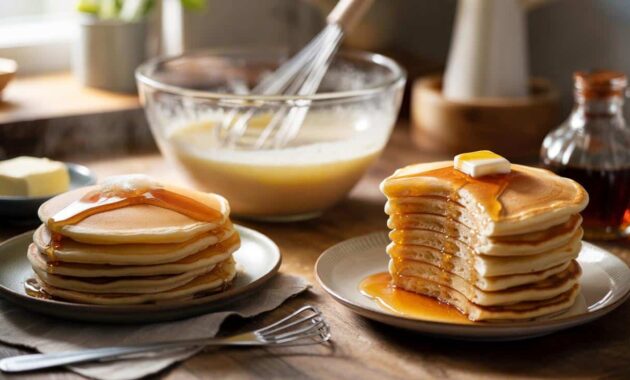
You’re standing at the stove on a lazy Sunday morning, doing everything “right”.
You followed the recipe, you whisked the batter, the pan is hot, the kitchen smells sweet and buttery. The pancakes look perfect on Instagram.
But when you finally cut into one, it’s… fine. Not bad, not great. Just a bit flat in flavor, slightly chewy, definitely not that cloud-soft, almost dessert-level pancake you demolished last weekend at that diner.
Same ingredients, same idea. Totally different result.
Something tiny is off.
The real reason restaurant pancakes taste so much better
Most people think the difference comes from some secret ingredient.
But in pro kitchens, the biggest secret is not what they add, it’s what they don’t touch.
Restaurants treat pancake batter like a fragile thing. Once the wet and dry ingredients meet, cooks stir it just enough, then walk away. No obsession, no over-whisking, no chasing out every last lump.
At home, we do the opposite. We baby the batter to death, turning it from airy and loose into dense wallpaper paste. That single reflex move – overmixing – is the quiet mistake that ruins almost every homemade pancake.
Picture this.
You’re at brunch with friends, the kind that order “just one more stack” even when everyone’s already full. The pancakes come out tall, with those tiny air tunnels inside, glistening with butter that disappears in seconds.
Now think of your last homemade batch. You probably whisked until the batter was smooth like cake mix. No lumps, no streaks of flour. It felt satisfying, even responsible. Yet the result was flat and rubbery at the edges, with that vague taste of cooked flour.
Restaurants don’t do that. They keep the batter barely mixed, often a little lumpy, then let it rest. The difference on the plate is brutal.
➡️ Hedgehogs in spring: this one urgent garden corner trick can save them when they wake up
➡️ This forgotten kitchen liquid effortlessly turns grimy cabinets smooth, clean, and noticeably shiny
➡️ Ultra-soft cake ready in 10 minutes flat: just 3 simple ingredients
➡️ The clever method to keep homemade guacamole bright green longer
The science is simple.
Flour contains gluten-forming proteins. Once they meet liquid and you start stirring, gluten develops, building structure and chew. That’s amazing for bread, terrible for fluffy pancakes.
When you go at the batter like you’re beating whipped cream, you activate too much gluten. The result is a tough, bouncy texture that resists your fork instead of melting on your tongue.
*The “secret” diner texture is nothing mystical: it’s just controlled laziness with a whisk.* Less mixing, more air trapped in the batter, and a softer crumb that tastes rich instead of bready.
How to mix your pancake batter like a restaurant cook
Here’s the move restaurant cooks learn fast: they keep the wet and dry separate until the very last moment.
In one bowl, flour, sugar, baking powder, salt. In another, milk, eggs, melted butter. Then – and only then – they marry the two.
Once combined, the whisk comes out for a short, almost rude visit. Ten, maybe fifteen gentle stirs. You’re not smoothing, you’re just getting rid of dry pockets. Lumps? Totally allowed. They’ll hydrate and disappear on the griddle.
Then the batter rests for 5 to 10 minutes. Tiny bubbles form, the starch relaxes, and you suddenly have something closer to restaurant magic than “Sunday experiment”.
Here’s where most home cooks sabotage themselves.
You mix the batter, you spot a streak of flour, and your brain screams: “Keep going, it’s not ready!” So you whisk. And stir. And scrape the sides. By the time you’re done, it’s shining, silky, and doomed.
That little voice comes from every cake recipe you’ve ever read, every baking show, every “no lumps allowed” school pudding. Pancakes are not that. They tolerate mess. They need restraint.
Let’s be honest: nobody really does this every single day. You’re busy, you eyeball ingredients, you rush the process. Still, once you feel the difference between a barely mixed batter and a polished one, it’s very hard to go back.
“Once I stopped chasing the perfectly smooth batter, my pancakes finally tasted like the ones we serve at brunch,” confessed a line cook from a busy city café. “The hardest part for home cooks isn’t technique. It’s resisting the urge to ‘fix’ what already works.”
- Stop overmixing – Stir only until you no longer see big streaks of dry flour. A few lumps are not a crime.
- Let the batter rest – Give it 5–10 minutes. This short pause relaxes gluten and boosts fluffiness.
- Use enough leavening – Fresh baking powder, not something that’s been open for two years at the back of the cupboard.
- Control the pan heat – Medium to medium-low. Too hot and they burn outside while staying raw inside.
- Grease, don’t drown – A thin film of butter or oil, not a shallow fry. That’s how you get an even golden surface.
Why this tiny change transforms your whole breakfast
Once you get used to under-mixing on purpose, something else happens.
You start tasting more than just “sweet dough”. You pick up the nuttiness from the butter, the warmth of the vanilla, the tang of buttermilk if you use it. The texture shifts from spongy to tender, with those delicate pockets that drink up syrup instead of letting it slide off.
You also speed things up. No need to stand there attacking the bowl. You mix, you rest, you pour, you flip. And suddenly the whole breakfast feels calmer, more intentional, less like a performance and more like a quiet ritual worth repeating.
| Key point | Detail | Value for the reader |
|---|---|---|
| Minimal mixing | Stir batter only 10–15 times, leaving small lumps | Leads to softer, fluffier pancakes with a restaurant-style crumb |
| Resting the batter | Let it sit 5–10 minutes after mixing | Improves rise, texture, and flavor without extra work |
| Gentle cooking | Moderate heat and light greasing of the pan | Gives even browning and prevents dry or rubbery edges |
FAQ:
- Question 1My batter is lumpy. Should I keep whisking until it’s smooth?
- Answer 1No. For pancakes, small lumps are normal and even desirable. They dissolve as the batter rests and cooks, while overmixing to remove them makes the pancakes tough.
- Question 2How long can I let pancake batter rest?
- Answer 2For classic pancakes with baking powder, 5–30 minutes is ideal. Wait too long and they may lose some lift, though the texture can still be pleasant and tender.
- Question 3Why do restaurant pancakes taste richer than mine?
- Answer 3Besides not overmixing, many restaurants use more fat (butter or oil), sometimes buttermilk, and generous salt and sugar. That combination boosts flavor and softness.
- Question 4Can I use a mixer or blender for pancake batter?
- Answer 4You can, but it easily overdevelops gluten. If you use one, pulse very briefly and finish with a spoon or spatula, stopping the moment the dry patches disappear.
- Question 5Why are my pancakes flat even when I don’t overmix?
- Answer 5Common reasons: old baking powder, too little leavening, batter that’s too runny, or a pan that’s not hot enough when you pour the first round.