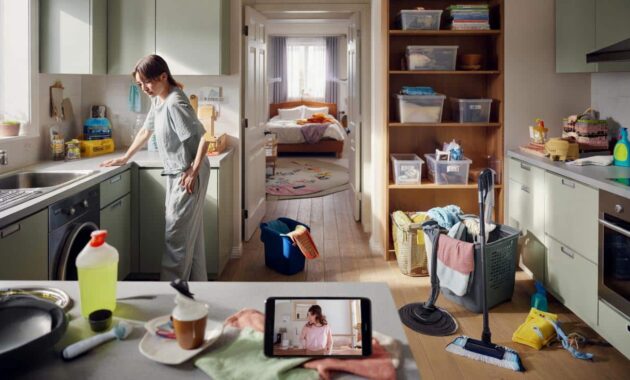
Saturday morning, 7:42 a.m.
The coffee is half cold on the counter, the mop bucket is already out, and the to‑do list on your phone looks like the floor plan of a supermarket. “Deep clean bathroom. Strip beds. Descale kettle. Wipe skirting boards. Organize toy bins by category.” You haven’t even brushed your teeth and you’re already behind.
Somewhere between the third load of laundry and the fake lemon scent of an all‑purpose spray, you catch yourself thinking, “Wasn’t this supposed to feel satisfying?”
The house isn’t really dirty. You just feel like you’re constantly failing at keeping it perfect.
The weird thing is, no one told you to do half of this.
It just… crept in.
When “just a quick tidy” turns into a part-time job
Cleaning routines rarely explode overnight.
They expand quietly, like a subscription you forgot you signed up for and now can’t cancel. One new habit here, one “hack” from Instagram there, and suddenly your Sunday looks like a shift in a hotel housekeeping team.
We start with something simple: “I’ll wipe the counters every evening.” That feels light, doable.
Then we add vacuuming the whole place, washing the bathroom floors twice a week, soaking showerheads, decluttering drawers on rotation.
By the time we notice, our “routine” is a spreadsheet we carry inside our heads.
Picture this.
You scroll through cleaning videos while lying in bed, and there she is: the woman who strips her beds daily, empties every crumb from the toaster, disinfects every handle, and folds towels like a five-star spa. She says it takes her “just 20 minutes a day.”
You believe her. You try it.
By Wednesday you’re going to bed at midnight because you couldn’t sleep knowing the sink wasn’t shiny. Your partner laughs at first, then avoids the kitchen for fear of “messing up the system.”
Meanwhile, the bathroom gets cleaned twice as often, but you haven’t read a single page of the book on your nightstand.
This is how cleaning routines quietly become unsustainable.
They stop being about living in a healthy space and start being about controlling anxiety, perfection, or guilt. Each new task feels small when you add it, but the total load hits like a second job.
We’re also cleaning for an invisible audience now: the people on social media, the friends who might “pop by,” the imaginary judge who checks the dust on the TV stand.
Let’s be honest: nobody really does this every single day.
Yet the image of the “ideal routine” has become so normalized we no longer question whether our effort matches our actual life.
Peeling back a routine that’s quietly draining you
There’s one simple gesture that can expose how overloaded your cleaning routine has become.
Take a sheet of paper and write down, line by line, everything you regularly do to “keep the house decent.” Not what you think you should do — what you really do, across a normal week.
Change sheets. Vacuum. Wipe fridge shelves. Scrub shower. Wash towels. Tidy kids’ rooms. Clean microwave. Mop.
Then, next to each task, write how often you aim to do it and how long it honestly takes. No cheating, no “oh, it’s just five minutes” if it’s actually twenty with all the small steps included.
Seeing it in black and white is mildly shocking.
Most people notice the same thing: their routine was built randomly.
A tip from a friend here, a childhood habit there, a TikTok hack about vinegar and baking soda, a smell you associate with “proper cleaning” because your mother used that product. None of it was designed with your current life in mind — your working hours, your health, the number of people in your home.
So you end up washing the floors twice a week like your grandmother, even though you don’t wear outdoor shoes inside. You keep “laundry day” on Sunday because that’s how your parents did it, ignoring the fact that now you have a dryer and a tiny balcony instead of a backyard.
The routine doesn’t fit, yet you keep trying to squeeze yourself into it.
Underneath, something more subtle is going on.
Cleaning offers quick, visible results. Wipe, and the mark disappears. Vacuum, and the crumbs are gone. In a messy, unpredictable world, that hits like a tiny shot of control.
So every time you feel overwhelmed, you add another micro task: another check on the list that promises “If I just do this, I’ll feel on top of things.” For a while, it works. Then the list grows too heavy, and the same routine that calmed you starts stressing you out.
*The line between self-care and self-punishment can be a damp cloth wide.*
Building a routine that doesn’t eat your whole life
A sustainable cleaning routine often begins where pride loosens its grip.
Forget the Pinterest version of your home for a moment. Start by choosing your “non-negotiables” — the three things that genuinely change how you feel in your space. For some, it’s an empty sink at night. For others, it’s a clean toilet and no visible dust on the living room table.
Circle those few tasks on your list.
That’s your core routine, the everyday spine. Everything else? Optional layers, not obligations. You can schedule them weekly, monthly, or seasonally, depending on your reality instead of an imaginary standard.
A small trap many of us fall into: turning every task into a daily one.
Floors do not need mopping every day in most homes. Showers don’t need a full scrub after each use. Fridge shelves can wait a week. When everything becomes “daily,” nothing feels optional, and your nervous system never gets to exhale.
So spread the load. Pair tasks with what already happens: toilet and sink on Tuesday after your evening shower, dusting during a podcast on Thursday, towels on Friday before dinner.
Be kind with your expectations. Cleaning doesn’t have to be a moral performance. **You are not a better person because your grout is whiter.**
Sometimes the most radical cleaning hack is accepting that “good enough” really is good enough.
➡️ This country could face a historic winter due to a rare mix of La Niña and the polar vortex
➡️ No more oil pouring everywhere: this Amazon gadget can halve your calories
➡️ China Begins Returning Boeing Aircraft to US
➡️ Vegetarian diet linked to lower risk of 5 cancers: which ones and why
➡️ A giant find under the desert could upend the global nuclear race
- Decide your minimums: a clear sink, a reasonably clean bathroom, and one tidy surface can transform how a home feels.
- Time‑box your effort: 20–30 minutes on weekdays, a bit more on one chosen day, then stop even if the list isn’t finished.
- Rotate deep tasks: one week it’s the oven, another it’s windows, another it’s the dreaded junk drawer.
- Share the load: kids can wipe tables, partners can handle bins, guests can be allowed to see a normal, lived‑in home.
- Question new “hacks”: before adding anything, ask, “Will this still make sense for me in six months?”
Living in a home, not curating a showroom
Once you see how quietly a routine can grow out of control, you start noticing it everywhere.
The friend who apologizes five times for “the mess” while you sit in a spotless living room. The colleague who spends her only day off “resetting the house” and then wonders why Monday always feels heavy. The parent who cleans the playroom every night, even though it looks like a toy explosion again by 9 a.m.
We’ve normalized a level of domestic perfection that leaves almost no room for actual life to unfold.
What if the goal of cleaning wasn’t a home that could survive a surprise inspection, but a home that quietly supports you? A kitchen where you can cook without moving seven things first. A bathroom that doesn’t stress you out when you’re already late. A bedroom that feels restful enough for sleep, even if the closet isn’t Instagram-ready.
Sustainable routines don’t usually look spectacular from the outside. They look like someone who has energy left for a walk, a nap, a book, a conversation that runs a bit long.
They look like someone who knows when to stop.
There’s a strange relief in admitting you can’t — and don’t want to — clean like the people in your feed.
You live in your home. You spill, you cook, you shed hair on the bathroom floor, you leave socks in weird places. That’s not failure, that’s evidence of life.
The real quiet luxury might not be a perfectly folded linen closet, but the ability to sit on your own slightly dusty sofa and feel, deeply, that you’re allowed to rest in it.
**A routine that lasts is always gentler than the one that impresses.**
| Key point | Detail | Value for the reader |
|---|---|---|
| Spot the overload | Write down every cleaning task, with frequency and real timing | Reveals hidden workload and unrealistic expectations |
| Define non‑negotiables | Choose 3 core tasks that truly change how home feels | Creates a lighter, realistic daily routine |
| Rotate, don’t repeat | Spread deep‑clean tasks across weeks and months | Prevents burnout and keeps home “good enough” long term |
FAQ:
- Question 1How do I know if my cleaning routine has become unsustainable?
- Question 2Is it okay to lower my standards if I have kids or a demanding job?
- Question 3How often do I really need to deep clean things like the oven or windows?
- Question 4What if my partner doesn’t follow the routine I’m trying to simplify?
- Question 5How do I stop feeling guilty when I leave something undone?
Originally posted 2026-03-09 08:39:00.