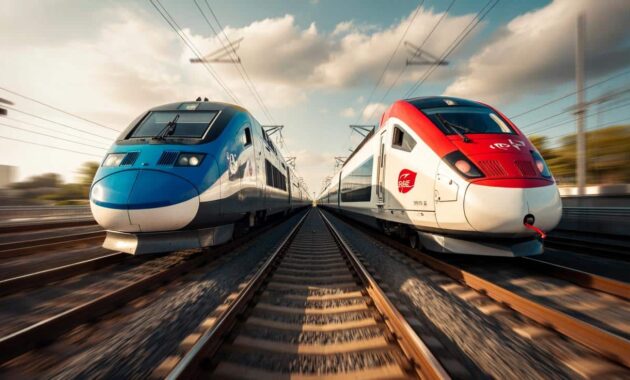
Across Europe and Asia, high-speed rail keeps raising the ceiling for fast, low‑carbon travel. The United States has fresh ambitions through Amtrak. France, for its part, points back to a famous milestone as the speed race edges into a new phase.
Why that 574.8 km/h record still matters
France’s TGV holds the absolute world speed record on steel wheels: 574.8 km/h, set in 2007 by the V150 test train. The run used uprated power, fine-tuned aerodynamics, and a specially prepared section of the LGV Est. The movement stayed on conventional rails under catenary power. That detail counts because maglev uses different hardware and track physics.
574.8 km/h remains the fastest verified run for wheel‑on‑rail. It still shapes how engineers think about headroom on steel.
The TGV’s commercial services run much lower, usually 300–320 km/h, because timetables must balance safety, energy draw, noise, and maintenance windows. France continues to invest in high-speed operations, rolling out new-generation trainsets and upgrading signaling. The record serves as proof of what the platform can tolerate under controlled conditions. It is also a reminder that comfort and reliability decide daily loyalty more than headline speeds.
China’s 450 km/h push and what “operational” really means
China’s current workhorse, the Fuxing Hao, cruises up to 350 km/h between megacities such as Beijing and Shanghai. Engineers have moved to the next target with CR450 technology. The program has showcased 450 km/h capability in trials and early operational runs on prepared corridors. That phase blends testing with limited service to validate systems at scale.
Commercial speed wins trips; records win headlines. China is now pressing both, with dense networks and new peak envelopes.
“Operational” can describe several stages. It may mean verification runs on revenue-grade track, a pilot schedule with controlled ticketing, or full public timetables. Certification regimes, driver training, and maintenance adaptation all matter before a network runs 450 km/h day in, day out. The direction of travel is clear, though: higher cruise speeds, tighter energy management, quieter bogies, and lighter materials.
How the headline speeds compare
| Train/system | Type | Peak speed | Status | Note |
|---|---|---|---|---|
| TGV V150 (France) | Wheel‑on‑rail | 574.8 km/h | Test record | 2007, purpose‑prepared run |
| TGV (France) | Wheel‑on‑rail | 320 km/h | Commercial | Routine high-speed service |
| Fuxing Hao (China) | Wheel‑on‑rail | 350 km/h | Commercial | High-frequency trunk lines |
| CR450 program (China) | Wheel‑on‑rail | 450 km/h | Operational trials | Pilot runs and validation |
| Shanghai Maglev (China) | Maglev | 431 km/h | Commercial | Airport link, different tech |
| Eurostar e320 (Europe) | Wheel‑on‑rail | 320 km/h | Commercial | London–Paris/Brussels |
| ICE 3 (Germany) | Wheel‑on‑rail | 320 km/h | Commercial | Cologne–Frankfurt corridor |
| Frecciarossa 1000 (Italy) | Wheel‑on‑rail | 300–320 km/h | Commercial | Rome–Milan backbone |
| AVE S‑103 (Spain) | Wheel‑on‑rail | 310 km/h | Commercial | Madrid–Barcelona |
| KTX (South Korea) | Wheel‑on‑rail | 305 km/h | Commercial | Nationwide HSR grid |
Europe’s steady pace, America’s renewed appetite
Europe spreads performance across multiple brands. Eurostar e320 units carry city pairs under the Channel at up to 320 km/h. Germany’s ICE 3 keeps tight schedules on dedicated high-speed spines. Italy’s Frecciarossa 1000 stitches business markets with premium onboard service, while Spain’s S‑103 anchors a wide‑ranging network of AVE routes. The French TGV still sets the rhythm for cross‑border traffic out of Paris.
The United States sits in a different place. Amtrak has signalled a step change on the East Coast with a new high‑speed line concept and ambitions around 299 km/h. Delivery will depend on track segregation, signaling upgrades, and rolling stock acceptance. Real‑world timetables often cap speeds where legacy curves, bridges, and shared freight traffic remain. The direction, though, points to faster runs and improved reliability.
➡️ I realized cleaning wasn’t the problem, my system was
➡️ Your favourite colour says a lot about your personality, according to psychology
➡️ Neither Nivea nor Neutrogena: the moisturizer experts rank as the new number one
Big numbers draw attention, but what riders feel is frequency, punctuality, and fair fares between dense city pairs.
What actually decides the top speed you get
- Track geometry: curve radii, superelevation, gradients, and turnout design set hard limits.
- Power and aerodynamics: high speed needs megawatts and lower drag; pantograph–catenary stability is key.
- Signaling: moving‑block or advanced ETCS/CTCS cuts headways and raises safe cruise speeds.
- Maintenance windows: higher speeds increase wear; crews need access without crushing the timetable.
- Noise and vibration: speed control near towns reduces nuisance and meets regulation.
- Energy cost: the last 20 km/h can add a steep power penalty, especially in headwinds.
- Dwell times and station spacing: long stops erase speed gains; fewer stops raise average speed fast.
What the French claim signals right now
When France points back to 574.8 km/h, it is not nostalgia. The message is capability on rails that many countries already understand and use. The TGV platform still moves at the front of conventional high‑speed rail. The record also frames a rivalry with China’s 450 km/h program, which is converging on higher commercial speeds on carefully prepared corridors.
Travelers will care about end‑to‑end time and predictability. A 320 km/h network that runs to the minute can beat a 350+ km/h network with bottlenecks and delays. A 450 km/h envelope creates room for recovery, but it also demands new rules for track design, evacuation, and power infrastructure.
Risks, gains, and a quick way to judge your trip
Raising speed increases aerodynamic noise, crosswind sensitivity, and energy use per seat. It can shorten parts’ lifecycles and demand stricter inspection regimes. The gains are real, though: more trips shifted from short‑haul flights, lower emissions per passenger‑kilometre, and stronger regional economies.
Want a simple door‑to‑door check for your next route? Take the train’s best journey time. Add the time to reach each station, and a five‑minute buffer for boarding. Compare that with a flight by adding airport transfer time, security time, and boarding time. Many city pairs under 1,000 km tilt toward rail once you add those numbers.
Context that widens the picture
Commercial speed, line speed, and test speed do different jobs. Commercial speed is what you buy. Line speed is the published maximum for a section of track. Test speed validates a margin above both for safety and certification. Maglev sits in a separate category, with higher top speeds but dedicated guideways and different cost curves.
For the next few years, expect France to target reliability and capacity at around 320 km/h while China validates higher envelopes where the network allows. Europe’s other leaders will refine punctuality and frequency. The United States will try to close a large gap with new infrastructure on the East Coast. The race keeps shifting, yet the core stays the same: fast, frequent, electric trains that beat the car and compete with the plane on time, price, and comfort.