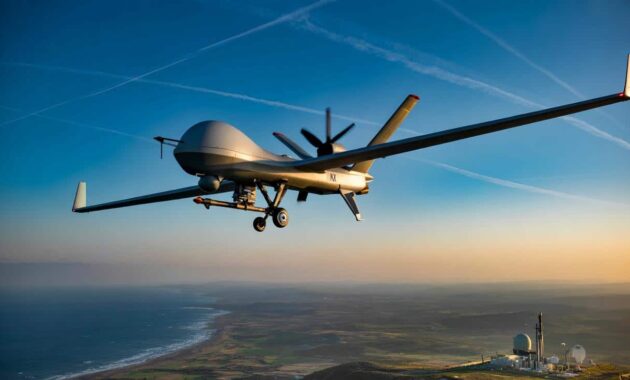
The project, called ENBATA, aims to give European forces a long-endurance, heavily loaded unmanned aircraft that can watch, listen and act for more than two days without landing.
A young French player steps into a strategic race
ENBATA is being developed by Aura Aero, a relatively new aerospace firm better known until now for low-carbon regional aircraft projects. Backed by heavyweight partners Thales and Safran, the company is pushing into the highly competitive field of military drones.
The goal: a medium-altitude, long-endurance (MALE) drone able to fly up to 55 hours straight while carrying up to one tonne of payload. That payload could be sensors, communication systems or light weapons, depending on the mission.
ENBATA targets 55 hours of continuous flight with a maximum take-off weight of 2,000 kg, half of it usable payload.
French defence planners see long-endurance drones as a gap in Europe’s arsenal. Allies have largely relied on US and Israeli systems for years, often under strict export and usage rules. Paris wants a homegrown option that can be deployed and upgraded without asking Washington’s permission.
Backed by France’s defence procurement agency
The programme has been selected by France’s Direction générale de l’armement (DGA), the powerful arm of the Defence Ministry that buys and tests military equipment. The DGA is funding the development of a first operational prototype, with a target of initial flights by the end of 2026.
A central selling point is that ENBATA is designed as an ITAR-free platform. In other words, it avoids US components covered by Washington’s International Traffic in Arms Regulations.
By aiming for an ITAR-free configuration, France wants a drone it can export and upgrade without US legal constraints.
For Paris, that matters not just for sovereignty but also for industrial strategy. If ENBATA reaches maturity, it could be offered to European partners and friendly countries as an alternative to American or Turkish systems.
➡️ “At 66, my balance improved with slower steps”: the reflex timing adjustment
➡️ Paris and Berlin weigh scrapping fighter jet plan to prioritise combat cloud
➡️ This job offers financial freedom without requiring long working hours
➡️ “I stopped using scented products once I removed hidden odors”
An endurance figure that changes how commanders think
The headline figure is the drone’s projected autonomy: 55 hours in the air. For a 2,000 kg aircraft carrying up to 1,000 kg of mission equipment, that is an ambitious target.
Such stamina gives commanders options that shorter-range drones cannot provide. Instead of rotating multiple aircraft over a region, a single ENBATA could loiter quietly for more than two days before needing to refuel and rearm.
- Maximum take-off weight: 2,000 kg
- Payload capacity: 1,000 kg
- Endurance: up to 55 hours
- Intended altitude: medium altitude, long endurance (MALE class)
- First prototype target: by the end of 2026
This sort of endurance is particularly valuable for missions where timing is unpredictable: tracking smugglers across seas, monitoring a slow-moving convoy in a desert, or listening to radio traffic in a tense border region.
Designed as a multi-role platform from the start
Aura Aero is pitching ENBATA as a modular, digitally designed platform. The airframe and systems are built around a fully modelled, software-driven architecture, which should speed up configuration changes and upgrades.
From armed reconnaissance to search and rescue
The drone is intended to support a broad set of missions:
- Long-range strategic intelligence and surveillance
- Armed reconnaissance with light precision weapons
- Search and rescue over sea or remote terrain
- Anti-drone operations, including tracking and interception support
- Electronic warfare, such as jamming or signal collection
- Maritime and coastal patrol of exclusive economic zones
- Relay of secure military communications over large areas
The same airframe could watch a coastline one day, jam enemy communications the next and support a rescue after a wildfire the day after.
Aura Aero highlights the digital backbone as a way to swap mission kits quickly. In theory, forces could reconfigure an ENBATA overnight, shifting from intelligence work to maritime patrol simply by changing pods and software profiles.
Dual certification: military and civil skies
Another unusual ambition is dual certification. Aura Aero is working towards approval both from European defence authorities and the European Union Aviation Safety Agency (EASA). That would clear the drone to operate in controlled civil airspace, alongside airliners and business jets, under strict conditions.
That capability opens up non-military roles. Potential uses mentioned around the programme include:
- Monitoring large forest fires and directing firefighting assets
- Environmental surveillance, such as tracking pollution plumes or illegal fishing
- Humanitarian support, providing communications and imagery after earthquakes or floods
Dual-use certification also matters for acceptance. European publics tend to be wary of drones, especially armed ones, flying near populated areas. A civil-standard safety case could help ease some concerns, at least for unarmed missions.
A tightly knit French industrial team
Aura Aero is not working alone. For propulsion, it has turned to Safran, France’s flagship engine manufacturer. Thales, a leader in radars and optronics, is involved in sensors and mission systems. Other French firms from the aerospace supply chain are expected to bring structures, avionics and ground-control components.
By keeping suppliers European, the programme aims for a sovereign supply chain from engine to datalink.
This aligns with a broader French and European push to secure key technologies. Drone warfare has shown how quickly export rules, spare parts and software updates can turn into political levers. A domestically controlled system gives governments more room to manoeuvre.
A five-way race inside France’s MALE contest
ENBATA is not the only candidate in town. At the 2025 Paris Air Show at Le Bourget, the DGA signed contracts with five companies to develop MALE demonstrators by 2026. Alongside Aura Aero, the selected firms are:
- Daher
- FLY-R
- SE Aviation
- Turgis Gaillard
Each team is taking a different design path, from more conventional twin-boom drones to mixed-wing or highly efficient propeller concepts. The French state wants to see real aircraft flying before choosing which ideas to push towards full operational programmes.
| Company | Role in MALE contest |
|---|---|
| Aura Aero (ENBATA) | High-endurance, 2,000 kg-class drone with 55-hour target |
| Daher | Leveraging experience in turboprop aircraft and mission platforms |
| FLY-R | Specialist in innovative wing configurations and efficiency |
| SE Aviation | Light aircraft and aerostructures expertise |
| Turgis Gaillard | Fast-growing defence engineering player |
For the DGA, this competition is a way to spread risk, stimulate innovation and avoid betting too early on a single platform. For Aura Aero, it raises the stakes: ENBATA has to stand out on performance, cost and industrial credibility.
Could Enbata become a European reference?
Military planners across the continent are watching. Europe already has the Eurodrone project, led by Airbus, Dassault and Leonardo, but that aircraft targets a heavier category and has struggled with delays and rising costs. A lighter, more agile platform such as ENBATA could fill a different niche.
The demand is there. Conflicts from Ukraine to the Sahel have shown how drones change operations, from artillery spotting to border surveillance. European armed forces want systems they can deploy overseas, integrate with NATO networks and upgrade quickly as threats shift.
If ENBATA meets its endurance, payload and certification targets, it could become a go-to option for European MALE missions.
The first real test will come with flight trials planned before the end of 2026. Those will need to show not just raw performance, but also reliability, maintenance needs and how easily operators can handle the system in realistic scenarios.
Key concepts behind long-endurance military drones
For non-specialists, some jargon around ENBATA can be confusing. The label MALE stands for “medium altitude, long endurance”. These drones usually fly between 10,000 and 30,000 feet for more than 24 hours. They are slower than fighter jets but excel at staying over an area for long periods.
Long endurance comes from several design choices: efficient wings, lightweight structures, carefully tuned propeller engines and fuel management. Navy-style ruggedness is less of a priority than fuel economy and low acoustic signature.
On the ground, a MALE drone is usually controlled by a team. One person pilots via satellite link or radio relay, another manages sensors, and a third handles mission planning and data. As autonomy improves, some of those tasks may be supported by onboard algorithms, but human oversight remains central for now.
Scenarios and risks around a 55-hour autonomous watch
Imagine a crisis in the eastern Mediterranean. A European task force wants to watch shipping lanes, detect potential sabotage against undersea cables and track air movements near disputed waters. Launching an ENBATA at dawn on Monday could give commanders real-time imagery, radar tracks and communications relay all through Monday, Tuesday and into Wednesday morning with a single airframe.
Or consider a series of wildfires across southern Europe. A civil-configured ENBATA could orbit above smoke, mapping hotspots, identifying trapped communities and acting as a flying 4G or military network node for ground teams cut off from infrastructure.
There are downsides too. A drone that stays airborne that long is exposed to changing weather, electronic attacks and potential interception. Losing one means losing a large amount of persistent intelligence from the sky in one hit. Saturated airspace also complicates integration with manned aircraft, especially in crowded European corridors.
Ethical questions are never far away either. A long-endurance armed drone can keep a city or region under near-constant observation, raising concerns about surveillance overreach. If governments move from human-in-the-loop control towards greater autonomy, debates over accountability in strikes will likely intensify.
For now, ENBATA is still a project on paper, test benches and factory floors. But if the numbers translate into flight hours, this French drone could mark a noticeable shift in how Europe shares the skies between human pilots and machines that do not need to sleep.