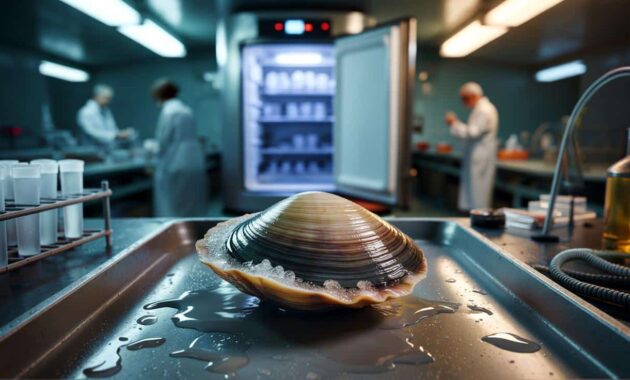
The creature on the tray looked like a dark, oversized clam that had lost a fight with time. No dramatic eyes. No teeth. Just a heavy, ancient shell, slick with melting ice under the harsh white light of the lab. Around it, the hum of freezers, the distant buzz of fluorescent tubes, and the soft squeak of rubber soles on linoleum. A Tuesday afternoon, nothing special, except this animal had started its life when Leonardo da Vinci was still alive.
Its heart had beaten quietly on the ocean floor since 1499.
It died when someone shut a freezer door.
The clam that outlived empires, and died of curiosity
They called it “Ming.” A quahog clam, hauled from the chilly seabed off Iceland in 2006 by researchers measuring climate history from seashells. The animal didn’t struggle, didn’t scream. It was just one more shell among hundreds in a dredge net, clacking softly like loose coins as it rose through the water column. To the scientists on deck, it looked like any other bivalve you could order in a seaside restaurant.
Only later would they realize this lump of calcium carbonate had been quietly alive since before Shakespeare was born.
The story is almost mundane in its first act. The team brought the clams to shore, logged them, and did what marine researchers often do: they froze them to analyze them later. The animal’s death wasn’t a villainous act, just a routine step in a standard protocol. No one suspected this particular clam was older than their entire lab, older than their country’s constitution, older than the microscope they used to examine it.
When they thawed it, they cracked the shell, counted the fine concentric rings like a tree trunk, and their jaws dropped. Rough estimate: around 405 years. A living being born in 1601.
Later, more careful counting pushed the age even further back: about 507 years. That meant this creature settled onto the seabed in 1499, while caravels still traced uncertain routes across the Atlantic and printing presses clattered for the first time in European cities. While dynasties collapsed, borders shifted, and new languages were born, Ming simply sat there, feeding on drifting particles in cold, dark water.
The tragic twist is nearly cinematic. This animal survived storms, predators, centuries of changing oceans. Not war, not warming seas, not trawling nets finished it off. Curiosity in a white coat did. That’s the strange, uncomfortable beauty of the story.
What a 500-year-old clam quietly teaches us
When scientists realized what they had done, they didn’t just shrug and archive the shell. They started reading it. Each growth ring in Ming’s shell held microscopic clues about the temperature and chemistry of the water it grew in. Layer by layer, it turned into a timeline. A physical diary of North Atlantic history, from before the Reformation to the age of satellites.
➡️ An ultra?trendy ingredient that enhances your dishes and your skin
➡️ More people are putting aluminum foil on door handles : here’s why
➡️ The unusual ingredient some chefs add to tomato soup for a richer and smoother taste
➡️ No bleach or ammonia needed: the simple painter-approved method to eliminate damp at home for good
➡️ The French Rafale could soon be technically outclassed by a new Asian fifth-generation rival
➡️ Microwaving a lemon : A simple kitchen trick you’ll keep using
That’s the real science: turning guilt into data, regret into knowledge.
Inside the shell, patterns of growth showed slowdowns that matched known cold periods, like the Little Ice Age. Researchers used chemical signatures to reconstruct variations in ocean circulation over centuries. Not from computer models alone, but from an animal that had actually been there, quietly living through all of it.
It’s a bit unsettling. While we rush through our days, checking notifications and half-finishing tasks, there was a creature that just calmly existed for half a millennium. No drama. No career plan. Just survival, ring by ring.
Ming also blew up one stubborn myth: that big, old animals are fragile by default. This clam was old precisely because it was tough and slow. Its heart beat extremely slowly, its metabolism crawled, its body invested in repair instead of speed. That’s longevity strategy in its purest form.
Let’s be honest: nobody really does this every single day. We talk about wanting to “slow down”, then drink more coffee and open another browser tab. This clam actually did it. And it outlived everyone who will ever read this sentence.
The awkward line between protection and sacrifice
So what do you do with a story like this? You can’t rewind the freezer door. You can’t bring back the animal that survived 500 winters. What researchers did, in a way, was the only thing left: admit the mistake, use the data, and change how they talk publicly about fragile, long-lived species.
The method isn’t glamorous. It’s a lot of lab meetings, revised sampling protocols, and those quiet, uneasy “should we really do this?” conversations that happen before a new expedition.
Many people reacted online with anger when Ming’s story went viral a few years ago. “How could they kill it?” “Why didn’t they release it?” Those questions sting because they’re right and wrong at the same time. The scientists didn’t know what they had, and that’s not an excuse, just a plain fact.
We’ve all been there, that moment when you realize you’ve broken something precious you didn’t even know you were holding. The only honest response is to remember the feeling and act differently next time.
One marine biologist who worked with long-lived clams summed it up like this:
“We like to imagine science as clean progress, but it’s often messy. Sometimes you learn the most from the thing you wish you hadn’t done.”
From that mess came a few hard lines researchers now talk about more openly:
- Limit how many individuals of long-lived species you sacrifice for studies.
- Prioritize non-lethal methods when you suspect extreme longevity.
- Share uncomfortable stories, so younger scientists don’t repeat them.
- Treat “common” species as if one of them might secretly be 500 years old.
*Ethics in science isn’t just about big declarations; it’s about tiny, boring decisions on a boat deck at 5 a.m.*
The quiet legacy of an animal that never knew our names
Ming’s shell now sits in a collection, cataloged like any other specimen, its age printed on a label that looks almost too small for such a number. It won’t trend again on social media, and it won’t get a Netflix documentary. It’s just there, in a drawer, waiting for the next person who needs to read the climate history etched into its rings.
That’s the strange afterlife of many extraordinary animals: no statue, no song, just a case number and a thin line in a research paper.
Yet the story lingers in people’s heads long after they close the article tab. A creature born before modern banking, before antibiotics, before electricity, living calmly at the bottom of the sea until a steel net and a lab freezer ended everything. It’s hard not to see our own frantic, bright, short lives against that backdrop.
We measure our years in promotions, heartbreaks, deadlines. Ming measured time in a few micrometers of shell per season.
There’s a quiet, unsettling question behind this: how many other “Mings” have already been dragged up, dissected, forgotten? And another one, even more uncomfortable: how many of our daily conveniences skim over lives and systems just as old, just as fragile, without us ever noticing?
You don’t need to become a marine biologist to feel the weight of that. Just knowing that a clam born in 1499 once existed, and that its last chapter took place in a humming lab freezer, slightly changes how the world looks when you open your fridge, scroll your feed, or stand at the edge of the sea.
| Key point | Detail | Value for the reader |
|---|---|---|
| Extreme longevity | Ming the clam lived about 507 years, from 1499 to 2006, on the North Atlantic seabed. | Gives a concrete, mind-bending sense of how long non-human lives can quietly unfold. |
| Scientific mistake | The clam was killed as part of routine sampling and stored in a lab freezer before its age was known. | Raises awareness about the ethical and practical limits of research on rare or long-lived species. |
| Data legacy | Growth rings in the shell revealed centuries of climate and ocean history. | Shows how one life can help us understand environmental change on a deep timescale. |
FAQ:
- What species was Ming the clam?Ming was an ocean quahog (Arctica islandica), a bivalve mollusk known for its slow growth and exceptional longevity in cold waters.
- How did scientists determine its age?They counted annual growth rings in the shell, similar to tree rings, then refined the estimate using more precise shell cross-sections and comparisons with known climate records.
- Did the scientists know it was that old when they froze it?No. At the time of collection, it was treated as a typical specimen among many others gathered for climate and growth studies.
- Are there other animals that can live this long?Yes. Some Greenland sharks may reach 400+ years, and certain deep-sea corals and sponges can live for thousands of years, though their ages are harder to confirm.
- Can discoveries like Ming’s change research practices?They already have, at least in part. Stories like this push teams to reduce lethal sampling, especially of potentially long-lived species, and to discuss ethics more openly in marine research.
Originally posted 2026-03-09 04:53:00.