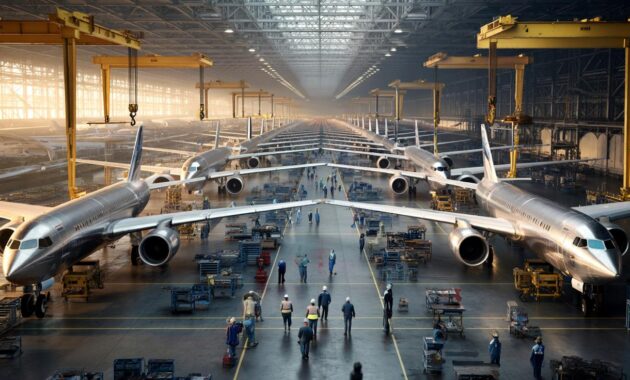
The first thing that hits you is the walking. Row after row of fluorescent lights, a ceiling so high it feels like weather could form up there, and a floor that seems to go on to the horizon. People in blue vests glide past with tool carts, forklifts whisper by with wings the size of small apartment buildings, and somewhere, an alert beeps in that soft, industrial way that never really stops. You glance up, and the space is so big your brain needs a second to accept what your eyes are seeing.
You’re inside the world’s largest factory, the Boeing Everett plant, just north of Seattle. A place that can swallow 3,753 Olympic-sized swimming pools in volume, employ 30,000 people, and quietly assemble eight massive jets at the same time. It looks less like a building and more like a man-made continent.
This is what it feels like to stand inside a machine that builds machines that circle the planet.
The factory that feels like its own small planet
From the outside, the Boeing Everett plant looks almost unreal, like someone copy-pasted a warehouse and hit “enlarge” too many times. The façade stretches across the horizon, as if the building forgot to stop. Cars line the parking lots in perfect grids, thousands of them, each belonging to somebody whose day revolves around bolts, wings, and schedules tighter than a drum. You don’t just “swing by” a place like this. You commit to it.
Step inside and the scale finally lands. Your footsteps echo on polished concrete while overhead, cranes move entire airplane sections like they were Lego bricks. A 777 fuselage, longer than a blue whale, slides past as calmly as a city bus. Workers cluster around a wing, each with their own task, each apparently knowing exactly when to move, when to step back, when to just watch the laser-guided drills do their job. *You half expect to see traffic lights and street signs hanging from the rafters.*
The official numbers sound like something cooked up in a bar bet. About 399,000 square meters of floor area. Around 13.3 million cubic meters of volume, enough to float those 3,753 Olympic pools. Up to eight wide-body aircraft built at the same time, each worth hundreds of millions. Yet when you’re there, the numbers feel almost too small for the reality. What really tells the story are the small things: a worker’s lunchbox perched on a tool cabinet, a handwritten checklist taped to a wing section, the tired-but-proud posture of someone finishing the last shift of the week on a dreamliner line.
How you choreograph 30,000 people and eight jets at once
You don’t run a factory this big with brute force. You run it like a ballet. On the floor, the choreography is everywhere: painted lines on the ground that separate people from machines, color-coded zones where only specific teams are allowed, screens that blink with tiny timing windows that could derail a whole day if they slip. Planes move down the line nose-first, and each stop is like a stage in a play. Lighting, props, cast, script. Then the curtain rises.
A veteran supervisor describes one morning when a critical part for a 787 wing was delayed by just a few hours. The line couldn’t simply stop. So teams reshuffled tasks on the fly, doing steps 23 to 29 before step 19, borrowing staff from another jet that was a day ahead. A forklift driver did an extra six kilometers that day, just weaving parts from one station to another. By evening, the schedule was somehow back on track. No drama, no applause. Just a quiet nod and another plane drifting down the line under the ceiling cranes.
The logic behind this controlled chaos is ruthless in its simplicity. Everything is built around flow. If a worker has to search for a tool, that’s friction. If a part arrives late, that’s friction. If a wing section doesn’t fit within a few millimeters, that’s a fire alarm. So the plant is designed almost like a living computer: information in, instructions out, feedback loops everywhere. Digital screens show each plane’s status in real time, while sensors watch temperature, humidity, even how many minutes a crane sits idle. Let’s be honest: nobody really does this every single day in perfect form, but the striving for near-perfection is baked into the floor paint.
What this mega-factory quietly teaches about big goals
Watching Everett at work, you start to see a weird kind of comfort in its routines. Giant goals become small, almost boring steps. An entire jet that will cross oceans begins with someone checking a torque wrench, someone else tightening the 58th bolt of the morning, another person scanning a barcode on a crate. One precise gesture at a time. That’s the first quiet lesson this place throws in your face: scale is just repetition with discipline.
➡️ The Parkinson’s disease trigger may be this well‑known mouth bacterium
➡️ Gardeners say watering plants at this precise time of day changes growth dramatically
It’s tempting to romanticize this and forget the human side. There are long nights, delayed parts, shifts that start before sunrise in the damp Seattle cold. Some workers commute more than an hour to spend their day on a single sliver of a wing or a door frame they’ll never see again. We’ve all been there, that moment when your piece of the puzzle feels so small you wonder if it matters. In a plant like this, management wins or loses on how honestly they connect those tiny tasks to the bigger flying thing rolling out the hangar doors.
“People think they’re building planes,” one line manager says, leaning on a railing above the assembly floor. “But what keeps them coming back is knowing they’re building the trips their kids will take, the reunions, the first big moves overseas. If you forget that, this just turns into a noisy warehouse.”
- Scale is broken into tiny, repeatable steps: from mega-factory to personal project, progress lives in clear, modest actions.
- Flow beats force: systems that reduce friction outperform raw effort, whether on a production line or in your own workday.
- Meaning multiplies motivation: tying routine tasks to a larger story keeps people sharper, prouder, and more resilient.
A factory that mirrors the way we now build the world
Standing in Everett, it’s hard not to think about how much of modern life depends on places we rarely see. Planes that shrink continents, supply chains that span oceans, teams so big that no one person can name even a fraction of the faces. This one building, big enough to swallow skyscrapers on their side, quietly hosts that whole conversation every day. The noise, the coffee breaks, the managers on catwalks, the new hire on their first shift trying not to look lost.
The world’s largest factory isn’t just about Guinness-record numbers or jaw-dropping photos from the visitor gallery. It’s about what happens when thousands of people learn to move in sync around goals too big for any one of them. Missed bolts get caught by checklists, late parts trigger backup plans, and entire planes inch toward daylight at the end of the hangar. The Everett plant just pushes that logic to an extreme we can actually see.
You walk out at the end of the tour into the gray Washington light, and a jet roars overhead, banking toward some distant city. A few hours ago, you watched its siblings being built piece by piece inside that vast metal box. The line between “factory” and “future” suddenly feels very thin. Once you’ve seen where giants are assembled, it’s hard not to look at your own oversized dreams and wonder: if they can build eight airplanes at once, what’s the first tiny bolt you could turn tomorrow?
| Key point | Detail | Value for the reader |
|---|---|---|
| Extreme scale is made of small steps | Boeing Everett can host 3,753 Olympic pools yet runs on repetitive, precise tasks | Helps reframe big personal or professional goals as series of manageable actions |
| Flow and systems beat raw effort | 30,000 people and eight jets move through tightly choreographed processes and layouts | Inspires readers to design better workflows instead of just “trying harder” |
| Meaning keeps massive teams motivated | Workers connect daily routines to the real lives and journeys their planes will carry | Encourages readers to link their own routine work to a larger, motivating story |
FAQ:
- Question 1Where is the world’s largest factory located?The largest factory by volume is the Boeing Everett plant in Everett, Washington, about 40 kilometers north of Seattle in the United States.
- Question 2How big is the Boeing Everett factory in simple terms?Its internal volume is around 13.3 million cubic meters, enough space to fit roughly 3,753 Olympic-sized swimming pools or several city blocks under one roof.
- Question 3How many planes can be built there at the same time?The assembly lines are designed so that up to eight wide-body jets can be worked on simultaneously, each at a different stage of construction.
- Question 4How many people work at the Everett plant?Approximately 30,000 employees are associated with the site, from assembly-line workers and engineers to logistics staff, planners, and support teams.
- Question 5Can the public visit the world’s largest factory?Yes, there are guided tours that allow visitors to see parts of the assembly lines from elevated galleries, though access is restricted and cameras are usually limited for security and safety reasons.