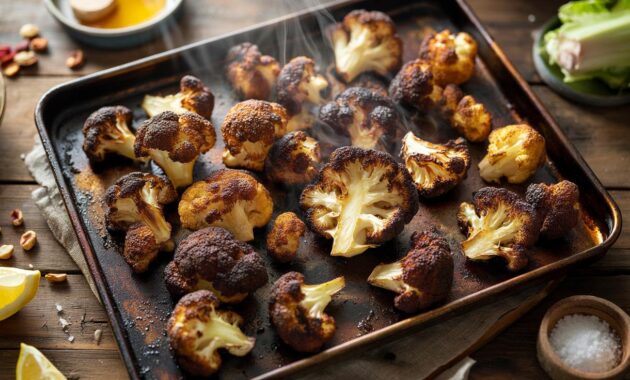
The first time I smelled it, I honestly thought someone was roasting chestnuts in my tiny apartment building. It was a Tuesday, the kind of evening when you open the fridge and stare at a lonely head of cauliflower, already regretting your “healthy” intentions from the weekend. Then this scent floated through the hallway: warm, toasty, almost caramelized, with that deep nutty note you usually expect from coffee beans or brown butter, not from a pale cruciferous vegetable.
I followed my nose like a cartoon character, straight to my neighbor’s half-open door. Inside, a tray of cauliflower florets was hissing and crackling under a blast of heat, edges turning mahogany, steam rising in sweet little puffs.
Cauliflower, but almost… candied.
There was only one strange thing about how it was roasting.
The “too hot, too fast” secret that transforms cauliflower
Most recipes tell you to roast vegetables gently, as if they’re made of porcelain. Low oven, long time, a drizzle of oil, done. That night, my neighbor did the opposite. Her oven was cranked almost to the maximum, the tray shoved up higher than I’d ever dare. The florets weren’t politely spaced out either. They were crowded, some almost overlapping, like they’d been dumped in a hurry by someone getting home late from work.
Yet the smell was unreal. Deep, nutty, slightly sweet. The kind of aroma that makes you forget you used to hate cauliflower as a kid.
She pulled the tray out and one floret caught my eye. It was nearly brown at the tips, with shiny, blistered curves and crisp, chiseled edges. When I bit into it, the texture was shocking. Crunch at the edges, creamy in the center, like a cross between a roast potato and a toasted hazelnut. No sulfur, no “school cafeteria” sadness.
That’s when she revealed her trick: she roasts cauliflower at a much higher heat than most cookbooks recommend, and she doesn’t fuss about perfect spacing. “I want it to almost scare me,” she laughed, pointing at the dark spots. “If I’m not slightly worried it’s burning, I know it’s not ready yet.”
There’s science behind that almost reckless approach. At very high heat, the natural sugars in cauliflower race toward what chefs quietly chase in every kitchen: deep browning. That browning, called the Maillard reaction, is what turns plain bread into toast, raw meat into a steak crust, simple milk solids into nutty brown butter. Cauliflower happens to carry a surprising amount of natural sugar, and when those sugars and amino acids get blasted by heat, they transform into dozens of complex flavor molecules.
That’s why the result tastes unexpectedly nutty and sweet, more like roasted almonds than boiled veg.
➡️ A rare sighting has scientists reassessing previous theories
➡️ Blue whales are becoming eerily silent and researchers say it’s not a good sign anymore
➡️ Legendary rock band retires after 50 years “the hit everyone knows”
➡️ Why salt can help scrub stubborn grease on oven racks
The unusual method: from pale florets to golden nuggets
Here’s the core move: start hot, stay hot, go darker than you usually dare. Preheat your oven to 240–250°C (465–480°F). Yes, that high. While it heats, break the cauliflower into uneven, chunky florets. Some with stems, some with more curd. This mix of shapes gives you a mix of textures: crisp edges, tender bites, a few extra-caramelized scraps that almost crunch like chips.
Toss the florets with just enough oil to lightly coat, plus salt. Spread on a heavy sheet pan, but don’t obsess about empty space between every piece. The slight crowding traps a touch of steam in the beginning, which softens the centers while the exposed edges roast into golden, nutty ridges.
Most people pull cauliflower too early, when it’s only turning pale gold. For this method, let it go until the edges are deeply bronzed, even speckled with dark spots. Depending on your oven, that might be 18–25 minutes. Rotate the tray once, maybe twice, and resist the urge to stir every three minutes. You want some surfaces to sit still and tattoo themselves with color.
The surprise is what happens at the end. Those caramelized edges taste faintly sweet, not burned. The stems pick up a buttery softness. And the whole tray smells like someone’s baking something with nuts and sugar, not cooking a budget vegetable.
Underneath, the logic is pretty simple. High heat accelerates water loss. As moisture escapes, the surface dries enough to brown instead of steaming into mush. That’s also why you don’t want wet florets: pat them dry or spin them in a salad spinner after washing. Drier cauliflower means faster browning, faster sweetness. When the outside has those glossy, nearly charred tips and the inside yields easily to a fork, you’ve hit that tiny window where it tastes like a completely different ingredient.
*This is the moment where cauliflower stops behaving like a side dish and starts acting like a snack you’d eat over the sink.*
Little tweaks that change everything on the tray
Once you’ve nailed the “too hot, too fast” baseline, small gestures amplify that nutty, sweet thing. One powerful move: add a spoonful of neutral oil and a small knob of butter, melted together, instead of only oil. The butter solids brown along with the vegetable, echoing and boosting those toasted flavors. Toss the florets in this fat mix, then season with salt and maybe a touch of sugar or honey if you want to lean even harder into caramel tones.
Another trick is to start plain and finish loud. Roast the cauliflower with just salt and oil, then, while it’s still scorching hot out of the oven, throw on crushed toasted nuts, lemon zest, or grated hard cheese. The residual heat slightly melts the cheese or wakes up the citrus oils, and everything clings to the rough, browned surfaces like it was meant to live there.
We’ve all been there, that moment when you follow a “perfect” recipe and still end up with beige, limp cauliflower that nobody reaches for. The usual culprits are simple. The florets are too small, so they dry out before they can caramelize. Or they’re crowded but the oven isn’t hot enough, so they steam in their own juices instead of browning. Sometimes there’s just too much oil, making the whole thing greasy instead of crisp.
Let’s be honest: nobody really does this every single day. You’re tired, you’re hungry, and you don’t want a lecture from a baking sheet. That’s why this method works: it’s forgiving. Rough chopping is fine. Imperfect spacing is fine. As long as the heat is fierce and you let the edges go darker than your comfort zone, something magical still happens.
One chef I spoke to put it in blunt terms:
“If your cauliflower still looks shy, it’s not done. You want it bold. Dark edges. A little char. That’s flavor. That’s where the nuttiness lives.”
To keep that bold flavor from tipping into bitterness, a few anchor ideas help:
- Roast on a dark, heavy tray for quicker browning and more intense flavor.
- Dry the florets really well before oiling to avoid that sad steaming effect.
- Taste a small floret at the 15-minute mark, then every few minutes, to find your ideal sweet-spot of color.
- Finish with acid (lemon juice, vinegar) to balance the sweetness and wake up the nuttiness.
- Serve it hot, right away, when the contrast between crisp edge and tender center is at its best.
When a “simple” side dish becomes the main event
The most interesting thing about this unusual roasting method is what it does to your idea of what a vegetable is supposed to be. Once you’ve tasted cauliflower that’s gone all the way to dark gold and beyond, the boiled, pale version feels like a different food group. Suddenly, a head of cauliflower starts to look less like a duty and more like an opportunity. You start imagining it with tahini and lemon, or tucked into a warm flatbread, or piled over yogurt with chili oil and herbs.
Some nights it doesn’t even reach the table. People hover by the stove and pick at the tray, one floret at a time, the way they’d hover around a bowl of nuts or a plate of fries.
What might surprise you even more is how adaptable this approach becomes once you trust it. You can dial the sweetness up with a touch of maple syrup, or push the nuttiness with toasted sesame oil. You can shower it with fresh herbs at the end, or dust it with smoked paprika, or crumble feta over the top so the salty cheese melts into the roasted crevices. That same “too hot, too fast” rule works on Romanesco, on broccoli, even on thick slices of cabbage.
It’s a small shift in technique, but it changes the way you cook when you’re tired and need something satisfying without much thinking.
You might find yourself sharing trays of this cauliflower at gatherings, watching people hesitate, take a cautious bite, then come back for more. You might hear the same quiet surprise: “Wait, this is cauliflower?” At that point, you’re not just getting more vegetables into a meal. You’re offering guests that small, rare pleasure of rediscovering something they thought they knew.
And maybe that’s the real nutty, sweet trick here: not just transforming a vegetable, but transforming the story we tell ourselves about what “healthy food” is allowed to taste like.
| Key point | Detail | Value for the reader |
|---|---|---|
| High-heat roasting | Use 240–250°C (465–480°F) and let edges darken | Unlocks nutty, sweet flavors instead of bland, steamed notes |
| Texture contrast | Chunky, irregular florets, lightly crowded on the tray | Gives crispy edges and creamy centers, more satisfying to eat |
| Simple finishing touches | Add butter, lemon, nuts, or cheese after roasting | Turns a basic side into a craveable, almost snack-like dish |
FAQ:
- Question 1Why does high heat make cauliflower taste nutty and sweet?
- Question 2What oven temperature works best for this method?
- Question 3How do I stop it from burning while still getting deep color?
- Question 4Can I use frozen cauliflower for this roasting style?
- Question 5What seasonings pair well with nutty, sweet roasted cauliflower?