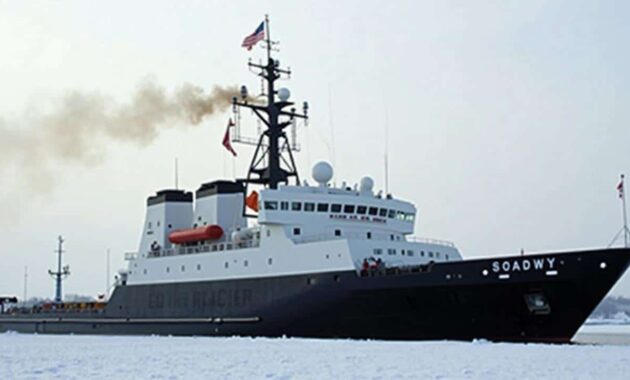
The Arctic is heating up, sea lanes are opening, and Washington suddenly finds itself short of the ships it needs.
As Russia and China surge ahead with powerful icebreaking fleets, the United States is scrambling for options, including buying or copying foreign designs, and critics say that shift exposes deep problems in America’s once-dominant shipbuilding industry.
Arctic ambitions collide with an aging fleet
For decades, the US barely thought about icebreakers. The Coast Guard’s small fleet was enough to resupply Antarctic stations and support missions off Alaska. That era is over.
Climate change is thinning sea ice and lengthening the shipping season in the Arctic. New routes across the top of the globe shorten journeys between Asia, Europe and North America by thousands of miles.
Russia has poured money into nuclear-powered icebreakers. China, calling itself a “near-Arctic state,” has launched its own modern ships and plans more. Washington, by contrast, relies heavily on the Polar Star, a heavy icebreaker launched in the 1970s.
The US currently operates just one working heavy icebreaker, a single point of failure for missions at both poles.
That ship is old, temperamental and prone to breakdowns. Maintenance is costly, and crews regularly report parts being cannibalised from its decommissioned sister ship, the Polar Sea, to keep it going.
A turn to foreign designs
After years of delays, cost overruns and technical disputes on the domestic Polar Security Cutter programme, US officials are now openly looking abroad.
The Coast Guard has studied existing foreign icebreaker designs and visited shipyards in countries such as Finland, Canada and South Korea. Under discussion: licensing a foreign design, buying a completed ship from an allied yard, or building a hybrid design in US yards using foreign engineering.
For some in Washington, that shift is pragmatic. For others, it is a red flag.
➡️ Stop buying anti fog sprays: this bathroom staple keeps your mirror clear after every shower
➡️ Valentine’s day: this is the ideal hair tool for a dream blowout
➡️ Meteorologists warn an early February Arctic breakdown is becoming increasingly likely
➡️ Physical exercise, a natural anti‑inflammatory against osteoarthritis
➡️ Salt and pepper hair: the worst mistakes to make with your cut
Relying on foreign icebreaker designs is seen by critics as an admission that US industry no longer leads in complex shipbuilding.
Why icebreakers matter for power projection
Icebreakers are more than niche tools for scientists. They are floating symbols of reach and sovereignty.
- They keep sea lanes open for commercial shipping and energy projects.
- They escort naval and coast guard vessels into frozen waters.
- They support search-and-rescue, environmental response and law enforcement.
- They underpin claims to continental shelves and exclusive economic zones.
Russia uses its massive nuclear icebreakers to escort cargoes of liquefied natural gas along the Northern Sea Route. China’s Xue Long and Xue Long 2 have been highly visible on polar research voyages, giving Beijing a scientific and political footprint in polar forums.
The US, by contrast, often has to choose between Antarctic resupply and Arctic presence because it lacks hulls.
How the US fell behind in icebreaking
US naval shipbuilding still turns out advanced submarines and destroyers, but the specific craft of building icebreakers has withered.
Icebreakers need unusual hull forms, heavy structural reinforcement, specialised propulsion and unique systems for coping with violent shocks in pack ice. The last time the US built a heavy icebreaker was decades ago, when the Polar Star and Polar Sea were laid down in the 1970s.
That long gap means engineers, welders, planners and inspectors with hands-on icebreaker experience have largely retired or moved on. When the Polar Security Cutter programme started, shipyards were effectively rebuilding that know-how from scratch.
| Country | Approximate heavy icebreakers | Notable feature |
|---|---|---|
| Russia | Dozens (including nuclear) | Nuclear-powered Arctic fleet |
| China | Several and growing | Rapid expansion, dual-use research focus |
| United States | 1 operational heavy, 1 medium | Reliance on aging Polar Star |
Meanwhile, countries such as Finland and South Korea quietly built up world-leading competence by serving commercial clients and other navies. Their yards have turned out advanced ice-capable LNG carriers, offshore support vessels and modern icebreakers on a regular basis.
Strategic anxiety in Washington
Members of Congress, Pentagon officials and Arctic experts increasingly warn that the US is arriving late to a strategic contest.
The Arctic Council, military exercises in the High North and debates over seabed resources all depend on ships that can safely operate in ice. Without them, the US risks relying on allies for access to its own backyard.
There is also concern about signalling. If Russia can send a nuclear icebreaker to escort warships, while the US struggles to send one creaking vessel, the optics shape perceptions of power, even if underlying military strength remains formidable.
In geopolitics, showing up matters almost as much as what you bring, and icebreakers decide who can show up in frozen seas.
Critics: a symptom of deeper industrial troubles
The debate over foreign-built icebreakers has spilled into a broader argument about American manufacturing and state support.
Critics argue that decades of fragmented procurement, budget instability and a shrinking industrial base have undermined complex shipbuilding. The US can still build highly advanced warships, but programmes are frequently late and over budget. Commercial shipbuilding has largely migrated to Asia.
When foreign designs suddenly look faster, cheaper and more reliable, some see it as proof that Washington has not invested in long-term capability, only short funding cycles tied to political winds.
Supporters of a foreign deal respond that the urgency in the Arctic leaves little room for sentiment.
Options on the table
Policymakers are effectively weighing three paths, each with trade-offs.
- Stick with domestic designs: Preserves jobs and independent capability but risks more delays and higher costs.
- License foreign designs: Uses proven blueprints while keeping construction mostly in US yards.
- Buy abroad: Fastest way to get hulls in the water, but politically charged and sensitive for national security.
There is also a hybrid option: purchase one or two completed foreign-built ships as a stopgap, while continuing a domestic programme that will take longer to deliver.
Finland and South Korea are often cited as potential partners, given their track record and status as US allies. Canada has also grappled with similar capability gaps and might be a collaborator in design or procurement.
Security, secrecy and political headaches
Handing sensitive military or law-enforcement vessels to foreign yards naturally raises security concerns. US officials would have to weigh where sensitive systems are installed, which parts of the ship’s architecture are shared, and what oversight American inspectors have over construction.
Congress is also protective of the Jones Act and domestic shipyard jobs. Any plan that shifts big-ticket work abroad invites pushback from powerful lobbies and states that depend on naval contracts.
The political cost of admitting a foreign yard can do the job faster competes with the strategic cost of waiting years for homegrown ships.
What an icebreaker actually does, beyond “breaking ice”
From a distance, an icebreaker looks like a beefed-up ship with a reinforced bow. In practice, its job is far more violent and technical.
Rather than simply ramming, a modern icebreaker often rides up on top of ice sheets and uses its weight to crush them. Powerful engines drive specialised propellers and sometimes water-jet systems along the hull to reduce friction and break up floes.
Inside, crews manage vibration, noise and brutal conditions. Systems must survive repeated shocks as the ship slams, twists and grinds through thick ice. That demands unique engineering in everything from hull plate thickness to pipe routing.
These stresses explain why simply turning a standard naval design into an icebreaker by “adding steel” usually fails. It also explains why experience, once lost, is hard to regain.
Future scenarios for the US in the Arctic
If Washington chooses a foreign partnership, its presence in the Arctic could stabilise faster. Within a few years, multiple new hulls could replace the aging Polar Star and support regular patrols, research and joint exercises with allies like Norway and Canada.
That would give the US more leverage in shaping Arctic shipping rules, environmental protections and emergency response plans. It would also offer a platform for future technologies, from unmanned systems to better ice monitoring.
If political resistance blocks foreign options and domestic programmes continue to slip, the Coast Guard may face hard choices: prioritise Antarctic resupply or Arctic patrols, and accept periods when the US simply has no heavy icebreaker at sea.
In that scenario, commercial operators and even research missions could find themselves relying on foreign hulls in US-adjacent waters, a prospect many in Washington find uncomfortable.
Key terms and practical angles for readers
Two phrases shape this debate and help explain the stakes:
- Freedom of navigation: The principle that ships of all states can move through international waters. Icebreakers make that principle real in frozen seas.
- Exclusive economic zone (EEZ): The area up to 200 nautical miles off a country’s coast where it controls resources. In polar regions, proving where the seabed extends – and enforcing rules there – often needs ice-capable ships.
For shipping companies, more icebreakers could open seasonal routes that cut fuel use and travel time. Yet those benefits come with risks: unpredictable ice conditions, limited rescue options and a fragile environment in case of spills or accidents.
For coastal communities in Alaska, Greenland and northern Canada, more activity can bring jobs and infrastructure, but also pressure on ecosystems, traditional hunting grounds and already eroding shorelines. Icebreakers, in practice, become referees between industrial ambition and local survival.
As Washington weighs foreign help, the decision will ripple far beyond shipyards. It will shape how quickly the US can act in the Arctic, who sets the rules there, and whether a maritime power once seen as the shipbuilder to the world still trusts itself to build the vessels it needs.