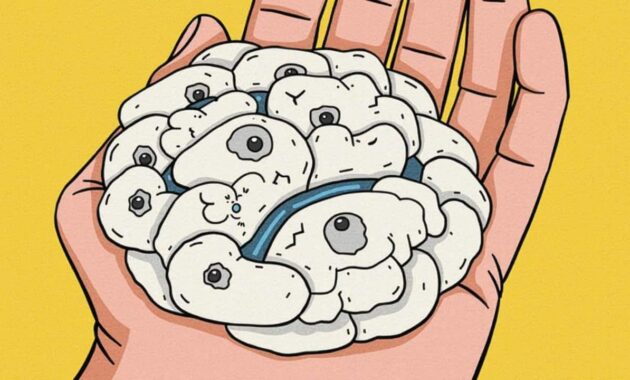
You’re in the shower and suddenly remember that email you sent three years ago with the terrible typo in the subject line.
You don’t remember the dozens of emails that went perfectly, the projects that landed, the quiet wins.
No, your brain goes straight back to the one thing you messed up, replaying it like a bad home movie on loop.
Water runs, day moves on, but that old mistake still has a front-row seat.
Why does it stay, when so many good moments fade into the background?
Why your brain clings to mistakes like Velcro
The short answer is: your brain is not built for happiness, it’s built for survival.
Successes are nice. Mistakes, on the other hand, could mean danger, rejection, or loss.
So your brain gives them priority treatment, like VIP guests at the nightclub of your memory.
This is called a “negativity bias”.
Bad experiences leave deeper grooves in your neural circuits than positive ones.
It’s not you being dramatic, it’s your nervous system doing quality control.
Think about your last performance review.
You might have heard ten kind, detailed compliments and one short, sharp criticism.
Walk out of the meeting, and what’s echoing in your head on the way home?
That one pointed remark about being “a bit slow to respond on urgent tasks”.
You can quote the exact sentence, the tone, the tiny pause before your manager said it.
The praise blurs, the criticism glows in neon.
Researchers at Washington University have shown that our brains light up more strongly in response to negative feedback than to positive.
The electrical activity is higher, the signal is stronger.
Your brain literally turns up the volume on what went wrong.
From an evolutionary angle, this wiring once kept us alive.
Remembering which berries made you sick or which path hid a predator mattered more than savoring a pretty sunset.
Forget the danger, and you might not get another chance to learn.
So the brain developed a kind of “error alarm system”.
When you fail, certain regions—like the anterior cingulate cortex—activate to flag the gap between what you expected and what happened.
That “ouch, I messed up” feeling is your internal software update.
The problem is, in a world of emails, presentations, and social media, that ancient system is still running.
The brain doesn’t distinguish between “I almost ate poison” and “I stumbled in a meeting”.
The same alarm, the same sticky memory, just a different jungle.
➡️ Preserved hair reveals just how bad lead exposure was in the 20th century
➡️ A new kitchen device is set to replace the microwave for good
➡️ Most people rush this daily moment without realizing how much it drains them
➡️ Pasta gratin: easy, indulgent recipes for every night of the week
➡️ This simple habit keeps everyday tools from wearing out
How to stop mistakes from becoming mental permanent markers
There’s a simple practice high-performing athletes use after a bad race: review, reframe, release.
You can borrow it, quietly, in your everyday life.
First, you sit with the mistake just long enough to ask: what actually happened, in concrete terms?
Not “I’m useless”, but “I missed a deadline by 24 hours because I underestimated the research time”.
Then, you name one tweak you’d try next time.
Finally, you consciously end the review: close the notebook, shut the laptop, walk away.
It sounds almost too basic, but this sequence gives your brain what it wants—learning—without letting the error squat in your mind rent-free.
Most of us do the opposite.
We replay the scene over and over, adding more drama each time, until the original mistake is buried under layers of self-criticism.
We turn a single failed presentation into a personal identity: “I always choke in public.”
*This is where the memory changes shape.*
Each replay strengthens the emotional charge while blurring the facts.
You’re no longer remembering the event, you’re remembering your latest version of the story.
Let’s be honest: nobody really does this every single day, even though therapists keep suggesting reflective journaling.
We rush, we scroll, we distract.
Then the brain, unsupervised, files “mistake” under “threat” and keeps it glowing in red.
The shift starts when you treat mistakes as data, not as a verdict on your worth.
One executive coach I spoke with told me she asks clients to give each mistake a “job description”: what is this error here to teach me, specifically?
“Your brain is like a risk manager that never clocks off,” says Dr. Elena Marsh, a neuropsychologist who studies memory and emotion.
“If you don’t give it a structured way to process errors, it will do the processing for you, and it usually chooses rumination over resolution.”
Then she suggests turning that into a tiny plan, no bigger than a sticky note.
To keep it tangible, many people like to use a simple list:
- Write down the mistake in one neutral sentence.
- Add one lesson: what would I tweak next time?
- Add one boundary: how long will I think about this today?
That small ritual tells your brain: we heard the alarm, we fixed the wiring, you can stop ringing now.
Living with a brain that remembers the bad more than the good
Once you know your brain is biased toward errors, daily life looks a little different.
You start to notice how quickly a small setback overshadows a whole day of quiet wins.
The one awkward comment at lunch weighs more than the three genuine laughs you shared.
Some people respond by trying to banish negative thoughts completely.
Others sink into them like quicksand.
Neither extreme plays well with the way memory actually works.
A gentler way is to build counterweight.
Not toxic positivity, just a habit of giving your successes slightly more airtime than feels natural.
Because your brain is already giving your mistakes a head start.
| Key point | Detail | Value for the reader |
|---|---|---|
| Negativity bias | The brain reacts more strongly to mistakes than to successes | Stops you from blaming yourself and shows it’s a shared human pattern |
| Review–reframe–release | Short, structured way to process errors as information | Helps prevent endless mental replays that drain energy |
| Balance the scales | Consciously give wins more attention to offset brain bias | Makes your memory landscape less hostile and more realistic |
FAQ:
- Why do I remember embarrassing moments from years ago so clearly?Your brain tags embarrassment as socially risky, so it files those memories with a bright “pay attention” label. The strong emotion cements the memory, even when the actual event was minor.
- Does this mean I’m a negative person?Not necessarily. The tendency to remember mistakes more than successes is wired into almost everyone. You might feel negative, but you’re mostly experiencing a standard brain feature turned up high.
- Can I train my brain to remember successes better?Yes, to a point. Briefly replaying wins at the end of the day, writing down small achievements, or telling someone about something that went well all strengthen positive memory traces.
- Why do I cringe at night about things no one else remembers?Other people don’t have the same emotional imprint of your mistake. For them, it was a passing detail; for you, it triggered that error alarm system, so your brain archived it more carefully.
- When does normal rumination become a problem?When thoughts about past mistakes disrupt sleep, concentration, or day-to-day functioning for weeks, or come with intense shame or anxiety, it can be worth talking to a mental health professional for support.