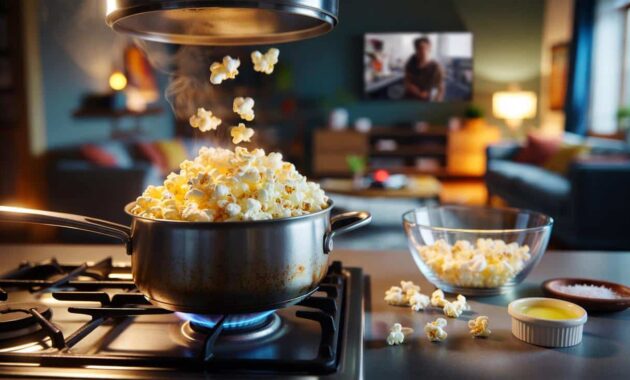
The first pop always comes as a tiny shock.
You’re standing over a pot, waiting in that awkward silence, wondering if you already ruined it, and then—crack. One little kernel slams the lid, then another, then dozens, a fast, happy rattle that smells like movie night and childhood and staying up too late.
Five minutes ago, you were scrolling your phone, hovering over a delivery app. Now you’re by the stove, shaking a pan like some low-key food magician, hoping you won’t burn the bottom or leave half the kernels stubbornly hard and tooth-breaking.
Some nights, that line between fluffy, cloud-light popcorn and a pot of smoky regret feels very thin.
There’s a shortcut across it.
The tiny kitchen science behind perfectly fluffy popcorn
Watch anybody making stovetop popcorn for the first time and you’ll see the same look.
Head tilted.
Lid half lifted.
Mild panic hovering, as if the pot might suddenly explode into flames or sadness.
Stovetop popcorn seems simple, yet those few minutes at high heat feel oddly intense.
You throw in oil, toss in kernels, and hope for the best.
Sometimes you nail it: big, soft clusters, almost no unpopped “old maids.”
Other times, you get burnt bits and a smoky kitchen that sets off the alarm while your neighbor wonders what on earth you’re doing at 10 p.m.
The margin between the two is smaller than we think.
Picture this: Tuesday night, cheap action movie lined up, streaming app buffering.
You grab a bag of microwave popcorn, then pause.
You remember the last time—the weird chemically buttered smell, the greasy film on your fingers, that one dark corner of the bag that always burns.
So you drag out the dented pot you’ve had for years, toss in a generous glug of oil, crank the heat all the way up, and wait.
Nothing happens.
You wait more, doubt creeping in, then suddenly it all goes haywire, loud pops, frantic steam, and when you pour it out, half the batch is scorched, the other half still rock-hard.
You didn’t do anything “wrong” exactly.
You just didn’t give the kernels what they secretly need: steady, controlled heat and a few simple moves.
Inside every popcorn kernel is a tiny pocket of water trapped in starch.
When it heats, that water turns to steam and pressure builds until the hull explodes, flipping the kernel inside out into that airy, crunchy bite.
The quick stovetop method works when you manage that pressure gently, not violently.
Dumping kernels into blazing-hot oil is the biggest trap.
The outside burns while the inside hasn’t had time to build enough steam to puff.
On the flip side, going too low and too slow dries things out, leaving you with stubborn unpopped kernels.
➡️ Neither swimming nor Pilates: The best activity for over 65s with joint problems
➡️ Why Do Crocodiles Not Eat Capybaras ?
➡️ Plant this fruit now for abundant spring harvests
➡️ This is the most effective way to stop condensation and mould on windows
The “secret” is something between those two extremes: brief high heat, then a quick drop, with a short pre-heating trick that feels too simple to matter.
But that’s where the magic hides.
The quick stovetop method that actually works
Here’s the move: start with just three kernels.
Set a medium pot on the stove, add 2–3 tablespoons of neutral oil (like canola, sunflower, or refined coconut), and drop in exactly three kernels.
Put the lid on, medium-high heat.
Then leave it alone.
Listen.
When the first kernel pops, then the second and third, kill the heat for 30 seconds.
This pause lets every kernel you’re about to add reach the perfect pre-heated temperature without burning the oil.
Pour in 1/3 cup of popcorn kernels, swirl the pot so they coat evenly, lid back on, then turn the heat to medium.
Now, gently shake the pot every few seconds as the popping ramps up.
When the pops slow to about 2–3 seconds between hits, pull the pot off the burner.
The most common heartbreak?
Leaving the pot on the stove “just a little longer” to get every last kernel.
That’s when your dreamy popcorn turns into a smoky, bitter mess.
We’ve all been there, that moment when a perfect batch goes wrong in the final 10 seconds.
Another quiet saboteur is the lid.
Trapping every bit of steam inside makes your popcorn tough and chewy.
So once it’s really going, slide the lid open a tiny crack or tilt it just enough for steam to escape, while keeping the kernels from jumping out like popcorn confetti.
And then there’s seasoning.
Salt in the pot with the oil seems logical, but coarse salt burns and falls to the bottom.
Season right after popping while the kernels are still hot and slightly oily, so everything clings.
Let’s be honest: nobody really measures that sprinkle every single day.
“The trick that changed everything for me was that 30-second rest off the heat,” says Lina, a home cook who now refuses to buy microwave bags. “Once I started treating popcorn like a tiny science project instead of a throwaway snack, my burn rate dropped to almost zero.”
- Use the three-kernel test
Those first three kernels tell you when the oil is properly hot, so you never guess blindly again. - Preheat, then pause
- That 30-second break off the heat evens out the temperature, which means fluffier, more consistent pops.
- Avoid crowded pots
- Stick to about 1/3 cup of kernels in a medium pot to prevent sogginess and uneven popping.
- Vent the steam
- Keep the lid slightly ajar once popping takes off to maintain crunch instead of rubbery texture.
- Season while hot
- Salt, melted butter, or spices cling best when the popcorn is just out of the pot and still glistening.
Why this tiny ritual hits different than a microwave bag
There’s something oddly grounding about standing over a stove, listening to a pot rattle and hiss while the rest of your evening waits in the other room.
It’s snack time, yes, but it’s also a small moment of presence in a day full of scrolling, swiping, and reheating leftovers.
You’re not outsourcing the job to a machine this time.
You’re watching for the first puff of steam, sensing when the popping is slowing, catching that exact beat when you pull the pot off the heat.
You season by feel.
A bit more salt.
Maybe smoked paprika.
Maybe just a square of good butter melted in the hot pan after you’ve emptied it.
And all that care shows up in the bowl: lighter kernels, deeper flavor, less plastic-tasting “butter aroma.”
Somehow, the whole evening feels slightly upgraded.
| Key point | Detail | Value for the reader |
|---|---|---|
| Three-kernel test | Heat oil with three kernels and wait for them to pop before adding the rest | Removes guesswork and prevents scorched oil and burnt popcorn |
| 30-second heat pause | Turn off heat after test pops, add full batch, then restart on medium | More even temperature, fewer unpopped kernels, fluffier texture |
| Steam venting and timing | Keep lid slightly ajar, remove pot when pops slow to 2–3 seconds apart | Crisper popcorn, less chewiness, almost no burnt pieces |
FAQ:
- Question 1What type of pot works best for this quick stovetop popcorn method?
- Answer 1A medium, heavy-bottomed pot with a lid is ideal. Thin pots heat unevenly and create hot spots that burn kernels, while a heavier base spreads heat more gently and consistently.
- Question 2Which oil should I use to get fluffy, not greasy, popcorn?
- Answer 2Use neutral oils with a high smoke point like canola, sunflower, grapeseed, or refined coconut oil. About 2–3 tablespoons per 1/3 cup of kernels is enough to coat without soaking.
- Question 3How do I avoid leaving lots of unpopped kernels at the bottom?
- Answer 3Rely on the three-kernel test, the 30-second pause off heat, and gentle shaking as the popping increases. This combination heats each kernel evenly so more of them reach the pressure needed to explode.
- Question 4Can I add butter directly to the pot while popping?
- Answer 4Better not. Butter burns too fast at popping temperature. Pop in oil, then melt butter separately or in the hot empty pot right after and drizzle it over the finished popcorn.
- Question 5Is this method actually faster than a microwave bag?
- Answer 5From cold stove to full bowl, this stovetop method usually takes about 4–5 minutes, which is nearly the same as most microwave bags but gives you more control over flavor, texture, and ingredients.