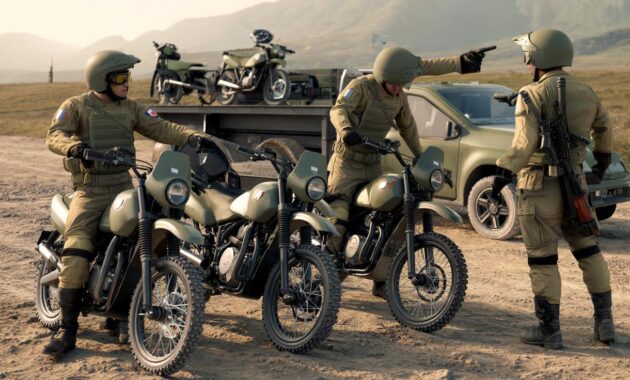
The French Army is planning a new wave of off-road motorbikes for its units, from engineering schools to special forces, in a multi-million-euro procurement that shows petrol engines still have a strong future alongside experimental electric bikes.
From silent electric trials to a return to petrol power
In late 2023, the French Army’s technical section tested the LMX 161, an electric off-road bike from French firm LMX Bikes. The machine offers roughly three hours of autonomy in “eco” mode and a nominal power of 3,100 watts, and was evaluated for missions such as discreet information relay, light logistics and infiltration.
Electric platforms like the LMX and another prototype called “Thundra” have been highlighted in army innovation days. Their near-silent operation and low thermal signature make them attractive for reconnaissance and infiltration, where sound and heat can easily give away a patrol.
The new procurement shows that, while electric bikes are advancing, the French Army is not ready to abandon combustion engines for demanding field use.
The latest tender, published by the French land equipment support structure (SIMMT), focuses squarely on conventional engines: rugged, road-legal, off-road motorbikes and the trailers needed to move them. Total value: close to €4.6 million.
What the French Army wants to buy
The call for competition covers an undisclosed number of “light, robust, militarised, two-wheeled, off-road-capable vehicles with combustion engines”, plus dedicated trailers. The bikes are split into three displacement ranges, assigned to different regions and units, reflecting distinct operational roles.
Lot 1: 125cc bikes for schools and mountain troops
The largest slice of the budget, roughly €2.3 million, is earmarked for 125cc motorbikes. These bikes must be militarised and certified for road use. They will serve units located mainly in the Maine-et-Loire and Isère departments, including:
- 6th Engineer Regiment
- Engineer School
- 2nd Dragoon Regiment
- Military Schools of Saumur
- 27th Mountain Infantry Brigade (based in Isère)
Looking at market prices for robust 125cc trail bikes, that budget suggests a purchase in the range of roughly 200 to 230 machines. These lighter bikes suit training, basic mobility and teaching off-road riding skills to young soldiers.
For the Army, 125cc trail bikes are a gateway tool: cheap to run, manageable for beginners, yet capable on rough ground.
➡️ Eight Dobbies stores to shut : is your local on the list and what about £50 gift cards ?
➡️ Start stop in cars a clever fuel saving innovation or an annoying gimmick that drivers love to hate
➡️ What if cutting calories did not make you lose weight science might be wrong about dieting
Lot 2: 245–280cc machines for commandos and high-readiness units
The second lot sets aside about €827,000 for higher-displacement motorbikes between 245cc and 280cc. Delivery locations point to elite units in the Pyrénées-Orientales and Gironde regions, likely including:
- National Commando Training Centre (CNEC – 1st Shock Regiment heritage)
- 13th Parachute Dragoon Regiment (13e RDP), France’s strategic reconnaissance unit
- 712th Signals Company
The 13e RDP already uses Yamaha WR250R motorbikes, a proven platform for long-range patrols and covert insertions. New 245–280cc machines would fit a similar profile: enough power to carry a fully equipped soldier and gear across difficult ground, while remaining light enough to manhandle, lift or load into a helicopter.
Lot 3: 300–380cc for special forces and high-risk theatres
The third lot, worth about €857,000, covers motorbikes in the 300–380cc range. These will be supplied to units based in the Pyrénées-Atlantiques, where several high-end formations operate:
- Army Special Operations Command (CAST)
- 1st Marine Infantry Parachute Regiment (1er RPIMa)
- 4th Special Forces Helicopter Regiment
- Special forces command and signals company
These units handle some of France’s most sensitive missions, from hostage rescues to deep reconnaissance. In such scenarios, a powerful enduro-style bike gives speed, range and the ability to escape or shift routes quickly if a mission goes wrong.
| Lot | Engine size | Estimated budget | Likely users |
|---|---|---|---|
| 1 | 125cc | €2.3m | Engineers, schools, mountain troops |
| 2 | 245–280cc | €827k | Commandos, reconnaissance, signals |
| 3 | 300–380cc | €857k | Special forces and supporting units |
| 4 | Trailers | €568k | Transport of bikes |
Lot 4: trailers to move the fleet
The final lot dedicates about €568,000 to flatbed trailers capable of transporting these bikes on public roads. That detail matters: troops rarely ride motorbikes over long distances to reach training areas or deployment hubs. Instead, bikes are loaded on trailers, moved behind tactical trucks or utility vehicles, and unloaded close to the action.
Trailers are a quiet but crucial part of the deal, making the bikes deployable quickly across France or overseas.
Why petrol still dominates for combat use
Electric bikes draw attention for their stealth. They are easier to hide acoustically, and they avoid tell-tale exhaust fumes. Yet the French tender highlights why armies still rely heavily on combustion engines for most missions.
First, range and refuelling remain more straightforward with petrol. A jerrycan can be flown in by helicopter or carried on a vehicle, and the bike can be back in action within minutes. Batteries require charging infrastructure and time, which is harder to guarantee in remote or contested areas.
Second, maintenance skills and spare parts for combustion engines are already widespread in the French military. Mechanics know these systems well, and there is an existing supply chain for filters, oils and engine components.
Third, temperatures in high mountains, deserts or overseas deployments can push current electric batteries to their limits. Petrol engines are not perfect, but their behaviour in such conditions is well understood.
How soldiers actually use off-road motorbikes
In practice, military motorbikes are far more than a cool accessory. They form part of a broader mobility toolkit that includes 4x4s, armoured vehicles, quads and helicopters. Each has its own niche.
Common military uses for off-road motorbikes include:
- Route reconnaissance ahead of larger convoys
- Messenger roles when radio networks are disrupted or jammed
- Guiding columns through complex terrain or urban sprawl
- Training soldiers in navigation, balance and terrain reading
- Special forces raids or infiltration, where a small signature is required
French experience in places such as the Sahel has shown that narrow dirt tracks, wadis and forest paths can be more reliable than roads, which are vulnerable to ambushes and improvised explosive devices. Light bikes can bypass such risks, or at least scout ahead for threats.
Key terms and what they actually mean
Several units mentioned in the tender can sound cryptic to outsiders. A few quick definitions help clarify who might ride these new machines:
- Commando Training Centre (CNEC): Trains French and allied troops in advanced commando skills, including mountain and amphibious operations.
- 13e RDP: A long-range reconnaissance regiment, often working well ahead of main forces, gathering intelligence deep inside hostile territory.
- 1er RPIMa: A flagship French Army special forces unit, broadly equivalent to a Tier 1 special operations regiment.
- CAST: The land component of France’s special operations command, coordinating army special operations units.
For these units, motorbikes are not recreational. They are treated like any other weapon system: with dedicated training, maintenance, and strict rules for use in operations.
What could change by 2026
The deadline for companies to submit applications or requests to participate is set for 17 March 2026. That extended timeline leaves space for industry to adjust offers and for the French Army to fine-tune requirements as electric and hybrid technologies progress.
One plausible scenario is a mixed fleet. Petrol bikes could handle demanding overseas operations and heavy-duty training, while electric models remain focused on specific missions that need stealth and low signatures. Over time, if batteries improve and fast-charging options spread, the balance could shift.
There are also safety and risk angles. Off-road motorbikes can produce serious injuries if training is rushed or protective gear is neglected. Modern militaries increasingly combine riding schools, strict licensing procedures and advanced protective equipment to reduce accidents. For special forces, advanced riding skills become almost as central as parachuting or close-quarters combat.
As France modernises its land forces, this procurement of 125–380cc off-road bikes might look modest next to tanks or drones. But for the soldiers who navigate mountain tracks, narrow rural paths or hostile suburbs, a reliable motorbike can be the difference between a stalled patrol and a successful mission.