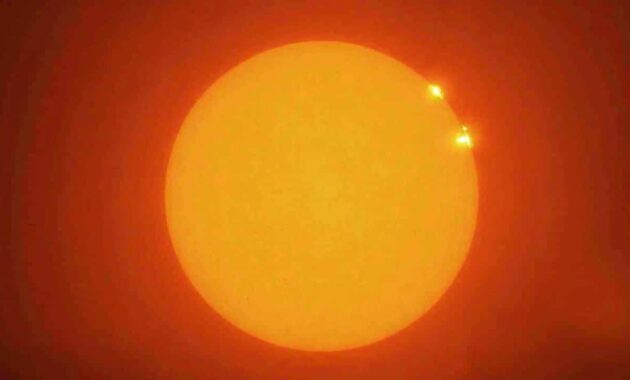
Temperatures, politics and the Sun itself are all running hot, even as some claim our star is about to cool dramatically.
Headlines warn of a looming “mini ice age” as the Sun slips into a quiet phase with few visible spots, while climate scientists insist the bigger danger still comes from greenhouse gases. Caught in the crossfire, the public is left wondering who to trust: those sounding the alarm, or those calling the whole thing hype.
What a solar minimum actually is
The Sun runs on a roughly 11-year cycle, swinging from busy, spot-speckled years to calmer periods with a blank-looking surface. The calm phase is known as a solar minimum.
During solar minimum, the number of sunspots falls sharply. These dark patches are regions of intense magnetic activity. Their decline signals a quieter magnetic Sun, with fewer solar flares and weaker outbursts of charged particles.
Solar minimum does not mean the Sun “switches off”, but that its magnetic activity dips to a low ebb in its normal cycle.
Historically minded commentators point to the so‑called Maunder Minimum, a prolonged period of low sunspot activity in the 17th century that lined up with some of the coldest decades of the “Little Ice Age” in Europe. That association has become the backbone of today’s “mini ice age” headlines.
Where the ‘mini ice age’ panic comes from
Several recent studies have suggested the Sun could be heading into an unusually weak cycle, possibly something resembling a “grand solar minimum”. That phrase sounds dramatic, and some outlets have jumped straight to “mini ice age”.
At the same time, charts of sunspot counts do show quieter years compared with especially active decades in the late 20th century. This has fed blogs and social media posts proclaiming that global warming will soon reverse itself thanks to a sleepy Sun.
The leap from “weaker solar cycle” to “Europe freezing over and Thames iced solid” rests on very shaky ground.
Serious solar physicists do consider the possibility of a grand minimum. Yet most stress that any cooling effect would be modest compared with what greenhouse gases are already doing to the climate.
➡️ Grey hair after 50: “silver gloss” is the ideal colour to enhance it
➡️ Grey hair: the haircut that makes your face look younger
➡️ Furniture marks on the carpet: this freezer trick leaves everything looking new in 10 minutes
➡️ Swinging bob: the perfect cut for damaged fine hair
➡️ After years of mistakes, genetic analysis finally reveals the true story of the Beachy Head Woman
➡️ Salt and pepper hair: “reverse colouring” is the best technique to avoid a granny look
➡️ Hairstyles after 70: the best haircut to look younger
What climate scientists actually say
Groups such as NASA, the UK Met Office and multiple university teams have modelled what a strong drop in solar activity would do to Earth’s climate this century. They typically simulate a Sun that dims about as much as it did during the Maunder Minimum.
The result: a cooling effect, but not a radical one, and not enough to offset human-driven warming.
Peer‑reviewed estimates suggest a future grand solar minimum might trim global temperatures by around 0.1–0.3°C at most.
By contrast, current climate policies still put the planet on track for warming far above that. So a weaker Sun slightly slows the rate of warming rather than reversing it.
How solar and human influences compare
| Influence | Main driver | Estimated global effect this century |
|---|---|---|
| Solar minimum / possible grand minimum | Natural change in solar output | Cooling of roughly 0.1–0.3°C |
| Human greenhouse gas emissions | CO₂, methane, nitrous oxide, etc. | Warming of around 1.5–3°C or more, depending on emissions |
The comparison shows why most climate researchers keep talking about emissions, not sunspots.
Alarmists versus skeptics: who is overselling what?
The clash is not only about data. It is also about storylines that grab attention.
On one side, some commentators highlight worst-case warming scenarios in stark, almost apocalyptic language. On the other, certain skeptics amplify any sign of natural cooling as a get‑out‑of‑jail‑free card for fossil fuels.
The fight between “climate alarmists” and “solar saviour” skeptics risks hiding a more nuanced reality: both forces matter, but not equally.
Media outlets chasing clicks can worsen the confusion. A nuanced paper on solar variability becomes an article titled “Scientists predict mini ice age by 2030”. A cautious climate report turns into “Last chance to save civilisation”.
Readers end up toggling between panic and fatigue, with little room left for calm interpretation.
What a quieter Sun really changes
A weaker solar cycle affects more than just temperature charts. It also nudges space weather and Earth’s upper atmosphere.
- Fewer solar storms usually mean less risk to satellites and power grids.
- Reduced ultraviolet radiation can slightly contract Earth’s upper atmosphere, affecting satellite drag.
- Changes in solar wind influence the flow of cosmic rays reaching Earth, which may impact aviation radiation exposure and high-altitude electronics.
These shifts matter for space agencies, airlines and telecom operators that track solar conditions closely. They tend to be far less dramatic for everyday weather at ground level.
Regional cold snaps versus global trends
Cold winters still happen, even in a warming climate. When they strike, they are often cited as “proof” that solar cooling is already biting or that climate change is exaggerated.
Climate scientists draw a line between regional, short-term weather and long-term, planet-wide averages. A blocking high-pressure system over Europe, or a wobble in the polar jet stream, can bring brutal cold to one region while the global mean temperature remains above the 20th-century norm.
Single winters do not settle the argument about global warming or solar-driven cooling; long-term global data does.
What current models suggest for the coming decades
Climate models that include both greenhouse gases and realistic solar cycles show a clear pattern. Even with a strong solar minimum, the upward push from CO₂ dominates.
In one common scenario used in research, a grand solar minimum starting mid-century delays a given warming threshold by only a few years. It does not cancel it. That means coastal flooding, heavier downpours and heatwaves still intensify, just slightly more slowly than they would otherwise.
Some scientists view this as a narrow silver lining. A small cooling nudge buys a sliver of extra time to cut emissions and adapt infrastructure. It is not a substitute for action.
Key terms worth unpacking
Three phrases tend to cause the most confusion in this debate.
- Solar minimum: The quiet phase in the regular 11‑year solar cycle, with fewer sunspots and weaker magnetic activity.
- Grand solar minimum: A rarer, longer-lasting slump in solar activity, similar to the Maunder Minimum in the 1600s.
- Radiative forcing: The net energy imbalance at the top of Earth’s atmosphere, caused by changes such as extra CO₂ or shifts in solar output.
Once these are separated clearly, the discussion becomes less about camp loyalty and more about comparing magnitudes. A small negative forcing from the Sun can partly counter a larger positive forcing from greenhouse gases, but cannot fully erase it.
Practical scenarios for readers and policymakers
Thinking in scenarios helps cut through the noise. Imagine three broad futures for the next 40–50 years:
- A normal solar cycle and high emissions: Warming accelerates, with more record heat and growing pressure on water, food and health systems.
- A grand solar minimum and high emissions: Warming still occurs, just a bit slower, leaving many climate impacts intact.
- A grand solar minimum and strong emission cuts: Warming stabilises at lower levels, with solar cooling acting as a small bonus, not the main solution.
Only the last scenario offers a realistic path to limiting disruption. The Sun’s behaviour may nudge the curve, but policies on energy, land use and transport shape the main trajectory.
For individuals, the solar minimum debate also highlights how easily complex science can be spun. Checking whether a dramatic climate or solar claim comes from a peer‑reviewed study, a press release, or a blog post makes a real difference. In an era where sunspots and carbon budgets alike trend on social feeds, a bit of skepticism toward both “we’re doomed” and “the Sun will fix it” narratives goes a long way.