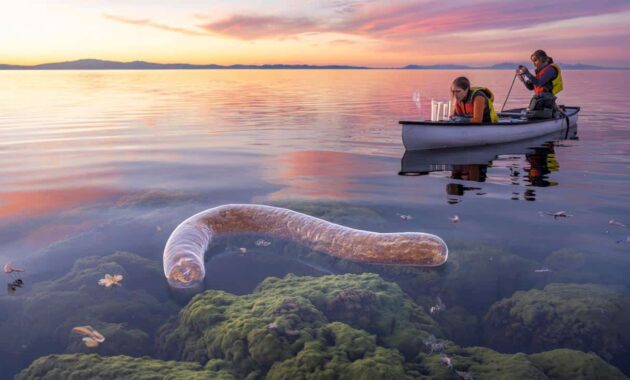
Researchers surveying the Great Salt Lake’s shallow floor have identified a microscopic animal that no one had confirmed there before, adding a surprising new player to one of North America’s most threatened ecosystems.
A tiny worm with a big scientific impact
The animal is a nematode, or roundworm, newly named Diplolaimelloides woaabi. It lives in the lake’s microbialites – rock-like mounds built by layers of microbes on the lakebed. Until now, scientists believed only two types of complex animals managed to survive in the Great Salt Lake’s salty water: brine shrimp and brine flies.
For the first time, nematodes have joined brine shrimp and brine flies as permanent residents of the Great Salt Lake.
Biologists from the University of Utah spent three years confirming that the tiny worm represented a species new to science. The work involved repeated sampling by kayak and bike, careful microscopy, and genetic analysis.
The team chose the name “woaabi” in partnership with the Northwestern Band of the Shoshone Nation. Tribal elders suggested the Indigenous term “Wo’aabi”, meaning “worm”, acknowledging that the lake lies within their ancestral homelands.
How scientists finally spotted it
Nematodes are famously easy to overlook. Most are shorter than a millimetre and nearly transparent. They slip between grains of sand, films of algae and layers of mud. Researchers had looked for them in the Great Salt Lake before, but without success.
That changed in 2022, when postdoctoral researcher Julie Jung collected samples from microbialites at various sites around the lake. Under the microscope, wriggling shapes appeared among the algal mats coating the rocky structures. Follow-up surveys confirmed the worms were not a one-off find: they were living there in substantial numbers.
Genetic and anatomical work placed the animal in the family Monhysteridae, a group adapted to harsh, salty environments. More specifically, it belongs to the genus Diplolaimelloides, whose members usually inhabit brackish and coastal marine habitats.
This is only the second known species of its genus that lives away from the coast, and the first ever recorded in the Great Salt Lake.
➡️ China Unearths 2,200-Year-Old Imperial Road That Challenges Our Modern Highways
➡️ Heating: why the 19°C rule is outdated and what experts now recommend
Why this species matters for the Great Salt Lake
Finding a new species in a well-studied ecosystem always matters, but in this case the stakes are higher. Nematodes are among the most abundant animals on Earth, often dominating food webs in soil and sediments.
They feed on bacteria, algae and fungi, and in turn become prey for larger invertebrates. Even though each worm is microscopic, their combined activity can shape nutrient cycles and energy flow.
In the Great Salt Lake, D. woaabi appears tightly linked to microbialites. The worms live only in the top few centimetres of the algal mats blanketing these structures. Below that shallow layer, researchers could not find them.
- Habitat: top layer of microbialite algal mats
- Food source: bacteria growing on those mats
- Environment: highly saline, changing lake conditions
- Neighbours: brine shrimp, brine flies, diverse microbes
Because microbialites are central to producing the lake’s biological productivity, any organism that feeds on them or helps recycle their nutrients can influence the entire system. That includes the millions of migratory birds that depend on brine shrimp and brine flies as refuelling stops.
A living warning signal
Nematodes are widely used as “bioindicators” – species whose presence, abundance or behaviour signals shifts in environmental conditions. Different nematode communities respond in quite specific ways to changes in salinity, oxygen levels, pollution and sediment chemistry.
The new nematode may function as an early warning system for the health of the Great Salt Lake.
The lake has been shrinking due to water diversion and drought. As water volume drops, salt concentration rises, putting pressure on brine shrimp, brine flies and microorganisms. A species that is both sensitive and relatively easy to monitor offers scientists a powerful monitoring tool.
Tracking D. woaabi populations over time could show when conditions shift past critical thresholds long before iconic wildlife begins to crash.
How did a marine-style worm end up in a desert lake?
One of the biggest puzzles is how a nematode usually tied to coastal environments ended up in a landlocked basin more than 800 miles from the nearest seashore and about 4,200 feet higher in elevation.
Researchers have two leading hypotheses, both unusual in their own way.
| Hypothesis | Core idea | Main challenge |
|---|---|---|
| Ancient resident | Descended from marine nematodes living along a Cretaceous seaway that once covered the region. | Would have had to survive dramatic shifts from seas to freshwater Lake Bonneville to today’s salty lake. |
| Long-distance hitchhiker | Carried in mud or feathers of migratory birds moving between saline lakes on different continents. | Requires successful transport, survival and establishment far from any coast. |
During the Cretaceous Period, a shallow inland sea split North America, with what is now Utah forming part of its shoreline. Streams pouring into that seaway could have supported ancestors of D. woaabi. As tectonic forces raised the Colorado Plateau and the inland sea retreated, isolated pockets of organisms would have been left behind in forming basins.
Later, between roughly 20,000 and 30,000 years ago, Lake Bonneville – a vast freshwater lake – covered the region. For D. woaabi to have persisted since ancient times, it would have endured repeated swings between fresh and salty conditions, adapting across geological eras.
The competing scenario is more modern and airborne. Migratory birds that shuttle between hemispheres often visit saline lakes in South America as well as Great Salt Lake. Tiny organisms can become lodged in their plumage or stuck to muddy feet. If even a few nematodes survived the trip and landed in a suitable microhabitat, they might have founded a new population.
A baffling sex ratio in the lake
Another puzzle lies at the microscopic scale. When researchers examine worms collected directly from the lake, almost all of them are female. Males make up less than one per cent of wild samples.
Yet in laboratory cultures, once the worms are settled in controlled conditions, the sex ratio evens out: males account for about half the population, as might be expected in a typical sexually reproducing species.
Something about the lake environment is pushing males out of view – or changing how and when they appear.
The team suspects that environmental stress, chemical conditions or specific microbial partners could influence either the survival of males or the timing of reproduction. Another possibility is that the worms switch reproductive strategies depending on how tough conditions become, for instance relying more on self-fertilising females during challenging periods.
Why nematodes matter beyond this single lake
Nematodes often get attention only when they damage crops or infect humans and animals. Yet most species are free-living and play vital roles in ecosystems. They control bacterial populations, break down organic matter and link microscopic life with larger animals.
In soils worldwide, nematodes shape plant health by regulating microbial communities around roots. In oceans, they dominate the seafloor fauna, influencing how carbon and nutrients move through sediments.
Finding a specialized nematode clinging to life in the Great Salt Lake underlines how adaptable these animals are, and how incomplete our catalog of life remains, even in a lake that sits next to a major city.
Key terms readers keep hearing about this lake
Two terms in the research are especially useful to understand:
- Microbialites – Solid, often knobbly structures built over time by layers of microbes, largely bacteria and algae. They trap minerals, forming hard mounds that act like underwater “reefs” in the lake, providing habitat and producing much of its biological energy.
- Bioindicator – A species or group of organisms used to gauge the condition of an environment. Changes in their numbers or behaviour can hint at pollution, rising salinity or oxygen loss before those problems are obvious to casual observers.
For people living around the Great Salt Lake, these scientific details have very practical implications. If falling water levels lead to higher salinity and collapsing microbialites, nematodes, brine shrimp and brine flies could all decline. That, in turn, would mean fewer food resources for birds and a greater risk of dust storms picking up dried lakebed sediments.
Regularly sampling nematodes from different parts of the lake could slot into wider monitoring efforts that also track water diversion, inflows from rivers and climate trends. A shift in the tiny worms’ distribution might offer an early clue that a particular bay, marina or marsh is nearing a tipping point, giving land managers a chance to adjust water use or restoration plans before the damage becomes severe.
The Great Salt Lake’s newest resident is not charismatic, colourful or big enough to spot with the naked eye. Yet that small, twisting thread of life carries new questions about deep time, migration and resilience – and may help chart the future of a lake on the edge.