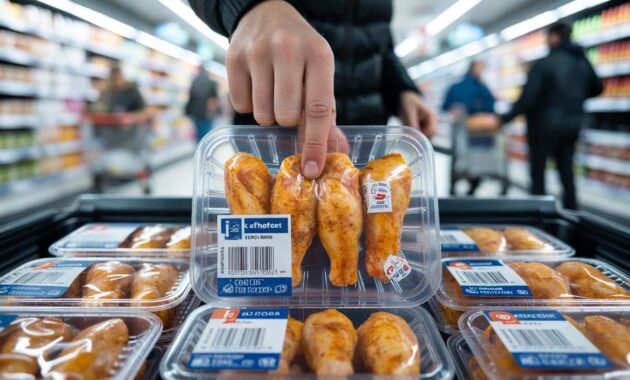
The French government’s recall platform has flagged several batches of seasoned chicken pieces sold nationwide, warning that some packs may carry the dangerous Listeria bacterium and should not be eaten.
What’s happening with chicken recalls in France?
French authorities have launched a nationwide recall of “grignottes” – bite-sized cooked chicken pieces – sold in major chains including Leclerc, Carrefour, Auchan and Système U. The products are suspected of being contaminated with Listeria monocytogenes, the bacterium that causes listeriosis.
Consumers are being told to stop eating the affected chicken immediately and return it to stores for a refund.
The alert comes via Rappel Conso, the official French government site that lists unsafe food and consumer products. While the products targeted are sold in France, the case underlines a recurring food-safety issue that resonates far beyond the country’s borders: how quickly bacteria such as Listeria can slip into everyday foods and reach supermarket shelves.
Which chicken products are affected?
The recall centres on chicken grignottes – small, ready-to-eat pieces, often eaten as snacks or used in salads and wraps. Several flavoured ranges from a well-known brand, along with a plain version under a different label, are involved.
Le Gaulois chicken grignottes pulled from shelves
Three seasoned grignotte ranges from the brand Le Gaulois are subject to the recall:
- “Intense spicy curry” chicken grignottes
- “Saveur Japanese Teriyaki” chicken grignottes
- “Indienne” (Indian-style) chicken grignottes
According to the recall notice, these products:
- Were sold between 24 January 2026 and 30 January 2026
- Carry GTIN codes: 3266980025724, 3266980025755, 3266980239886
- Have a use-by date of 14 February 2026
- Share the same batch number: 023/023
All affected Le Gaulois packs share batch code 023/023 and a mid-February 2026 use-by date.
These packs have been distributed widely across France through large supermarket chains, raising the possibility that many households may already have them in their fridges.
➡️ Unlocking Hidden Tech Talent Through Fellowship Based Pathways
➡️ Neither undercooked nor dry: an 11‑Michelin‑star chef’s trick for fast, ultra‑crispy baked potatoes
➡️ Cleaning experts say you should always wash your baseboards first, and the reason makes total sense
➡️ Ukraine wants 20-year US security guarantee to sign peace deal
➡️ No vinegar or baking soda: plumber reveals trick for clearing blocked drains
Belle France plain chicken also recalled
The recall also targets a plain, unflavoured chicken grignotte product sold under the Belle France brand and distributed by Francap. While it lacks the bold marinades of the Le Gaulois range, the risk is the same: potential Listeria contamination.
This Belle France product:
- Was sold between 26 January 2026 and 30 January 2026
- Has GTIN code: 3258561470528
- Shares the same batch number: 023/023
Consumers are being advised not to rely purely on brand recognition but to check batch numbers and dates carefully.
What should consumers do right now?
If you live in France or have recently travelled there and brought back food, the first step is very simple: check your fridge. Look at the brand, flavour, GTIN code, use-by date and batch number on any chicken grignottes you may have purchased over late January.
If your pack matches the GTIN, dates and batch code listed in the recall, do not eat it – even if it looks and smells normal.
Authorities advise consumers to:
- Stop eating the product immediately if it matches the recall details
- Keep the packaging so you can read the GTIN and batch number
- Return it to the store where it was purchased for a refund, available until 2 March 2026
- Monitor for symptoms if you have already consumed the product
Cooking or reheating does not fully erase the concern once a recall has been issued, because authorities cannot guarantee how the bacteria may have multiplied or whether handling has spread contamination.
Listeria: why this bacterium worries health authorities
Listeria monocytogenes is not a new threat, but it remains one of the most feared bacterial contaminants in chilled, ready-to-eat foods. It can grow at refrigerator temperatures, which makes it particularly difficult to control in products like sliced meats, soft cheeses and prepared chicken.
| Aspect | Details |
|---|---|
| Type of infection | Foodborne bacterial illness (listeriosis) |
| Main route | Eating contaminated food, especially chilled, ready-to-eat items |
| Key symptoms | Fever, headache, muscle aches, digestive issues |
| Incubation period | Up to eight weeks after consuming contaminated food |
| High-risk groups | Pregnant women, elderly people, those with weakened immune systems |
Because Listeria can take up to eight weeks to cause symptoms, people may not immediately link a fever or aches to something they ate days or weeks earlier. This long incubation period is one reason public health bodies keep stressing recall notices.
Symptoms to watch for after eating recalled chicken
French authorities are particularly keen for anyone who has eaten the recalled products to monitor their health. Symptoms can be quite general at first, which makes them easy to dismiss.
A persistent or intense fever, strong headaches and marked muscle aches after eating recalled chicken should prompt a medical consultation.
Health officials highlight several red flags:
- Intense or persistent fever
- Strong headaches that do not ease with simple painkillers
- Muscle aches and general body pain
- Sometimes digestive problems, such as nausea or diarrhoea
Anyone who has consumed the affected chicken and experiences these symptoms is advised to contact their GP or local doctor and mention the recall. This helps clinicians assess whether further tests or treatment are needed.
Pregnant women and vulnerable people face higher risk
Listeriosis can be especially dangerous for certain groups, and French authorities are putting particular emphasis on pregnant women. Even if the mother has only mild or flu-like symptoms, the infection can lead to serious complications for the fetus, including miscarriage, premature birth or severe neonatal infection.
Also at higher risk are:
- Older adults
- People living with cancer, diabetes or chronic kidney disease
- Those on immunosuppressive treatments, such as chemotherapy or high-dose steroids
For these groups, an apparently simple foodborne illness can escalate into severe neurological complications, such as meningitis or sepsis.
Why chicken snacks are regularly in the spotlight
Chicken-based products have featured in several recent recalls in France, including rotisserie chickens sold at major chains. Ready-to-eat chicken is convenient, but it sits at the crossroads of three risk factors: meat that can harbour bacteria, processing that involves multiple handling steps, and chilled storage where Listeria can still multiply.
Grignottes and similar snacks are often eaten cold and straight from the packet, without any further cooking at home. That means any bacteria present in the pack go directly to the consumer. If hygiene slips at any point in the production chain, the margin for error is small.
How to reduce your own risk with chilled ready-to-eat foods
This French recall offers a useful reminder for shoppers everywhere. While regulation and testing catch many problems, no system is perfect. A few habits can noticeably cut everyday risk:
- Keep your fridge at or below 4°C (39°F) and check it with a thermometer once in a while
- Eat chilled ready-to-eat products before the use-by date, not just “when they still look fine”
- Avoid leaving such foods at room temperature for long periods, especially during picnics or parties
- Pay extra attention if you are pregnant, elderly or have a weakened immune system; you may want to limit high-risk items such as soft cheeses and pre-packed deli meats
For families, one practical scenario often arises: a pack of chicken snacks opened on a Friday, then forgotten at the back of the fridge until the following week. Even if there is no recall, food-safety agencies advise binning anything that has been open for several days and looks or smells even slightly off. The cost of replacing it is low compared with the potential health impact.
Another point worth understanding is the difference between “use-by” and “best-before” dates. For high-risk chilled products like ready-to-eat chicken, the use-by date is a safety marker, not just a quality suggestion. Eating such foods after that date carries a concrete risk that bacteria such as Listeria may have reached harmful levels, even if the product still appears normal.