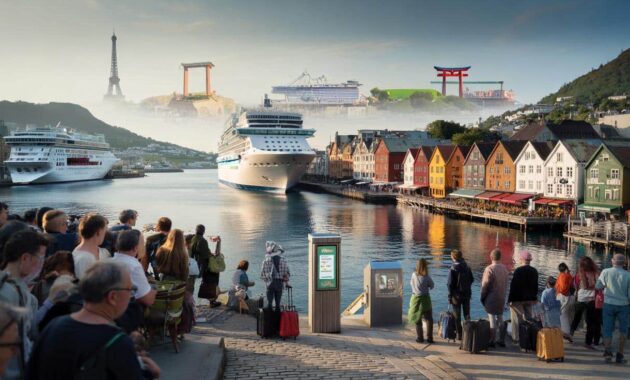
Giant floating hotels, stacked like white apartment blocks, nudging right up against wooden warehouses that have survived for centuries. On the cobbles, a guide lifts a bright yellow umbrella to gather her group. Behind them, a handwritten sign appears in a café window: “Locals before 10 a.m., tourists after.”
Over the past few years, that kind of sign has become a quiet rebellion in travel hotspots around the world. From Venice to Vancouver, residents are tired, city budgets are stretched, and yet visitor numbers keep climbing. Now Norway is getting ready to do what an increasing list of destinations have already done: charge visitors a new tourist tax.
The goal? Slow the crush, save the scenery, and still keep you coming.
Norway Joins the New Era of Tourist Taxes
Norway is lining up to join a growing club: the United States, Canada, Mexico, Italy, France, Spain, Japan, Iceland and others are all rolling out fresh layers of visitor fees. Some already exist as hotel taxes you barely notice on your bill. Others show up as “sustainable tourism contributions”, transit levies or new arrival charges.
Norway’s debate is crystal clear: those postcard-perfect fjords and dramatic hiking trails are being loved a little too hard.
Norwegian officials are looking at a mix of per-night hotel taxes and possible cruise passenger fees. Local councils from Lofoten to Flåm argue they need money to manage trails, toilets, waste and transport that tourists use every day but don’t pay local taxes for. The idea is simple: visitors help fund the experience they enjoy, instead of leaving residents to pick up the full bill.
This isn’t happening in a vacuum. In Canada, cities like Vancouver and Toronto already lean on hotel taxes that support convention centers and marketing campaigns. Mexico’s Quintana Roo state (home to Cancún and Tulum) charges its VISITAX fee per visitor. Japan’s “sayonara tax” adds a small cost when you fly out of the country. France and Spain routinely add nightly “taxe de séjour” or tourist stay taxes to hotel bills, money that helps fund tourism infrastructure.
Even Iceland, which has seen its population dwarfed by arriving tourists year after year, is reintroducing tourist taxes to protect fragile nature. You see the same pattern from U.S. cities like New York—where hotel taxes help pay for services—to Italian regions fed up with crowds. Venice has gone further, testing an entry fee for day-trippers. The message is spreading: travel is welcome, but not free for the host community.
Behind the politics, there is a blunt financial reality. Overtourism creates real costs: worn-out roads, emergency services for stranded hikers, garbage collection from scenic viewpoints, extra public transport at peak times. Someone pays. If it’s only locals, resentment builds fast. If visitors contribute, there’s more room to invest in better paths, cleaner public toilets, even quieter neighborhoods.
That’s the pitch leaders are now making to voters and travelers alike. And it’s catching on.
➡️ Oprah and Iyanla Vanzant on Daily Care for Your Spiritual Hygiene
➡️ Over 60 and waking up tired? This nighttime detail is often overlooked
➡️ It looks like cheesy pasta but hides a surprising green heart, lunch ready in 5 minutes guaranteed
➡️ Psychology reveals why emotional needs can be felt before they are understood
➡️ For irresistibly soft pasta, chefs always add this ingredient to the cooking water
What These New Tourist Taxes Mean For Your Trip
On the traveler side of the counter, these measures don’t need to be dramatic. The first thing to do, especially if you’re eyeing Norway or any of those now-taxed destinations, is to build a “tourist tax buffer” into your budget. Nothing fancy. Just add a small percentage—say 5–10%—on top of what you expect to pay for accommodation and local transport.
It takes the sting out of those extra lines at the bottom of your bill.
Many of these taxes are small per night, but across a two-week trip with family, they can add up. On a short stay in Paris or Barcelona, you might barely notice the city tax on your hotel invoice. On a cruise docking in Norwegian or Mexican ports, the charges might be baked into your ticket. Ask your hotel or host directly before you travel. Being upfront about it mentally and financially turns a potential annoyance into a known cost of seeing the world.
Where most travelers get caught out is not the amount, but the surprise. You land in a dream destination and then discover there’s a local environmental fee you have to pay in cash on arrival. Or a daily tax that your vacation rental didn’t clearly list. We’ve all been there, that moment when you open a bill, blink twice, and instantly feel your mood drop.
To avoid that, look for key phrases when you book: “occupancy tax”, “city tax”, “tourist tax”, “environmental fee”, “sustainability contribution”, “departure tax”. If you’re going to Norway, Iceland, or the more crowded corners of Italy, Spain or Japan, treat those lines as almost guaranteed. Let’s be honest: nobody really reads the full tax breakdown every single time.
But a quick scan, or a short email to your hotel, can save you arguments at check-out and grumbling in the taxi back to the airport.
There’s another layer beyond money. Tourist taxes are often used to push travelers toward better behaviour. Some cities tie extra revenue to public transit improvements or limit access to the most fragile spots. That’s why you might see timed-entry trails in Norway, caps on cruise ships in popular fjords, or new reservation systems in U.S. national parks. *The tax is only one tool in a bigger reset of how we move through these places.*
If you understand that part, the fee starts to feel less like a fine and more like a ticket to a cleaner, calmer experience.
That mental shift matters.
How To Travel Smart in the Age of Tourist Taxes
There’s a simple travel move that works surprisingly well in this new world: start your planning with the local perspective. Before you book Norway, France, Spain, Japan, Mexico or anywhere on that “new tax” list, search for the city’s official tourism site or municipal page and read their section on visitor rules. Many now explain the exact tourist taxes, where the money goes, and any seasonal caps or restrictions.
This takes five or ten minutes and can shape your whole stay.
You might discover that traveling in shoulder season cuts your nightly tax. Or that staying on the outskirts of a crowded historic center reduces costs and pressure on locals. You might find local passes that bundle transport, attractions, and taxes into one card. Some destinations, like certain regions in Italy or France, are experimenting with giving benefits or discounts for longer stays, nudging you away from day-tripping and toward slower, deeper travel.
The emotional trap many of us fall into is seeing these taxes as personal punishment for wanting a holiday. There’s a quiet resentment that creeps in: “I saved for this, why am I being charged extra just to be here?” That feeling is real, and it can sour a trip way more than the actual numbers.
The twist is that many locals feel the same intensity in reverse. Their rent climbs, their favorite café vanishes, their buses are full of suitcases, and then they watch tour groups storm through their streets without leaving much behind. A few extra euros or dollars per stay will not fix all of that. But it can fund better public toilets, clean-up teams, trail maintenance or busses that benefit both sides.
The key is to remember that these places are not theme parks; they are home to someone else.
That small mental shift turns “Why are they charging me?” into “What am I contributing here?”
“Tourist taxes are not a silver bullet,” a Norwegian tourism official told local media recently, “but they are one of the few tools that directly connect the visitor experience with the cost of caring for our landscapes and communities.”
When you accept that logic, you can start using it to your advantage. Look for destinations that clearly explain how they spend the money. Many already publish lists of funded projects: new hiking paths in Iceland, restored heritage sites in Spain, shoreline protection in Mexico, public transit upgrades in Canadian cities. That transparency is a quiet sign you’re in a place trying to get tourism right, not just squeeze visitors.
- Check official city or regional websites for up-to-date tourist tax details.
- Ask accommodations to confirm all fees in writing before you arrive.
- Travel in shoulder season to ease crowds and often lower costs.
- Stay longer in fewer places instead of hopping through many in a rush.
- Favour local businesses that invest visibly in the community.
The Future of Travel: Paying To Protect What We Love
The spread of tourist taxes marks a turning point in how we think about travel, and Norway’s move to join the trend underlines it. The old fantasy of “seeing the world” without leaving any kind of footprint is fading. From New York to Nagoya, from Oslo to Oaxaca, places are drawing new lines and asking visitors to share more of the cost of the welcome they receive.
That doesn’t mean travel is dying; the numbers say the opposite. It means the rules of the game are changing, slowly and sometimes clumsily. As more destinations—from Iceland’s lava fields to Italy’s lagoon cities—adopt these taxes, they’ll experiment, adjust, and sometimes over-correct. Some fees will feel fair, others will spark protests or boycotts. Travelers will vote with their wallet and their feet.
Between the big debates, there is a quieter conversation each of us has with ourselves. How much are we willing to pay, financially and ethically, to stand on that fjord, that plaza, that tropical beach? How do we balance our right to explore with someone else’s right to stay sane in their own city?
These are not questions with neat answers, but they are shaping every new tax, every resident protest, every sign taped in a café window. And they’ll shape your next trip much more than a line item on your receipt.
| Key point | Detail | Value for the reader |
|---|---|---|
| Growing list of destinations with tourist taxes | Norway joins the US, Canada, Mexico, Italy, France, Spain, Japan, Iceland and others adopting or strengthening visitor fees | Helps you anticipate where extra costs may appear on your next trip |
| Tourist taxes fund tourism-related services | Money goes to infrastructure, environmental protection, public transport and crowd management in many destinations | Shows how your payment can improve your own experience and support locals |
| Smart planning reduces frustration | Checking official sites, budgeting a buffer, and choosing travel dates and stays strategically | Lets you avoid surprises, control costs and travel with a clearer conscience |
FAQ:
- Question 1What exactly is a tourist tax and where do I pay it?
- Question 2How much will these new taxes add to the cost of a trip to Norway or Europe?
- Question 3Are tourist taxes the same as visa fees or airport departure taxes?
- Question 4Can I avoid tourist taxes by using home-sharing platforms or staying outside the city center?
- Question 5How can I check in advance what tourist taxes I’ll need to pay in a specific destination?
Originally posted 2026-03-09 00:33:00.