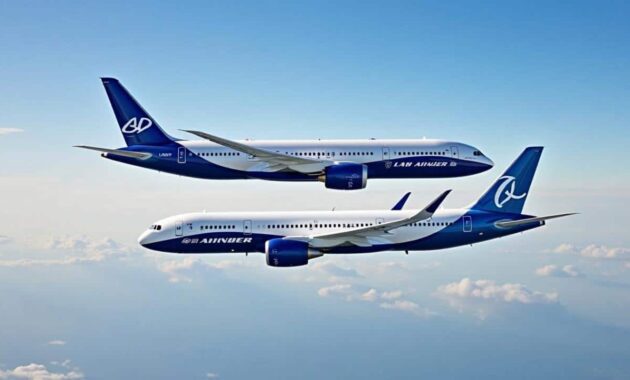
Two giants of the sky are edging closer to a long-awaited confrontation, as rival flagship jets near commercial reality.
After years of delays, redesigns and pandemic turbulence, Boeing’s 777-9 is finally moving toward service, lining up directly against Airbus’s long-haul A350-1000. Airlines, passengers and aviation regulators are watching closely, because this face-off will help shape long-distance travel for the next two to three decades.
The new flagship duel takes shape
For almost thirty years, the Airbus–Boeing rivalry has been defined by big symbolic aircraft: the 747 versus the A380, the 787 versus the A350, the 737 MAX versus the A320neo. The next chapter focuses on a very specific battle: Boeing’s 777-9 versus Airbus’s A350-1000.
Both are large, twin‑engine long-haul jets designed to carry hundreds of passengers over intercontinental routes using less fuel than the jumbo jets they replace. They target the same customers, the same airports and many of the same city pairs.
The 777-9 and A350-1000 aim to become the backbone of long-haul fleets just as airlines reset after the Covid crisis.
Behind the marketing slogans lies a deeper strategic contest. The winner in this size category can lock in airline loyalty, maintenance contracts and future upgrade paths for decades.
What sets the Boeing 777-9 apart
The 777-9 is the largest member of Boeing’s new 777X family. It is a modernised version of the highly successful 777, but with new wings, engines and cabin features. Boeing is pitching it as the natural successor to the 747 and older 777 variants.
A stretched aircraft with folding wingtips
The most eye-catching feature of the 777-9 is its folding wingtips. On the ground, the tips hinge upward, keeping the wingspan compatible with existing airport gates. In flight, the wings lock down, providing a long, efficient span similar to that of larger aircraft.
Folding wingtips allow the 777-9 to gain aerodynamic efficiency without forcing airports to rebuild their infrastructure.
The fuselage is longer than that of the A350-1000, giving airlines room for extra seats. In typical layouts, carriers may configure the jet with around 400 seats, depending on how much space they dedicate to premium cabins.
➡️ China “resurrects” a 50‑year‑old technology that uses 200 times less energy than digital
➡️ What if grey hair is a natural anti‑cancer shield? Here’s what the science says
➡️ France Is Potentially Sitting On €290 Billion But Has Been Banned From Tapping It Since 2017
➡️ Ibuprofen and paracetamol: everyday painkillers at the heart of a global public health threat
New engines, familiar materials
The 777-9 uses General Electric GE9X engines, some of the largest turbofans ever built for a commercial aircraft. They promise lower fuel burn per seat than older 777s, an essential selling point for cost-conscious airlines facing emissions pressure.
Unlike the A350, which relies heavily on carbon-fibre reinforced plastic for its fuselage, the 777-9 keeps a metal fuselage familiar to mechanics and engineers. Boeing is betting that this balance of new wings and engines with proven structure will appeal to long-term 777 customers, many of whom already operate extensive fleets of the type.
How the Airbus A350-1000 answers
The A350-1000 is Airbus’s largest twin‑engine widebody. It entered service several years ahead of the 777-9, giving Airbus a head start in signing up airlines that need long-range capacity now rather than later.
Lightweight design and long legs
The A350-1000 uses a high proportion of composite materials not just in the wings but also in the fuselage. This approach reduces weight and can help cut fuel burn, especially over very long sectors such as Europe to Australia or Asia to the US East Coast.
The aircraft is already certified and flying with carriers including Qatar Airways, Cathay Pacific and British Airways. Airlines praise its range and fuel efficiency, which become critical when fuel prices spike or environmental regulations tighten.
With the A350-1000 already in service, Airbus is selling not just a jet, but years of operational evidence and real fuel data.
Cabin comfort as a selling point
Airbus emphasises cabin comfort, highlighting features such as wider windows, lower cabin altitude and improved humidity. These elements are designed to leave passengers feeling less fatigued after 10- to 15-hour flights.
The A350 cross-section also allows airlines to choose between slightly wider seats or higher-density layouts. That flexibility can appeal to carriers mixing premium-heavy business routes with seasonal leisure flights.
Head-to-head: what airlines are comparing
When airlines evaluate these two giants, they do not focus solely on headline seat counts. They run complex financial and operational models covering efficiency, flexibility and long-term risk.
| Key factor | Boeing 777-9 | Airbus A350-1000 |
|---|---|---|
| Entry into service | Planned after regulatory approvals, later than A350-1000 | Already flying with multiple airlines |
| Typical role | High-capacity trunk routes | Long-range, slightly smaller capacity routes |
| Cabin size | Longer cabin, more seats possible | Smaller, lighter airframe |
| Design focus | New wings and engines on proven fuselage | Extensive composite structure and weight savings |
For airlines, a few questions recur in boardrooms and fleet-planning offices:
- Does the aircraft fit existing airport gates and runways without upgrades?
- Can it operate profitably during both peak and off-peak seasons?
- How does it perform on current climate and noise rules, and on those expected in the 2030s?
- What training and maintenance changes will crews and engineers need?
Regulators, delays and reputation risk
Timing plays a central role in this contest. The A350-1000 is a known quantity, with regulators already comfortable with its systems and structure. The 777-9, by contrast, still needs to complete certification, under a more cautious regulatory climate after the 737 MAX accidents.
Every extra year of delay gives Airbus more time to lock airlines into the A350 family.
Boeing must not only prove the safety and performance of the 777-9, but also rebuild trust with regulators, pilots and the public. Any issue on the 777-9 programme carries outsized reputational risk, especially since it represents Boeing’s flagship in the large twin-engine segment.
Airlines that already ordered the 777-9, such as Emirates and Lufthansa, are pressing for clarity on delivery timelines. They have long-term route plans and retirement schedules for older jets, and uncertainty can be costly.
What this means for passengers and fares
For travellers, the duel may sound abstract, yet it touches their everyday flying experience. Aircraft choice can influence ticket prices, legroom, cabin noise and even the number of direct routes offered.
Large, efficient jets allow airlines to concentrate passengers on fewer frequencies with more seats. On busy city pairs like London–Dubai or New York–Doha, that can lead to lower unit costs and, potentially, more competitive fares.
At the same time, both the 777-9 and A350-1000 are often deployed on prestige flagship routes, where airlines install their latest business-class and premium economy cabins. Passengers might notice larger entertainment screens, quieter cabins and more reliable Wi‑Fi when these aircraft replace older models.
Environmental pressure and future upgrades
Climate policy adds another layer to the rivalry. Both manufacturers promise double‑digit fuel savings compared with older widebodies, but regulators and campaigners argue that efficiency alone does not solve aviation’s emissions challenge.
Airlines are already experimenting with sustainable aviation fuel (SAF), and both the 777-9 and A350-1000 are being prepared to burn higher SAF blends as they mature. That capability allows carriers to align fleet decisions with future environmental rules and corporate sustainability targets.
The aircraft that adapts most easily to tighter climate rules could hold a long-term edge in airline boardrooms.
Manufacturers also plan incremental upgrades: software tweaks, weight reductions and cabin reconfigurations. A fleet that stays flexible through these upgrades can remain economically attractive well beyond its initial marketing brochure.
Key terms passengers keep hearing
The debate around these jets often uses jargon that hides simple ideas. A few examples help clarify what is at stake:
- Long-haul: flights typically over six hours, such as transatlantic or Europe–Asia routes.
- Widebody: an aircraft with two aisles in the cabin, used mostly for long-distance journeys.
- Seat-mile cost: the average cost to fly one seat over one mile; a crucial measure of efficiency.
- Sustainable aviation fuel: fuel produced from alternative sources, intended to reduce lifecycle CO₂ emissions.
When airlines speak about “upgauging” a route, they mean replacing a smaller aircraft with a larger one like the 777-9 or A350-1000, usually to handle stronger demand with fewer daily flights. That can change departure times, airport congestion and even the range of destinations connected through hubs.
Scenarios for the next decade
Several plausible paths lie ahead. In one scenario, Boeing secures certification smoothly, delivers the 777-9 in volume, and major Gulf and Asian carriers use it to dominate key long-haul corridors. That could push competitors to follow suit or risk losing market share.
In another scenario, more airlines hedge their bets and split orders between the A350 and 777X families. That approach spreads risk: if one programme suffers setbacks or regulatory constraints, the carrier can shift capacity to the other type.
There is also a long game at play. As demand patterns change, some airlines may pivot towards smaller long-range jets like the A321XLR or 787-9 for point‑to‑point flying, leaving the very largest widebodies for only the busiest hubs. In that environment, the 777-9 and A350-1000 will need to prove they can stay full, not just efficient.
For now, the stage is set. Airbus holds the early operational lead with the A350-1000, while Boeing prepares a late but ambitious counterpunch with the 777-9. The outcome will be written not just in engineering details, but in boardroom spreadsheets, regulatory files and the everyday choices of passengers booking seats across continents.