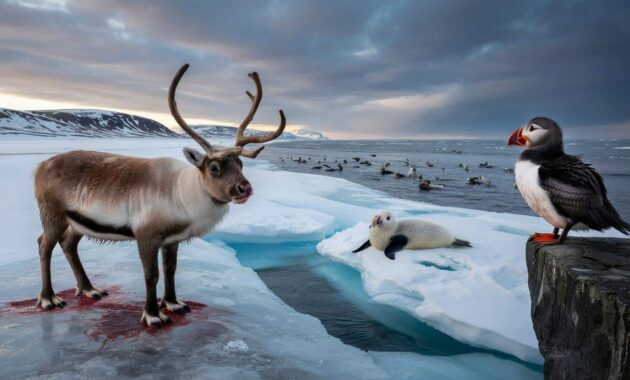
The first thing you notice is the silence.
Out on a frozen bay in northern Norway, the usual winter soundtrack – gulls crying, eiders chattering, the crack and sigh of shifting sea ice – feels strangely muted. The ice is slushy, almost grey, and a drizzle more like cold autumn rain patters on your jacket. A local fisherman points toward the horizon, where open water stretches much closer than it should. “Ten years ago,” he says, “we’d be standing on solid ice here. Now? February feels broken.”
He’s not being poetic.
Meteorologists say the Arctic itself is starting to crack out of its old rhythm.
And when the Arctic loses its rhythm, the animals that depend on it start to lose theirs too.
When February stops feeling like February
Across the high north, early February is changing character.
Instead of rock‑hard snow and bright, bitter cold, more regions are seeing yo‑yo conditions: a week of deep freeze, then a sudden thaw, then rain on snow, then another flash of cold. For meteorologists tracking the jet stream and polar vortex, this pattern has a name – an Arctic breakdown, when the usual tight whirl of cold air over the pole starts wobbling and spilling south.
From space, it looks like a bruised ring of cold being smeared across the map.
On the ground, it looks like confused animals and ice that can’t decide if it’s coming or going.
You can see the chain reaction in places like Svalbard.
There, reindeer used to scrape through soft snow to reach the moss and lichen below. Now, warmer air pulses in mid‑winter, triggers a melt, and is then followed by a snap freeze. That rain‑on‑snow event locks the ground under a sheet of ice. Reindeer pound at it until their hooves bleed. Many simply starve.
Scientists documented a mass die‑off in 2019, with hundreds of reindeer found emaciated, ribs showing under thick winter coats. The weather data for that season showed wild swings around February. One misplaced burst of warmth, one flash freeze – and a whole valley’s food supply is sealed in glass.
Meteorologists warn that these early‑season breakdowns don’t stay politely in the Arctic.
As the polar vortex weakens or splits, frigid air can plunge into North America, Europe, or Asia, while the Arctic itself warms above freezing. Birds moving north on instinct collide with blizzards. Bears emerging from hibernation stumble into late‑season cold they didn’t “budget” for.
This is how a technical phrase like “Arctic breakdown” turns into dead seal pups on thinning ice, early frog spawn frozen in backyard ponds, and spring insects hatching at the wrong time for hungry migrating birds. The cascade runs all the way from satellite maps to the hedgehog under your garden hedge.
How animals are forced into climate roulette
For wild animals, timing is everything.
Their lives are wired to signals they barely “think” about: day length, soil temperature, the feel of snow. An early February warm spell pushes some species into action mode. Plants bud. Insects stir. Amphibians creep out of mud. Then a returning cold wave slams the door on them.
What meteorologists are flagging is not just warmer winters, but winters with whiplash.
Species that evolved for a steady drumbeat of cold now have to gamble on a stuttering soundtrack.
➡️ Rafale: India prepares a second major Rafale M carrier jet contract
➡️ This rustic farm meal once associated with poverty is now praised by chefs for its incredible flavor
➡️ A new maker of passenger jets arrives: it’s not Chinese but Indian
➡️ The grandmother’s old mix that makes floors shine the easy method proven over decades
Take Atlantic puffins as one small, heartbreaking example.
These clown‑faced seabirds time their breeding to match the peak of tiny fish like sand eels. The fish themselves depend on plankton blooms that are tuned to sea‑ice melt and light. When Arctic breakdowns shake the ocean’s winter, the plankton bloom can come too early or too patchy.
Researchers in Iceland and the Faroe Islands have recorded “puffin wrecks” – thousands of starving puffins washing ashore, their bellies empty. The parents left chicks in burrows, flew out to sea as they always had, and found a buffet that had already come and gone. All because the sea got out of sync with the sky.
The logic behind the warning is brutally simple.
The Arctic is the planet’s thermostat, and early February used to be one of its most stable settings. When that control starts rattling, the knock‑on effects unfold in layers. Temperature spikes trigger ice loss and rain on snow. That reshapes food access, from lichens to fish. Predators then face a double trap: less prey, and more energy burned searching for it.
Behind the scenes, meteorologists track pressure patterns and jet stream loops, while ecologists log chick weights, birth dates, and survival rates. Different languages, same message. A system that evolved on predictability is being shoved into chaos, one “weird winter” at a time.
What experts (and ordinary people) are doing about a broken winter
On a sea‑ice floe off Labrador, a biologist kneels beside a newborn harp seal, its fur still startlingly white against the slush.
She measures, tags, photographs, all in minutes, before the mother slides nervously back toward open water. Years ago, this pup would have lounged on thick ice for weeks. Now, breakup can arrive so fast that scientists race the calendar just to get basic data.
The method looks almost old‑fashioned: boots, notebooks, hand‑held GPS, sometimes a drone humming overhead.
But this is how we build the timeline that links February’s broken Arctic to next year’s missing adults at a rookery hundreds of kilometres away.
For people living closer to temperate latitudes, the role is different but real.
Gardeners keep simple logs of first blossoms and last frosts. Birdwatchers upload photos and dates to citizen‑science apps. Farmers note when lambs are born into surprise snowstorms or when pollinators arrive late. *These tiny, personal records become the texture that fills the gaps between weather models and wildlife surveys.*
We’ve all been there, that moment when you notice “Winter feels off this year” and then move on with your day.
The shift now is that scientists are asking us not to look away. To treat those gut feelings as the first draft of data.
Some of the strongest warnings come in plain, almost tired voices from people who’ve watched the same ice, the same river, the same hill for decades.
Sámi reindeer herder Nils Peder Gaup told a researcher: “My grandfather taught me the snow. I knew how to read it. Now it rains in February, then freezes. The snow lies, the weather lies. The reindeer are the ones who pay.”
He’s not alone. Indigenous hunters, fishers, and farmers from Alaska to Siberia are saying similar things.
- Earlier thaws are collapsing traditional migration routes over rivers and fjords.
- Ice crust on snow is turning reliable winter grazing into a deadly lottery for hoofed animals.
- Mismatched seasons are uncoupling predators from their prey at key life stages.
Let’s be honest: nobody really tracks all their local changes every single day.
Yet those who do – whether with a weather station or just a worn notebook – are now on the front line of understanding a fraying February.
Living with a February that keeps breaking apart
There’s a strange tension in watching this unfold.
On one hand, early February Arctic breakdowns sound distant, like a technical glitch happening over some empty white map at the top of the world. On the other, you start to notice the echoes close to home: daffodils flowering in January, mosquitoes in a mild mid‑winter spell, then a deep freeze that wipes out frogspawn in the local pond.
The animals experiencing this don’t have the luxury of thinking in “climate trends”.
A malformed spring or a shattered winter is just hunger, missed breeding chances, offspring that don’t survive.
Meteorologists are, by nature, cautious.
When they start using phrases like “cascading effects on ecosystems” in February briefings, it means the pattern has repeated often enough to worry them. The breakdowns are arriving earlier, the swings are sharper, and the Arctic – that old, stern metronome of the seasons – is falling out of beat.
For readers scrolling this on a bus or in bed, the question is less “Should I panic?” and more “How do I pay attention?”.
From supporting local nature groups to simply learning the names of the species that share your neighbourhood, the first step is noticing who else is living through this stuttering winter with you.
An early February that feels wrong is no longer just weather small talk.
It’s a signal from a system that used to be rock‑steady, now creaking under the weight of extra heat and shifting air currents. Meteorologists see it in their models and maps. Wildlife carers see it in rescue centres crowded with underweight seal pups and owls hit by late storms. People on the land feel it in their bones.
The story is still being written, day by day, across tundra, city parks, and backyard bird tables.
What breaks, what adapts, and what we choose to protect will decide whether a “broken February” becomes the new normal or a warning we actually heeded.
| Key point | Detail | Value for the reader |
|---|---|---|
| Arctic breakdown is shifting earlier in the year | February warm spells and polar vortex disruptions are becoming more frequent | Helps you connect “weird winters” where you live to a larger climate pattern |
| Wildlife depends on stable seasonal timing | From reindeer and seals to garden birds, many species are thrown off by sudden thaws and refreezes | Shows how distant Arctic changes ripple into everyday nature you can see |
| Local observation has real scientific value | Logs, photos, and citizen‑science reports feed into climate and ecosystem research | Offers concrete ways you can contribute, even without being a scientist |
FAQ:
- Question 1What exactly do meteorologists mean by an “Arctic breakdown” in early February?They’re talking about periods when the usual tight pool of cold air over the Arctic – often controlled by the polar vortex and jet stream – destabilises, sending surges of cold south and allowing warmer air to flood the high north.
- Question 2How can that affect animals thousands of kilometres away?When the jet stream is distorted, it reshapes storm tracks and temperature patterns, which in turn alter food availability, breeding conditions, and migration timing for wildlife across entire continents.
- Question 3Are some species actually benefiting from these milder winters?A few, like certain pests and generalist predators, can gain short‑term advantages, but specialists adapted to snow, ice, and tight seasonal timing are generally losing out.
- Question 4Is this just natural climate variability, or is it linked to human‑driven warming?Long‑term data and modelling strongly suggest that rapid Arctic warming, caused largely by greenhouse gas emissions, is amplifying these breakdown events and making them more likely and more intense.
- Question 5What can an ordinary person do about something that sounds so global?You can reduce your own emissions, support policies that cut fossil fuels, back conservation projects, and contribute observations to citizen‑science platforms that help track how wildlife is coping with these shifting winters.