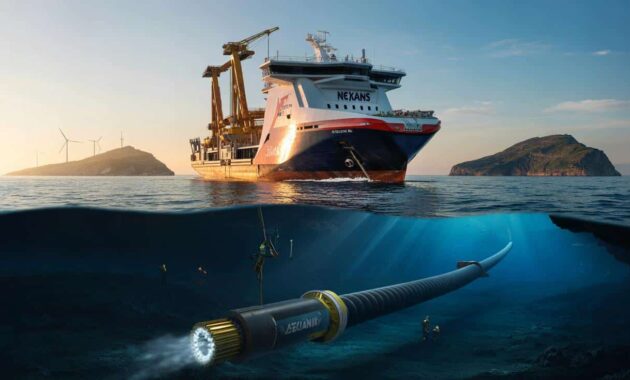
While political debates rage about deindustrialisation in France, one of its flagship companies is preparing a feat that few countries can even attempt: laying a high‑voltage power cable at a record depth between Italian islands, in the dark, crushing quiet of the deep sea.
France’s “sick industry” narrative faces a reality check
France is often portrayed as a fading industrial power, squeezed between low-cost Asian rivals and US tech giants. Yet in a niche that has become strategic for both energy and data, French know‑how sits right at the top of the global league.
The latest proof comes from Nexans, the French specialist in subsea cables. The group has been picked for one of Europe’s most ambitious energy infrastructure projects: Tyrrhenian Link, an underwater electrical “corridor” designed by Italian grid operator Terna.
Tyrrhenian Link will connect Sardinia, Sicily and mainland Italy using high‑voltage direct current (HVDC) cables laid hundreds of kilometres under the sea. Part of the route will reach 2,150 metres below the surface, setting a new world record for this type of power cable.
At 2,150 metres below sea level, the French-made cable will become the deepest HVDC link ever installed on the planet.
For Paris, this is more than a nice export contract. It is a demonstration that strategic industrial capacity still exists in sectors that matter for sovereignty, energy security and, increasingly, geopolitics.
Tyrrhenian Link: a hidden backbone under the Mediterranean
The Tyrrhenian Link project aims to fix a basic but serious problem in southern Italy: power production and consumption often do not match from one region to another.
Sardinia, with its strong wind resources and rising solar capacity, can produce a surplus of electricity at certain times of day. Sicily, and the densely populated Campania region around Naples, have more erratic demand profiles and a heavy reliance on imports from the mainland.
Balancing islands and continent in real time
Nexans is responsible for the western section of the project, running from southern Sardinia to Fiumetorto on the northern coast of Sicily. Several hundred kilometres of cable will be laid on the seabed, with the deepest stretch plunging past 2,150 metres.
➡️ A budget war machine: China unveils a mysterious tank alarming the West
➡️ The invisible roots of dementia form in the very first years of life
➡️ One simple gesture is enough as DJI launches a new drone that almost flies itself
➡️ The United States automatically blocks passport updates for citizens and foreigners with these names
The principle is simple, but the impact is large. When Sardinia generates too much renewable power, the link will ship that excess to Sicily and further on to the mainland grid. When Sicilian demand spikes, current can flow in the opposite direction.
By acting like an invisible electrical bridge, the cable turns three fragmented systems into one flexible network.
High‑voltage direct current is used because it carries power over long distances with fewer losses than traditional alternating current systems. That matters a lot when you are sending hundreds of megawatts through a cable lying on the seabed for hundreds of kilometres.
- Technology: HVDC subsea power cable
- Depth record: 2,150 metres under the Mediterranean
- Western route: southern Sardinia to Fiumetorto (Sicily)
- Total project cost: €3.7 billion invested by Terna
- Key supplier: Nexans, based in France
Engineering at 2,000 metres: precision under crushing pressure
The sea hides the true complexity of the task. At more than 2,000 metres down, pressure is roughly 200 times higher than at the surface. Temperatures are near freezing. Currents can shift unexpectedly. There is no easy room for improvisation.
Nexans is deploying some of the most advanced cable‑laying vessels in service, including the Nexans Aurora. This 149‑metre-long specialist ship can carry over 10,000 tonnes of cable and is fitted with dynamic positioning systems, remotely operated vehicles and subsea trenching tools.
Each metre of cable has to be laid with almost surgical care, following a predefined route to avoid slopes, rocks and existing infrastructure.
From the control room on board, operators monitor tension, speed, seabed profile and weather in real time. If the cable is pulled too hard, it can be damaged. If it is too slack, it can snag or bend in ways that weaken its structure over decades.
Once on the seabed, sections of the cable are often buried using underwater ploughs or jets, to protect them from anchors, fishing activity and potential sabotage.
Record-breaking, but also a test bed
The record depth is impressive, but for European energy planners, the more significant aspect is that Tyrrhenian Link shows what is now technically and commercially possible.
Subsea power highways can connect remote islands, offshore wind hubs and entire countries. Interconnectors already exist between the UK and France, Norway and Germany, or Denmark and the Netherlands. Deeper, longer routes will open new options, especially in the Mediterranean and North Atlantic.
For Italy, Tyrrhenian Link offers a way to strengthen its grid and bring more renewables online without relying only on local backup plants. For Nexans, it is a reference project that can support bids on future contracts around the globe.
French subsea cable power: a quiet strategic asset
Behind this project lies one of France’s less visible strengths. The country now accounts for roughly a third of the global fleet of cable‑laying ships used for power and telecom links. For a middle‑sized industrial economy, that is a strong position.
French vessels and crews are present in the Atlantic, the North Sea, the Mediterranean and Asian waters, installing both power lines and fibre‑optic cables that handle the bulk of international internet traffic.
Control over subsea cables is increasingly viewed in Paris as a tool of sovereignty, almost on the same level as satellites or secure data centres.
Recent incidents, such as damage to gas pipelines and communication cables in the Baltic, have triggered fresh concern among European governments. The more the economy depends on digital and electrical flows, the more vulnerable those lines become during crises.
That context makes industrial players like Nexans more than simple exporters. They are now part of a larger strategic conversation that includes defence, cyber security and foreign policy.
Electra: France’s next subsea heavyweight
The Tyrrhenian Link contract is not the end of the story. Nexans is finalising a new flagship vessel, Nexans Electra, which will further consolidate the French position.
Currently being fitted out in Norway, Electra is 155 metres long and built specifically for large‑scale subsea campaigns. It carries two enormous cable carousels of 10,000 and 3,500 tonnes, plus a dedicated 450‑tonne tank for fibre‑optic cables. A hybrid propulsion system compatible with biofuels reduces emissions and noise during operations.
With Electra, Nexans wants to chain together long missions, laying power and data cables across oceans without constant returns to port.
The ship’s design focuses on autonomy, precision and flexibility. It can handle different cable types in a single campaign, which is useful for projects that combine offshore wind connections, interconnectors and telecom links in the same area.
As offshore wind farms move further from coasts and into deeper waters, demand for such vessels is expected to grow. The French group is positioning itself as a go‑to partner for governments and utilities planning multi‑gigawatt projects.
Why deep subsea cables matter for everyday life
HVDC cables and fibre‑optic lines are not particularly visible. Yet their influence runs through a wide range of daily activities and future policy choices.
From streaming to grid stability
On the data side, subsea cables carry more than 95% of global internet traffic. Satellites receive lots of attention, but the binge‑watching, cloud computing and financial trading of modern life mostly rely on glass fibres lying on ocean floors.
On the energy side, projects like Tyrrhenian Link can support higher shares of wind and solar. By smoothing out mismatches between local production and demand, they reduce the need for gas‑fired backup and cut curtailment of renewables when the grid is saturated.
For consumers this can translate into fewer blackouts, more stable prices and an easier path to electrifying heating, transport and industry. For governments it creates options to trade electricity across borders, sharing backup capacity and reducing exposure to single suppliers of gas or coal.
Key terms worth decoding
Two technical expressions keep coming up in these projects:
- HVDC (high‑voltage direct current): a technology that sends electricity in a single direction at very high voltage. It limits losses over long distances and allows fine control of power flows between grids that may not be perfectly synchronised.
- Interconnector: a cable or line that links two separate power systems, often belonging to different regions or countries. It acts as a shared back‑up and a channel for energy trade.
In practice, an HVDC interconnector between two countries can help one export surplus wind power at night, while the other sends back hydroelectric or nuclear power during peak daytime use. That mutual support reduces strain on both systems.
Risks, opportunities and future scenarios
Relying more on subsea infrastructure brings some vulnerabilities. Cables can be hit by anchors, damaged by earthquakes or targeted in conflicts. Repair operations are complex and weather‑dependent. Insurance, monitoring and redundancy become critical parts of the equation.
At the same time, the benefits are concrete. Cross‑border links can lower the overall cost of decarbonising power systems. Deep‑sea connections can unlock remote renewable resources far from big cities. Industrially, countries that master this niche can secure high‑value jobs in shipbuilding, robotics, power electronics and advanced materials.
If projects like Tyrrhenian Link succeed and similar connections spread, Europe could end up with a dense mesh of subsea arteries carrying both electrons and data. For France, that scenario places its much‑discussed industrial sector in a less gloomy light: weaker in some areas, but still very present in a few that count quietly, thousands of metres under the waves.