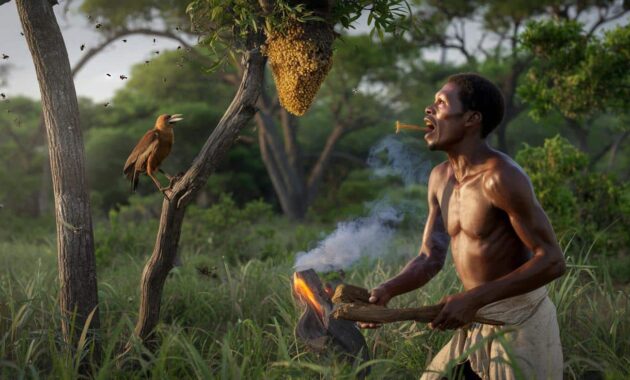
Those calls — trills, grunts and whistles — are more than bushcraft. They form a shared “language” with wild birds that guide people to bees’ nests, and that language appears to split into local dialects, just like human speech.
Humans and wild birds hunting together
In the Niassa Special Reserve of northern Mozambique, the Yao people rely on wild honey for food, trade and traditional rituals. They do not search blindly for hives. They ask for help.
The help comes from greater honeyguides, small, streaky brown birds that specialise in finding bees’ nests hidden high in trees or deep in trunks. The relationship is not tame or trained. These are fully wild birds.
Humans call to the birds; the birds answer and lead them, tree by tree, to hidden honeybee nests.
Once a hunter spots a honeyguide, he gives a distinctive call. If the bird is interested, it responds with its own chatter and flits ahead, pausing and calling until the human catches up. The two repeat this relay until they reach a nest.
At the hive, humans do what the bird cannot. They use fire and smoke to pacify the bees, crack open the nest and collect the honey and comb. The honeyguides swoop in afterwards to feed on wax and bee larvae, avoiding a direct, often lethal, confrontation with thousands of angry stinging insects.
A shared code with regional accents
Researchers led by behavioural ecologist Jessica van der Wal from the University of Cape Town set out to test whether this human–bird language varies from village to village inside the same region.
The team worked with 131 experienced honey hunters spread across 13 Yao villages within the Niassa reserve. They recorded the calls hunters used to summon honeyguides and compared them across distances and habitats.
The study found one shared “language” used with honeyguides, split into distinct local dialects that map onto human communities.
➡️ The 10-minute pasta sauce Italians cook when they have almost nothing left in the fridge
➡️ Professional chefs quietly agree on these restaurant dishes they personally avoid ordering (and why)
➡️ For brasserie-style French onion soup, Jean-François Piège swears by this one onion variety
➡️ Here’s the precise age when making new friends gets harder, according to researchers
➡️ Easy to make, this classic French sauce transforms even the blandest white fish
In some villages, the hunters’ signal sounded like a rolling trill. In others, it was more of a grunt or a rising whoop. Elsewhere, it became a whistle with a particular rhythm. The variation lined up with how far apart communities lived, not with differences in vegetation or landscape.
Hunters who moved to a new village did not keep using their old bird-call. They tended to adopt the local style, much like picking up a new accent after moving cities.
What the researchers actually measured
The team didn’t just listen informally. They treated the honey-hunter calls like speech and analysed them systematically. Key aspects included:
- Pitch and pitch contour (how the sound rises and falls)
- Length and rhythm of the call
- Repetition patterns (single call vs. repeated syllables)
- Acoustic distance between calls from different villages
By doing this across dozens of hunters, they could show that the “dialects” are not individual quirks but shared patterns within communities.
Culture in people — and maybe in birds
For van der Wal and colleagues, the work highlights how heavily human behaviour leans on culture, even in interactions with wildlife.
The Yao hunters already share a mother tongue and social traditions. On top of that, they share a specialised “honeyguide language” that is learned, transmitted and locally shaped. That makes it cultural in the scientific sense: behaviour passed socially, not genetically.
Independent experts say the most striking twist is that these dialects are not tied to forest type or open savannah, as might be expected if the habitat changed how sound travels. Instead, they track human social boundaries.
Some researchers suspect the birds themselves may help lock in local styles. If honeyguides learn over time to pay more attention to the familiar local call, those using that dialect will find more nests. People using unusual calls may simply get ignored more often.
Selection pressure from the birds could help stabilise a mosaic of dialects across human communities.
This creates a feedback loop. People copy the calls that work. The calls that work are the ones honeyguides already recognise. That cycle could keep dialects distinct for generations, even as people occasionally move between villages.
How do honeyguides learn the game?
Greater honeyguides add their own layer of complexity. They are brood parasites, meaning females lay their eggs in other birds’ nests and leave the parenting to unwitting foster species. Young honeyguides never meet their genetic parents.
That rules out the idea that a parent bird teaches its chick where to find people and how to cooperate. Instead, scientists think juveniles learn from watching older honeyguides interact with humans, or from instinctive tendencies honed by evolution, or a mix of both.
Van der Wal and partners in the Pan-African Honeyguide Research Network are currently comparing behaviour across multiple countries. They aim to see whether honeyguides in different regions also show local preferences for certain human calls or styles of interaction.
Where this cooperation happens
| Region | People | Bird species | Use of honeyguides |
|---|---|---|---|
| Niassa Reserve, Mozambique | Yao | Greater honeyguide | Active, with distinct human dialects |
| Parts of Tanzania | Hadza and others | Greater honeyguide | Documented long-term cooperation |
| Zimbabwe, Kenya and beyond | Various rural groups | Greater honeyguide | Reports of guiding traditions |
The Mozambique study adds high-detail evidence from one area, but honeyguide cooperation appears in scattered communities across eastern and southern Africa. In some regions, use of honeyguides is fading as people shift to store-bought sugar or different livelihoods.
Why this human–bird partnership matters
For the Yao, the relationship is practical. Honey is food, medicine and a trade good. Wax can be used for candles and crafts. Bee larvae provide dense protein. Having access to a bird that can find hives quickly saves time and energy in a vast landscape.
For the birds, humans are powerful but predictable allies. People can subdue bees and split open tough tree trunks. The birds then gain access to wax, which very few animals can digest efficiently.
From a broader perspective, this cooperation challenges the common picture of human–wildlife interaction as purely conflict or avoidance. Here, both sides benefit without domestication and without formal training.
The honeyguide partnership shows that cooperation between humans and wild animals can be stable, intricate and deeply rooted in culture.
Risks, pressures and what could change
The Niassa Special Reserve is remote, but not untouched. Shifts in land use, logging, climate and economic pressures could reshape both bee populations and bird behaviour. If wild bees decline, honeyguides would have less food. If younger Yao people turn away from honey hunting, they might stop learning the calls.
In that scenario, the dialects recorded today could fade within a few generations. The birds might adapt by shifting their focus to other food sources, or by working more with any remaining hunters who still know the signals.
There is also a safety aspect. Honey hunting carries risks: burns from fire, stings from disturbed swarms, falls from tall trees when retrieving hives. Having a bird that reliably indicates active nests can reduce wandering and fruitless climbing, but it does not remove those hazards.
Some terms and ideas unpacked
Scientists describe these shared calls as “cooperative signals”. The human vocalisations are not random shouts; they are intentionally used to start a joint activity with another species. The birds’ responses serve a similar function.
Another key term is “dialect”. In this context, it means a recognisable, community-level variation on a shared communication system. The core pattern remains the same — a specific type of call aimed at honeyguides — while details such as pitch and rhythm shift across villages.
This kind of dialect variation is common in humans and has also been recorded in animals such as whales and songbirds. The Mozambique study suggests that when two species cooperate closely, both may end up participating in a kind of cross-species cultural landscape.
For readers curious about trying to “talk to birds” at home, the lesson is more about patience than imitation. A shared code like that between Yao hunters and honeyguides appears to have developed over hundreds or thousands of years, shaped by need, environment and repeated contact.
What the research shows is that communication across species is not just a fantasy from nature documentaries. In the forests of Niassa, it happens each time a man lifts his voice, a small brown bird answers, and together they go in search of bees.