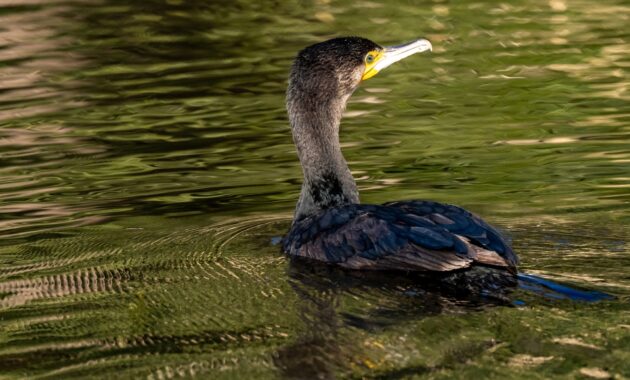
Anglers, fish farmers and bird defenders are clashing over a black‑feathered silhouette: the great cormorant. As the bird gathers in winter roosts along the French department’s rivers and lakes, a prefectural order has allowed limited shooting on fish farms, but not on open water. Local fishing groups say that leaves protected wild fish dangerously exposed.
The fishing federation’s warning shot
The Jura departmental anglers’ federation has run its own back‑of‑the‑envelope calculation. It starts with a figure supplied by the Ligue de protection des oiseaux (LPO), France’s main bird charity: just over 600 great cormorants overwinter in the department each year.
Each bird, they say, eats around half a kilo of fish a day. Multiply that roughly by the six or seven months they remain, typically from October to April, and you get a number that makes anglers bristle.
Local fishing leaders estimate that wintering cormorants consume more than 50 tonnes of fish in Jura’s waters each season.
For Roland Brunet, who heads the departmental anglers’ federation, that volume raises a blunt question: what is the point of pouring money into restoring rivers, spawning grounds and fish passages if, in their view, much of the rebuilt stock is simply swallowed by cormorants?
A protected bird facing a legal loophole
The great cormorant is protected under European and French law. It cannot be freely hunted. Yet those same laws include derogations that let authorities authorise targeted culls when serious damage is proven, typically to fisheries or biodiversity.
In Jura, the prefect signed such an order in November 2025. It allows the shooting of up to 300 great cormorants this winter season, but only on enclosed waters used for fish farming. The justification is clear: direct economic loss for pisciculture businesses.
That focus on ponds and basins leaves a grey area on natural rivers and lakes, often called “eaux libres” or open waters. Anglers say this distinction makes little ecological sense, because the bird does not respect property lines.
The same cormorant that raids a fish farm by dawn may hunt wild trout in a public river by midday.
Anglers say wild fish get second‑class protection
Among Jura’s anglers, frustration builds around the idea that farmed fish, destined for sale, benefit from legal protection that wild species do not. Yet some of those wild fish are themselves classified as protected or vulnerable.
➡️ Major capital raise seeks $450 million to “lead New Zealand’s renewable energy future”
➡️ “I was losing $90 a month without even noticing it”
➡️ Why adding a splash of cream can soften the acidity of tomato sauces
➡️ They’re under 60 and already living with Alzheimer’s
➡️ The oven-baked rice dish that cooks fully in broth without stirring
Locals point to emblematic species of the Jura rivers:
- Brown trout (truite fario), prized by fly fishers and sensitive to water quality
- Northern pike, a top predator vital for balancing ecosystems
- Grayling (ombre commun), a specialist of fast, oxygen‑rich currents and increasingly fragile
All three rely on clean, cool rivers, gravel beds and intact floodplains. For years, the federation and public authorities have funded bank restoration, fish ladders and stocking programmes. That work is expensive, and largely paid for through angling licences and public money.
Bird defenders call for perspective
On the other side, the LPO and other conservation groups urge caution. Yes, cormorants are voracious. But, they argue, the simple “tonnage” approach masks a more complex food web.
Not all prey are prized game fish. Many are small cyprinids, invasive species or individuals already weakened by pollution or disease. Cormorants often target shallow, degraded stretches where fish are more concentrated and easier to catch.
For ornithologists, the cormorant is less an invader than a visible symptom of rivers already under stress.
Conservationists also remind critics that the bird nearly disappeared from large parts of Europe in the 20th century because of persecution and toxic chemicals. Protective measures have allowed populations to bounce back. Fresh conflict signals, to them, that society still struggles to accommodate recovering predators.
Multiple pressures on Jura’s rivers
The argument over cormorants unfolds against a broader backdrop: the steady squeeze on freshwater ecosystems in eastern France. Several factors weaken native fish populations long before any bird arrives:
| Pressure | Effect on fish |
|---|---|
| Water pollution | Reduces oxygen, affects reproduction, increases disease |
| Hydropower and dams | Blocks migration, alters flows, fragments habitats |
| Climate change | Warmer water, harsher droughts, temperature stress |
| Agricultural runoff | Eutrophication, algae blooms, habitat siltation |
| Overstocking and introductions | Genetic mixing, competition with wild strains |
Anglers argue that these realities strengthen their case: since fish populations already face so many threats, any additional mortality from predators weighs heavily. Bird advocates reply that long‑term solutions sit in that table too, not solely in the crosshairs trained on cormorants.
Between science, emotion and politics
Local authorities now walk a tightrope between competing lobbies. Anglers provide valuable data from the field and represent thousands of licence holders. Bird groups carry legal weight through European directives and enjoy broad public sympathy for wildlife protection.
Scientists called in to advise the prefecture must separate strong evidence from anecdote. That involves monitoring cormorant roosts, tracking their feeding areas, and surveying fish stocks before and after the wintering period.
Behind each technical report lies a very human conflict: who gets to decide what level of predation is acceptable in a shared river?
In many French departments, compromise has taken the form of limited, tightly controlled shooting in certain river stretches, combined with non‑lethal measures such as scaring devices near vulnerable spawning zones. Jura’s anglers want at least the same for their rivers, not just for commercial ponds.
What “eaux closes” and “eaux libres” actually mean
The legal vocabulary fuels part of the confusion. In French law:
- Eaux closes are enclosed waters that do not directly connect to public rivers, like private ponds or fish‑farm basins.
- Eaux libres are natural rivers, streams and lakes that form part of the public water network.
This distinction shapes who manages the fish, who pays for upkeep and what kind of derogations can be granted. Prefects often find it easier to justify culls on enclosed, privately managed sites where economic loss is clearly measurable.
What could happen next in Jura
If the anglers’ federation keeps up the pressure, officials may be pushed to revisit the current order. A few scenarios circulate in local corridors of power:
- Extending derogations to specific river sections where sensitive species concentrate.
- Limiting culling to periods when fish are most exposed, such as low‑water winter pools.
- Testing alternative deterrents first, reserving shooting for last resort situations.
Each scenario comes with risks. Excessive culling could push cormorants towards neighbouring regions, shifting the problem rather than solving it. Too little action might feed resentment among anglers, who already feel sidelined in environmental debates.
Beyond the Jura case, the conflict offers a concrete example of how protective labels interact. A protected bird feeds on protected fish, inside rivers that European directives also protect. Law and policy were not designed with such overlapping protections in mind.
For anyone following freshwater issues, the debate also sheds light on a wider question: when conservation succeeds for one species, society has to adjust. The return of a predator triggers fresh negotiations over space, resources and shared rivers. Jura’s angling clubs, fish farmers and birdwatchers are now testing where those new boundaries will sit this winter, one catch — or one cormorant silhouette — at a time.