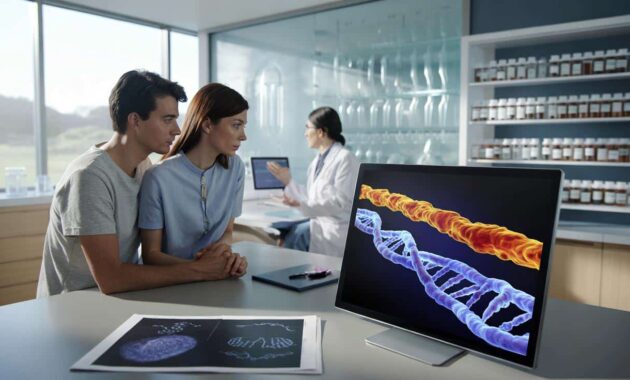
They believed modern screening would shield their future children from hidden health risks. Now, an extraordinary case involving a single Danish donor is forcing regulators and clinics to rethink how safe those assumptions really are.
A donor behind nearly 200 births
Denmark has quietly become a powerhouse of international sperm donation. The country hosts the European Sperm Bank, one of the largest suppliers of donor sperm on the planet, exporting to clinics across several continents.
Between 2006 and 2022, an anonymous Danish donor, known under the pseudonym “Kjeld”, provided sperm that was sent to 67 fertility clinics in 14 countries. According to Danish public broadcaster DR, those samples led to the birth of around 197 children worldwide, including 99 in Denmark.
For many couples facing infertility, this donor represented a lifeline. His samples were used repeatedly over more than a decade, a sign that he met — and kept meeting — the bank’s medical and genetic criteria.
One man’s sperm helped create almost 200 children, crossing borders and legal systems, before a hidden mutation came to light.
The story changed in 2020. That April, the sperm bank was alerted that a child conceived with “Kjeld’s” sperm had been diagnosed with cancer. Genetic testing showed the child carried a mutation in a crucial gene. At the time, this looked like a tragic but isolated case.
Three years later, another child, also conceived from the same donor, received a cancer diagnosis. Genetic analysis again pointed to the same underlying problem. This second alarm triggered a detailed re‑examination of stored sperm samples from the donor.
A rare TP53 mutation slips past screening
The new testing revealed something unexpected: the donor carried a mutation in the TP53 gene, a gene that plays a major role in preventing tumours from forming.
What TP53 normally does
TP53 produces a protein known as p53, often nicknamed the “guardian of the genome”. This protein monitors DNA inside cells and responds when damage appears.
➡️ Hairstyle after 70: the “trixie cut” is the youth-boosting short crop of the spring
➡️ Why Gen Z Needs To Relearn The Simple Gestures Of Everyday Life
➡️ Fortune, gains, and success: the zodiac signs favored by money in 2026
➡️ “After 65, my hands felt weaker”: the daily action that helped preserve strength
➡️ The surprisingly easy homemade flatbread that cooks in just minutes in a skillet
➡️ 10 hobbies to adopt that help prevent loneliness in old age, according to psychology
- If DNA damage is minor, p53 pauses cell division and gives the cell time to repair itself.
- If the damage is extensive, p53 can trigger the cell to self‑destruct, preventing it from turning cancerous.
- By doing this constantly, it reduces the chance that mutated cells will multiply into tumours.
When TP53 is altered, this protective system can fail. Faulty p53 no longer keeps damaged cells in check. People with inherited TP53 mutations often face a higher risk of multiple cancers, sometimes beginning in childhood.
TP53 acts like a cellular security guard. When that guard is compromised, rogue cells have more chances to grow into cancer.
A mosaic mutation, found only in sperm
The twist in the Danish case is that the donor did not appear sick. The European Sperm Bank stated that the mutation was “rare and previously undescribed” and only found in a subset of his sperm cells, not in the rest of his body.
This pattern fits what geneticists call a mosaic mutation. In mosaicism, not all cells carry the same DNA change. A mutation arises at some point during development, so only a proportion of the body’s cells are affected.
For this donor, the mutation seems to have been limited to part of his germ cells — the cells that produce sperm. Standard blood tests and health checks did not pick it up because the mutation was absent, or too rare, in other tissues.
As a result, the donor appeared healthy, passed routine screening, and was accepted again and again over many years.
How many children are at risk?
The number of children who actually inherited the TP53 mutation is not yet clear. The mutation was present in only a fraction of his sperm, meaning not every conception using his samples carried that risk.
What is known:
- 197 children were conceived with his sperm between 2006 and 2022.
- Some of these children developed cancers linked to the TP53 mutation.
- Other children conceived from the same donor do not carry the mutation.
Nearly 200 families now face a deeply uncomfortable question: did my child inherit a cancer‑linked mutation from a stranger we trusted?
Families who used this donor may be contacted by clinics or seeking genetic testing on their own. For those whose children are still very young, the uncertainty can be intense, even before any health problems appear.
What this means for sperm banks worldwide
The case touches on a broader issue: sperm donors can, by design, have many offspring. A problem in one donor’s DNA can spread widely before anyone notices.
| Point of concern | Why it matters |
|---|---|
| High number of offspring per donor | One rare mutation can affect dozens or hundreds of children. |
| Limits of current screening | Standard blood and questionnaire‑based checks may miss mosaic mutations. |
| Cross‑border use of sperm | Complicates tracking, notification, and coordinated follow‑up. |
| Long delay before detection | Cancers can take years to appear, by which time many children already exist. |
Clinics often cap the number of families or children per donor, but rules vary widely between countries. When sperm banks export internationally, oversight becomes harder, and a donor’s genetic issue can ripple through different health systems and legal frameworks.
Could this have been prevented?
Most sperm banks test donors with health questionnaires, physical exams, infectious disease screening, and targeted genetic tests. Those panels usually focus on well‑known hereditary disorders such as cystic fibrosis or certain muscular dystrophies, and on karyotyping to check chromosome structure.
Detecting rare, mosaic TP53 mutations is far less straightforward. Even advanced techniques like whole‑genome sequencing may miss a mutation present in only a small percentage of cells, depending on how and where the sample is taken.
This case exposes a blind spot: mutations confined to sperm can bypass the very tests designed to protect future children.
Some specialists argue for tighter limits on how many children each donor can father, reducing the potential scale of such events. Others call for broader genetic screening and for long‑term registries that track health outcomes in donor‑conceived children, while protecting privacy.
What families who used donor sperm may want to know
This Danish case will inevitably worry people who conceived children through sperm donation, whether in Europe, North America or elsewhere. While the exact risk in similar situations remains low, families may still want clear guidance.
Possible steps for concerned parents
- Ask the clinic whether the donor used was ever subject to a safety alert or recall.
- Discuss with a genetic counsellor whether testing for genes like TP53 is appropriate for your child.
- Watch for unusual symptoms in children — persistent pain, unexplained lumps, prolonged fevers — and report them to a doctor.
- Keep written records of the clinic, donor code, and dates of treatment, as this information can matter years later.
Most donor‑conceived children will not face such rare genetic issues. Still, this episode highlights that no screening system is foolproof. Fertility medicine sits at the intersection of hope, biology and risk, and rare events can have very human consequences.
Key terms and broader implications
For people trying to make sense of the science, a few concepts underpin this story:
- TP53 gene: encodes the p53 protein, central to controlling cell division and preventing tumour formation.
- Mosaicism: a condition where not all cells in a person’s body share the same genetic mutation.
- Germline cells: cells that give rise to sperm or eggs; mutations here can be passed to children.
- Somatic cells: the rest of the body’s cells; mutations here are not inherited.
One realistic scenario now being discussed by experts is a layered screening strategy: standard tests at the time of donation, combined with stricter caps on offspring numbers, and rapid international alerts when a serious problem emerges. Banks could also hold back some samples in long‑term storage purely for re‑testing if red flags arise years later.
The Danish donor known as “Kjeld” has become an unexpected case study in how a single, rare mutation can ripple through almost 200 families. For regulators and clinics, the question is no longer whether screening should change, but how fast they can adapt without shutting the door on families who still need help to have a child.