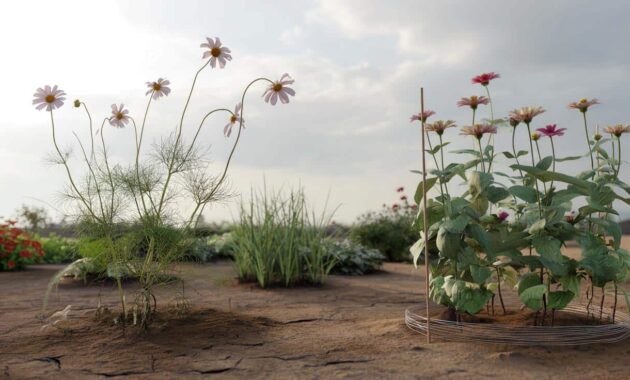
The first time you notice it, you almost feel proud. Your flower stems are shooting up fast, racing each other to the sky. The leaves look lush, the bed looks full, and for a moment you think, “Wow, I’m actually good at this.” Then the wind picks up. The tallest stems sway like drunk teenagers outside a bar. One or two bend a little too far. By the next morning, those “healthy” giants are flopped over, petals dragging in the dirt, like the party went on way too long.
You google in a hurry and land on the same verdict every time: too much nitrogen. Too much fertilizer. You feel a bit guilty. You were just trying to be kind to your plants.
But what if the real story in your soil is more subtle than that?
Why tall, floppy flowers are trying to tell you something
When flowers grow tall but weak, the garden almost looks like a stage set. From a distance, it’s glorious; up close, the stems are thin, brittle, and stressed. You touch them and they bend with a soft “snap” instead of a firm, springy resistance. These are what gardeners call “leggy” plants, and they’re not just awkward. They’re exhausted.
The usual suspect gets all the blame: nitrogen. Too much of it, we’re told, and plants shoot up in a frenzy of green that their stems can’t support. Yet many home gardeners, especially those who barely fertilize at all, still see spindly cosmos, drooping dahlias, or sunflowers that fold in half before they flower.
Picture this: a row of zinnias in early summer, planted from seed along a sunny fence. They germinate beautifully, stretch quickly, and within a few weeks are twice as tall as you expected. The leaves are a decent color, not neon green, the kind that screams “overfed.” Still, every time a storm rolls in, you’re out there with string and stakes, trying to rescue another fallen stem.
A neighbor walks by and says, “Too much nitrogen!” You nod, but in your head you’re replaying the spring: you mixed in a little compost, maybe a slow-release feed, nothing crazy. No weekly blue fertilizer, no manure overload. Yet your plants look like they spent all their energy on height and forgot to build a skeleton.
The truth is, tall and weak flowers are often a signal of imbalance, not just excess. Light, spacing, watering habits, and the overall structure of your soil work together like a team. If one player is off, the whole system tilts. Plants grown in low light stretch to reach the sun. Crowded seedlings compete upward, not outward. Shallow, frequent watering encourages roots to hover near the surface instead of digging deep for stability. And soil that’s rich in nitrogen but poor in potassium, calcium, or organic matter leads to lush leaves on sticks made of glass. *Nitrogen is just the headline in a much more complicated story.*
So if it’s not only nitrogen, what should you really change?
Start by looking up, not down. Weak, leggy flowers often begin with light that’s too soft, too brief, or blocked at the wrong time of day. Most flowering annuals and many perennials need a strong six hours of direct sun to build sturdy stems. If they’re constantly leaning toward one side, twisting to escape shade from a fence or a tree, they’re telling you they’re working harder than they should just to photosynthesize.
One precise move: track the sun on your bed for a full day, then be ruthless. Shift pots. Trim low branches. Rotate containers every few days. Give your flowers a stable, predictable light source, and you’ll already be cutting down the urge to stretch.
➡️ Ozempic and other weight-loss drugs linked to sudden vision loss, two studies suggest
➡️ Bird lovers use this cheap March treat to keep feeders busy and attract birds every morning
➡️ Snow down to the lowlands : Germany braces for a winter blast within days
➡️ A study analyzed LED headlight power in cars, and the conclusion is what every driver already knows
➡️ You should leave a glass and a paper towel in the sink when you go on summer vacation, here’s why
➡️ No eggs at home anymore: these magic substitutes make you forget they’re missing
➡️ Dolphins and orcas have passed the evolutionary point of no return
Next, look sideways: spacing. Those dreamy Instagram flower beds, with dense layers of petals and colors, can be misleading. At home, we cram seedlings closer “just this once” and then act surprised when they grow into a tangle of long, thin stems fighting for air and light. We’ve all been there, that moment when you’re holding extra seedlings and think, “I can’t throw them out, I’ll just squeeze them in.”
This squeeze leads to competition. The plants push upward to escape each other’s shadows, roots get tangled, and airflow drops. Mildew appears. Stems, having never been encouraged to thicken, fold at the first real wind. Giving each plant its recommended spacing feels almost too generous at first, but those extra inches are where strength is built.
Then there’s water and roots — the invisible gym where stems either become athletes or couch potatoes. Frequent, shallow watering teaches roots to hang around the surface, because that’s where the moisture always is. Deep, occasional watering nudges roots to tunnel down, anchoring the plant like a tent peg. The deeper the roots, the better the balance above ground.
Nutrients play a quieter role. A soil that’s loaded with nitrogen but short on potassium and other minerals creates unbalanced growth: lots of leaf, not enough structure. Think of it like feeding a teenager energy drinks but no protein. That’s why many experienced growers quietly favor balanced or low-nitrogen feeds, or even slow, steady nutrition from compost and mulch, rather than quick jolts of green-up fertilizer.
Practical moves that build stronger stems, not taller problems
One of the simplest, least glamorous tricks to fight weak stems is something many gardeners skip: pinching. When young plants like cosmos, zinnias, dahlias, or snapdragons reach about 10–15 cm high, you literally snip off the top growth just above a pair of leaves. It feels brutal the first time. You watch that growing tip fall into your hand and think you’ve just sabotaged your entire season.
A week or two later, the plant responds by branching. More stems, thicker stems, lower center of gravity. The plant becomes a bush, not a flagpole. Early pinching, done once or twice, often does more for stem strength than any fancy fertilizer.
Support is another area where guilt often sneaks in. Many gardeners feel like staking means they’ve “failed” at growing strong plants. Reality is, even the most experienced flower farmers net or stake varieties that are naturally tall or top-heavy. Let’s be honest: nobody really ties in every stem at exactly the right time, every single day.
What helps is choosing support that works with your laziness, not against it. Horizontal netting over a bed, a simple corral of stakes and twine, or even repurposed branches woven between plants can all act as a gentle frame. The goal isn’t to strap the plant in, but to stop that first dramatic flop that bends the stem before it’s fully mature.
So where does fertilizer fit into all this? Think of it as seasoning, not the whole recipe. A balanced, slow-release feed or a light liquid feed during key growth periods is usually enough. The real work happens with soil structure: compost, leaf mold, and regular mulching that improve drainage while holding just enough moisture and adding a wide spectrum of nutrients over time.
Sometimes the bravest thing a gardener can do is to stop throwing products at a problem and start watching more closely instead.
- Watch the light – Check if your plants lean or twist; adjust their position before blaming the soil.
- Respect spacing – Give each flower the room its label suggests, even if the bed looks “empty” at first.
- Water deep, not often – Train roots to go down, so stems can stand up.
- Pinch early growers – Sacrifice a bit of height at the start to gain strength and branching later.
- Feed lightly, build soil
Rethinking what a “healthy” flower actually looks like
Once you start seeing tall, weak flowers as a message instead of a failure, the garden changes. Those floppy cosmos aren’t just “ruined,” they’re clues: maybe that corner is too shaded, or the soil is too rich in quick nitrogen and poor in long-term structure. Your role shifts from fixer to observer, from product user to quiet detective.
You stop chasing dramatic growth and start valuing compact, sturdy plants that might look almost modest in early summer. Later, when the storms roll through and your beds stay upright, it clicks: strength in the garden is rarely loud. It’s built slowly in the dark, in root tips and steady stems that never make it to the fertilizer label.
You might even notice that the flowers you once considered “small” are the ones that survive the season, feed the bees longer, and keep blooming when the overfed giants have already snapped and gone. That’s the moment a garden stops being a contest of size and becomes something closer to a conversation. You adjust one thing, they answer back, and the whole place starts to feel less like a struggle and more like a shared project.
| Key point | Detail | Value for the reader |
|---|---|---|
| Light and spacing matter as much as nutrients | Leggy, weak stems often come from low light and crowding rather than just excess nitrogen | Helps readers fix problems without overcorrecting with harsh fertilizer cuts |
| Root health drives stem strength | Deep watering, good soil structure, and organic matter encourage strong root systems | Gives a practical focus: change watering and soil habits for sturdier plants |
| Simple techniques beat complex products | Pinching, gentle support, and light feeding often outperform aggressive fertilization | Reduces frustration, saves money, and leads to more resilient flower beds |
FAQ:
- Question 1My plants are tall and floppy, but I barely fertilize. What could be wrong?
- Question 2How do I know if it’s really too much nitrogen in my soil?
- Question 3Is pinching safe for all flowering plants?
- Question 4How deep should I water to encourage strong roots?
- Question 5What kind of fertilizer is best to avoid weak, leggy growth?