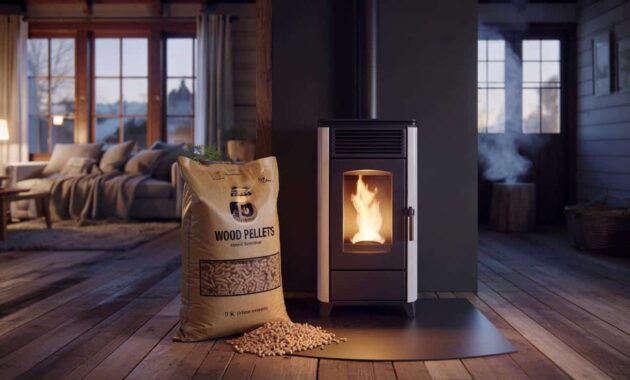
The response is less straightforward than the label on the bag suggests. Between the power setting of your stove, the age of your home and the quality of the fuel, the burn time of those 15 kilos can swing from a quiet, economical two days to a frantic eight hours on full blast.
Pellet consumption: more than just “one bag per day”
People often repeat a rule of thumb: “a bag a day.” In reality, that only fits a narrow range of homes and habits. A 15 kg bag is simply a stock of energy. How quickly you burn through it depends on how hard your stove has to work.
A 15 kg bag of good‑quality pellets can last anywhere from about 7–8 hours to more than 35 hours, depending on your stove settings and insulation.
Most modern pellet stoves on the European and US markets offer a nominal output between 2 kW (low power) and 9–10 kW (high power). The higher the output you ask for, the faster the auger feeds pellets to the flame.
How your stove setting changes burn time
To get a realistic picture, it helps to think in terms of power, not just kilos.
On full power: fast heat, fast empty hopper
When a stove runs near maximum output, it can consume 1.5–2 kg of pellets per hour. That is the kind of setting many users choose on a freezing evening, when the house is cold and everyone wants instant warmth.
At 8 kW output with roughly 2 kg of pellets per hour, a 15 kg bag is gone in about 7–8 hours of continuous heating.
That might cover a late afternoon and evening, but not a full day. In a poorly insulated house or in sub‑zero weather, that “one bag per night” pattern is common.
On eco mode: gentle warmth and much longer burn time
Dial the power down and the picture changes dramatically. Many stoves maintain a comfortable room temperature at 2–3 kW once the space is warmed up.
➡️ Stop washing your hair this often dermatologist warns we have been doing it all wrong
➡️ Mark Zuckerberg’s AI announcement shakes the global scientific community
➡️ Better Than Seeds: Put This Simple Object In Your Garden And Birds Will Return All Winter
➡️ The floating symbol of Chinese power drops anchor in Hong Kong: China flaunts its naval might
➡️ If you want your kids to respect you when they are older stop clinging to these 8 selfish habits
- At around 2 kW, typical consumption is roughly 0.4–0.6 kg per hour.
- At around 3 kW, it can rise to about 0.7–0.9 kg per hour.
In that case, that same 15 kg bag can last more than a full day of intermittent use, or over 30 hours of continuous low‑power operation.
With a well‑insulated home and a stove set around 2 kW, you can reasonably expect 25–35 hours of heat from a single 15 kg bag.
The hidden factor: how well your home keeps the heat
The state of your insulation quietly dictates how hard your stove must work. Two identical appliances will not consume the same amount in a draughty old farmhouse and in a renovated, airtight semi.
How much power do you really need?
Installers often use a simple sizing rule: around 1 kW of heating power for every 10 m² of average‑height living space, in a typical climate. That gives rough guidance:
| Home size | Insulation level | Typical required power | Estimated pellet use* |
|---|---|---|---|
| 60 m² flat | Good | 3–4 kW | 0.7–1.0 kg/h |
| 100 m² house | Average | 5–7 kW | 1.2–1.7 kg/h |
| 100 m² house | Poor | 8–10 kW | 1.8–2.3 kg/h |
*Figures are indicative and assume a reasonably efficient modern stove.
In a compact, well‑insulated home, the stove spends more time ticking over gently. In a leaky building, it is nearly always running hard, which chews through pellets much faster.
What type of pellet stove are you using?
Different stove designs also influence how long a bag lasts, even at similar power outputs.
Air stoves, hydro stoves and ducted models
- Air pellet stoves blow hot air directly into the room. They are common in open‑plan living spaces. Their pellet use is tightly related to the set temperature and fan speed.
- Hydro pellet stoves heat water for radiators or underfloor systems. Because they feed an entire central‑heating loop, they often run at higher average power, which means faster pellet consumption.
- Ducted pellet stoves distribute air to several rooms through ducts. The more rooms you try to heat, the higher the power setting needed.
A single 15 kg bag will generally last longer in a small air stove heating one room than in a hydro model feeding a full house.
Quality of pellets: why two identical bags don’t perform the same
Not all pellets are equal. Moisture content and density directly affect how much usable heat you get from each kilogram.
What to look for on the bag
High‑quality pellets often carry certifications like ENplus or DINplus in Europe. These standards limit moisture content and ash, and demand consistent size and composition.
- Moisture below about 10% means a hotter, cleaner burn.
- Low ash content reduces clinker build‑up and helps the stove maintain efficiency.
Cheaper, dusty pellets may lead to poor combustion, dirty glass and more frequent cleaning. That does not always cut burn time by half, but it can shave off several hours across a full bag and push you toward higher power settings to feel the same warmth.
Real‑life scenarios: how long does one 15 kg bag last?
Scenario 1: small, well‑insulated home
Imagine a 70 m² modern flat with good windows and limited heat loss. The pellet stove is in the living room and runs at low power most of the time.
With the stove mostly at 2–3 kW, a 15 kg bag can easily cover one long winter day or stretch over two milder days of evening use.
In that situation, the phrase “a bag every day and a half” can often be realistic, especially in mid‑season.
Scenario 2: older, draughty house
Now take a 100 m² house with original single‑glazed windows and minimal loft insulation. Temperatures outside stay close to freezing for weeks.
The stove is often pushed near 8 kW to feel comfortable, and maybe left on all day so the walls never cool completely. Pellet use quickly climbs to around 2 kg per hour.
Here, a 15 kg bag might last only 7–8 hours, meaning two bags per full winter day is not unusual.
How many bags will you need for a full heating season?
Once you have a sense of hourly consumption, you can roughly estimate your seasonal needs. Many households run their stoves between 5 and 8 hours per day on average, over a four‑ to five‑month period.
For a typical 100 m², reasonably insulated home, numbers often look like this:
- Daily use: 10–12 kg on cold days.
- Season length: around 120–150 days.
- Total: roughly 1.5–2 tonnes of pellets, or about 100–130 bags of 15 kg.
In harsher climates or in homes where the pellet stove is the sole heat source, the bill can climb toward 3 tonnes or more, especially if the stove runs for long stretches at high power.
Simple ways to make each 15 kg bag last longer
Adjust habits, not just the thermostat
Several low‑tech changes can stretch your burn time without sacrificing comfort:
- Use eco or modulation mode instead of switching the stove on and off at full blast.
- Lower the target temperature by 1 °C; the room often feels almost the same, but pellet use drops noticeably.
- Close doors to rooms that do not need full heating.
- Check and clean the burn pot, glass and flue regularly to maintain efficiency.
A clean, correctly adjusted stove can save several bags over a winter compared with a neglected, soot‑clogged one.
Automation and smart controls
Many newer stoves support thermostats or Wi‑Fi modules. Timers let you target the coldest hours of the day—early morning and evening—rather than running all night. Weather‑sensitive controls adjust power automatically when outside temperatures rise, preventing over‑heating and wasted pellets.
Key terms and figures that help planning
When comparing stoves or calculating how many bags to buy, a few technical notions are worth understanding:
- Rated output (kW): the maximum heat the stove can produce. Running constantly at this level shortens bag life dramatically.
- Efficiency (%): how much of the pellets’ energy actually becomes room heat. Modern stoves often claim 85–95% efficiency.
- Calorific value: how much energy a kilogram of pellets contains. Most wood pellets are around 4.5–5 kWh/kg.
With those figures, you can make simple back‑of‑the‑envelope checks. For instance, a 15 kg bag at 4.8 kWh/kg contains about 72 kWh of energy. A stove producing a steady 4 kW will theoretically empty that “energy tank” in around 18 hours, before factoring in efficiency and real‑world cycling.
Thinking ahead: insulation, backup heat and risk management
Pellet stoves rely on both fuel and electricity. A power cut means no auger, no fan and no control board. For households in rural areas, a backup heater—such as a small gas, electric or log appliance—can prevent unpleasant surprises during cold snaps.
On the financial side, buying pellets early in the season or in bulk often lowers the price per bag. That strategy only pays off if storage is dry, well ventilated and safe from rodents or moisture, which can ruin bags over several months.
Finally, the cheapest “extra bag” is often the one you never have to burn. Basic insulation work in lofts, around windows or on draughty doors can cut your required stove power, lengthen the life of every 15 kg bag and make your whole heating plan more predictable from year to year.
Originally posted 2026-03-11 06:41:00.