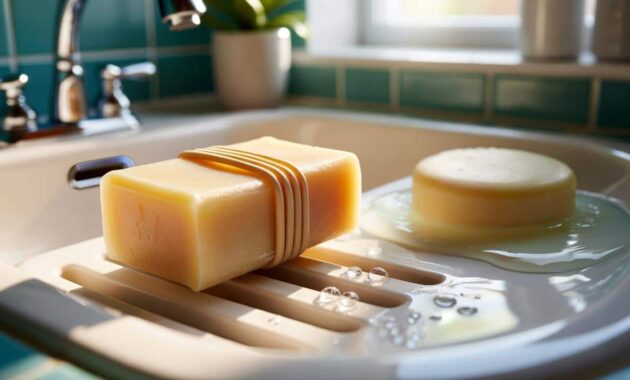
A bar of soap that turns to mush in two days is a quiet domestic tragedy. Slippery, wasteful, faintly icky. There’s a tiny fix doing the rounds in bathrooms and shared flats: slip a rubber band around the bar. No gadgets. No redecoration. Just a loop of elastic that stops the slow melt and keeps the bar firm.
The soap by the sink had sunk into a creamy puddle, edges slumping, scent gone woozy. I grabbed a rubber band from a broccoli bundle and hitched it around the middle of the bar like a belt.
The next morning, the bar felt different in the hand — not heroic, just less defeated. It didn’t skitter across my palm. The underside was drier, the dish cleaner, like the bar had found a spine overnight. A flimsy ring had changed the whole mood. Strange, right?
Why a rubber band keeps your soap from going mushy
Here’s the simple truth: a rubber band lifts the bar off the wet. By creating a low, grippy ridge, it cuts the contact area between soap and dish, so water has places to run and air can get in. That tiny bit of elevation interrupts the film of water that usually clings and wicks into the bar.
A tiny ring gives your bar a fighting chance. The band also adds friction. Your fingers press into it, you need less clasping, and you don’t drop the bar back into a puddle of its own making. Small tweaks, big difference. Not magic. Just mechanics you can feel.
In a chilly flatshare in Leeds, four of us shared one shower shelf. Our soap bars used to flatten like warm cheese by Thursday, no matter the brand. I looped a rubber band round a fresh bar, nothing fancy, just the one that had held the postman’s bundle. Over the next fortnight, the edges stayed square. The dish wasn’t coated in that grey-beige sludge that makes you wipe with the side of your hand.
The kicker? People actually used the bar to the end instead of abandoning a floppy wafer. We’ve all had that moment when you try to rescue a wafer-thin slice that folds like a napkin. With the band, the last sliver clung on longer, so it could be pressed onto the next bar and reborn. Quietly satisfying.
There’s a bit of physics here, friendly and domestic. Water spreads thinly under a smooth bar, then hangs around thanks to surface tension and capillary action between the soap and the dish. The rubber band creates a ridge that breaks that film and opens a tiny gap for drainage and airflow. Think of it as micro-legs.
It also disrupts wicking along the base, so the bar isn’t fed a constant supply of moisture. Glycerin-heavy or “transparent” soaps are the biggest melters; they drink ambient humidity. The band won’t turn a sponge into a stone, but it slows the soak. Less standing water. Less mush. More usable days.
How to do it right at home
Pick a plain rubber band with a medium width — the kind that comes on asparagus or the post. Slide it around the middle of a dry bar and seat it snug, not strangling. If your dish is flat and puddly, twist a second band into a figure-of-eight and wrap so you get a loose X underneath. That creates four tiny standoffs that ride above moisture.
➡️ Deputy Principal Kathleen Boland retires with pride after 40 years at Finn Valley College
➡️ Sweet potato: the microwave trick for perfect cooking in 6 minutes flat
➡️ Pro tip: a crêpe always stays soft when you cook it this way
➡️ If you feel uncomfortable being emotionally open, psychology explains the internal risk assessment
Place the bar with the banded side down after each use, and give the dish a quick tilt to let water escape. In a dish with ridges or holes, one band is enough; it adds grip in the hand and on the shelf. If your soap cracks as you fit the band, warm it briefly under a trickle and try again — warmth softens the surface just enough.
Common trip-ups? Going too tight so the bar splits along the band line, or using a thick neon band that leaches colour onto pale soap. Choose neutral or tan bands if you can. If latex is an issue, a slim silicone hair tie works brilliantly and tends to last longer.
Replace the band when it goes brittle, which it will in steamy rooms. Don’t wrap three or four bands thinking more is better; you’ll choke the bar and trap water rather than shed it. Let’s be honest: nobody really does that every day. So pick the one habit that actually sticks.
The joy of this little hack sits in the way it changes behaviour without asking you to become a saintly bathroom monitor.
“It’s not a gadget, it’s a nudge,” said a Bath shop owner who’d seen customers come back raving. “Lift the bar, and you lift the habit. People rinse, they rotate, they notice the dish again. The soap just lives longer.”
- Pair with a slotted or ridged dish for faster drying.
- Stand the bar on its edge after evening showers when air is still.
- Rinse off clinging suds; residue holds moisture against the bar.
- Rotate two bars: one in use, one resting and drying.
- Prefer denser, triple-milled bars for a slower melt baseline.
A tiny tweak that invites a different kind of care
There’s a wider mood to this fix: a respect for small constraints that make daily life go smoother. A rubber band is a humble thing, a storable loop with no shelf life and no app. It shifts the way the bar meets water and the way your hand meets the bar. That is the essence of good design, hiding in plain sight.
Once you spot it, you start seeing cousins of the idea everywhere — bread on a rack, a damp sponge standing on edge, trainers aired on a step. You might even notice how your bathroom holds moisture at different times of day. Share the nudge with a housemate or a parent. The best tips travel by word of mouth, and this one packs light.
| Point clé | Détail | Intérêt pour le lecteur |
|---|---|---|
| Lift and airflow | Rubber band acts as mini-legs, breaking the water film | Drier bar, slower melt, fewer mushy mornings |
| Grip and control | Band adds friction in the hand and on the dish | Fewer drops, less bar damage, calmer routine |
| Pennies, not pounds | Use any plain rubber band or slim silicone tie | Cost-free hack with immediate payoff |
FAQ :
- Does this work on every type of soap?Mostly, yes. Dense, triple-milled bars benefit most. High-glycerin or gel-like bars still soften in humid rooms, but the band slows the mush by helping water drain and air circulate.
- Where exactly should I place the band?Around the centre of a dry bar. If your dish is flat, add a second band in a figure-of-eight to create an X underside. Keep it snug, not tight enough to cut a groove.
- Will a rubber band harbour bacteria?Not if your bar dries between uses. The band itself doesn’t feed growth. Rinse off suds, let water run off, and give the dish a quick swish now and then. Clean surfaces dry out fast.
- Is a rubber band better than a soap saver dish?They’re cousins. A slotted or ridged dish plus the band is the sweet spot. The dish moves water away; the band reduces contact and adds grip. Use what you’ve got, then upgrade if you like.
- Can I use a hair tie or silicone ring instead?Yes. Slim silicone hair ties are gentle, long-lasting, and latex-free. Avoid bulky scrunchies or thick bands that trap water. One neat loop beats a bundle.