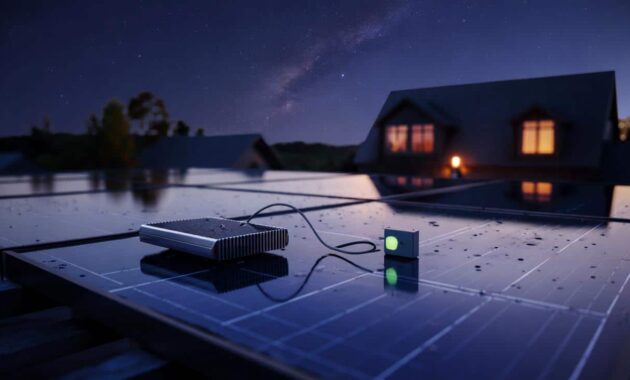
A solar panel that keeps making power after sunset sounds like a trick of language. It’s not. Engineers have finally stitched together radiative physics and familiar rooftop hardware to build panels that harvest the chill of night. The promise is simple: clean electricity, 24/7, without waiting for the morning.
The day had been a white wall of heat; now the air was still and cool. A thin sensor wire ran from a dark panel to a palm‑sized meter, and the numbers didn’t stop. Even as the sky went ink‑black, the panel kept feeding a steady trickle.
The engineer next to me grinned, hands in pockets, like a musician waiting for a drop. He pointed to the stars and said the power was “flowing into space.” It didn’t feel like a metaphor. It felt like a door opening.
Something about this doesn’t compute at first.
Night power, explained like you can feel it
In daylight, a solar cell catches photons and turns them into electricity. At night, the physics flips. The Earth itself glows in infrared, and the open sky acts like an ultra‑cold sink. Engineers are tapping that temperature difference with two approaches: thermoelectric generators stuck to standard panels, and new “thermoradiative” cells that make power by emitting heat to space.
Stand on a rooftop after dark and you feel it in your skin: the surface cools faster than the air. That cooling is energy leaving as radiation. A Stanford team built a prototype that hooks a basic thermoelectric chip to the back of a commercial panel, grabbing that small night‑time temperature gap. It’s modest, but not imaginary—around 50 milliwatts per square meter in field tests, enough for sensors, lights, or a smart lock.
Another group at UNSW pushed the concept deeper: a diode that works like an “anti‑solar” cell, generating current as it radiates infrared to cold space. Today it’s early days—more proof‑of‑concept than grid‑ready—yet the direction is unmistakable. **Night power won’t replace daytime solar; it stitches the dark hours to the day, shrinking the battery gap.** That’s the shift.
What it looks like when this tech meets real life
Picture a rural clinic that already runs on sun. Daytime, the fridges hum and the satellite link stays up. Night used to mean rationing or a stack of tired batteries. With a night‑harvesting layer, the clinic gets a low, constant baseline after sunset—ventilation, a row of LEDs, a cooler that doesn’t sweat. No drama, just continuity. We’ve all had that moment where a small, steady thing makes the big thing possible.
In towns hit by heat waves, radiative‑cooling materials—a cousin of this tech—already cut roof temperatures by several degrees, shaving air‑con bills. Put a thermoelectric module in the mix and you turn that cooling into watts. Early pilots report night power that might run a porch light or charge a phone. Multiply that across millions of roofs and the grid sees less evening surge, which means fewer gas peakers roaring to life at 8 p.m.
There’s a psychology shift here too. Rooftop solar used to be a sun‑only story; batteries were the band‑aid. This adds a second pillar: a quiet, maintenance‑light stream of dark‑hour power. It won’t run your oven at midnight, not yet. **It will keep the small stuff alive, shrink battery cycles, and buy time when storms knock lines down.** Stability is its superpower.
➡️ A French physicist claims to have replicated lightning energy in a lab and shocks the world
➡️ The hidden dangers of reusing ice cream tubs that many people ignore
➡️ Google scientists announce a chip that learns autonomously without human data input
➡️ Astrology predicts a time when karmic lessons finally turn into empowerment and self-respect
How to prepare your home for the first wave
Start with your energy map. What hums after dark that truly matters? List the “night loads” that keep you comfortable and safe: Wi‑Fi, a modem, a handful of LEDs, a fan, a CPAP, a smart lock. Add their wattage, add hours, and you’ve got your night budget. Now you can match that with a hybrid setup: daytime PV + small battery + night‑harvesting layer for the trickle. Think of it as a relay team, not a solo sprint.
Wiring matters. A hybrid inverter with a DC bus makes it easier to route tiny night flows to the devices that sip power. Keep lines short, use efficient DC appliances where it makes sense, and isolate your critical loads on a subpanel. Let the rest sleep. Soyons honnêtes : personne ne fait vraiment ça tous les jours. But one visit from a local installer and a small re‑think of outlets can lock in the gains.
Placement is a quiet win. Panels that “see” a clear sky cool more. Avoid trees that vault overhead and trap heat. Dark‑sky exposure beats rooftop clutter. At 2 a.m., the panel was still quietly working.
“People expect fireworks,” the engineer told me. “What they get is a steady whisper—and that’s what keeps the page online at midnight.”
- Choose a hybrid inverter with a low standby draw.
- Set a “night mode” on smart plugs to cut phantom loads.
- Use DC lighting in hallways and entries for maximum efficiency.
- Ask installers about thermoelectric add‑ons compatible with your array.
What’s changing behind the scenes
Utilities design for peaks. The ugly one hits after sunset when people cook, cool, stream, and charge. Night‑harvesting tech trims that curve from rooftops outward. It won’t flatten it alone, yet the compound effect with batteries, EVs, and demand response is real. A street of homes shaving 50 to 150 watts each over six hours is a transformer that runs cooler and lasts longer. That’s money saved you’ll never see as a headline.
Research is sprinting. Stanford’s field data shows dependable trickles without moving parts. UNSW’s thermoradiative work hints at future materials with far higher output, especially if paired with mid‑infrared optics. Startups are stitching radiative‑cooling films into roof membranes that reflect sun by day and shed heat by night. **The endgame is simple: roofs that generate, store less, and glide through the dark without blinking.** The timeline is less about if, more about how fast costs drop.
There’s also a cultural nudge. Energy at night has been a fossil‑fuel habit for a century. When rooftops whisper watts into the small hours, the story you tell your kids changes. You sleep under a ceiling that works. The grid becomes a partner, not a lifeline. That shift is hard to chart in kilowatts, but you feel it the first time the storm passes and your porch light never went out.
| Point clé | Détail | Intérêt pour le lecteur |
|---|---|---|
| Night‑harvesting basics | Uses radiative cooling and thermoelectric or thermoradiative devices to make power after dark | Understand how a “solar panel at night” actually works |
| Real‑world output today | Field demos ~50 mW/m² with thermoelectrics; thermoradiative cells are earlier but advancing | Set honest expectations for lights, sensors, and backup |
| Home prep | Hybrid inverter, critical‑load subpanel, DC‑friendly devices, clear sky view | Concrete steps to capture night power and waste less |
FAQ :
- Does a night‑solar panel really work in complete darkness?Yes. It doesn’t need moonlight. It harvests the heat your roof radiates to the cold sky, creating a temperature difference that a device can turn into electricity.
- How much power are we talking about right now?Think tens of milliwatts per square meter in field tests with thermoelectric add‑ons. Enough for sensors, routers in low‑power mode, and pathway lights. Future materials aim higher.
- Will this replace home batteries?No. It complements them. Night‑harvesting reduces how hard your battery cycles and keeps essential loads alive longer during outages.
- Can I retrofit my existing solar array?In many cases, yes. Installers can add a thermoelectric layer to the back of panels or integrate radiative‑cooling surfaces on the roof, tied into a hybrid inverter.
- Is this safe for my roof and the grid?Yes. The add‑ons are passive, with no moving parts. On the grid side, they reduce evening spikes rather than stress lines. Let’s be honest: nobody does that every day, but once it’s set up, it just works.