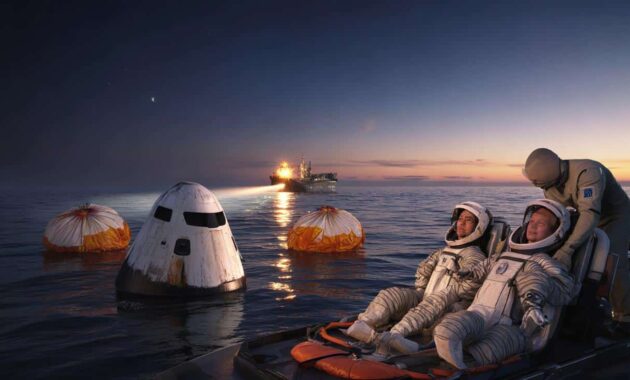
A SpaceX capsule sliced back through the atmosphere at dawn, ending a mission that suddenly changed course mid‑orbit.
The Crew-11 astronauts touched down earlier than scheduled after a medical concern on the International Space Station, prompting a rare, fast-tracked return to Earth that space agencies say was cautious, controlled and unprecedented in ISS history.
A carefully shortened mission, not an emergency scramble
Crew-11 had been expected to stay on the International Space Station (ISS) for roughly six months. Instead, the four astronauts came home after about five, following reports that one crewmember had fallen ill in orbit.
Space agencies have kept tight-lipped on the medical details. The case is described only as a “medical issue” affecting one astronaut, with no indication of a life-threatening emergency. Flight controllers decided that bringing the whole crew back early, as a unit, was the safest way to handle the situation.
Crew-11’s return marks the first time in ISS history that a long-duration mission has been cut short specifically for medical reasons.
The Crew Dragon spacecraft undocked from the ISS and re-entered Earth’s atmosphere before splashing down off the coast of California at 09:41 Paris time. Recovery teams were in place, approaching the capsule within minutes and towing it to a recovery ship near shore.
A textbook splashdown for Crew Dragon
NASA video showed the Crew Dragon capsule, darkened by re-entry, descending under four main parachutes before hitting the Pacific in calm seas. Within the hour, the spacecraft was secured and winched aboard a recovery vessel.
Extraction followed the standard order: pilot Mike Fincke first, then mission commander Zena Cardman, followed by mission specialists Kimiya Yui and Oleg Platonov. Each astronaut was lifted out one by one, helped into reclining seats and then transferred onto stretchers.
All four crewmembers appeared conscious, smiling and in “apparent good health” as medical teams began initial checks on deck.
This stretcher procedure is routine for long-duration spacefarers. Months in microgravity weaken leg muscles, alter blood circulation and reduce bone density. Standing up too quickly after landing can trigger dizziness or fainting, so teams keep the first few hours strictly controlled.
➡️ “It’s the first time I’ve ever seen one”: Dinard fisherman hauls up ultra-rare blue sea spider crab
➡️ Pressure mounts on Nasa: the space station is nearing its end and no replacement is ready
➡️ This creamy avocado pasta sauce comes together in less than five minutes
➡️ Wood heating: pellets give way to pallets
➡️ There Are 4 Kitchen Utensils To Watch Out For In 2026, According To “60 Millions de Consommateurs”
➡️ Scientists create powerful new form of aluminum that could replace rare earth metals
➡️ Does my landlord have the right to enter my garden to pick fruit?
Why astronauts leave the capsule on stretchers
Even for healthy astronauts, walking immediately after a long mission is not recommended. Returning crews often face:
- temporary muscle weakness and balance issues
- lower blood volume and blood pressure regulation problems
- a slight delay in how the inner ear readjusts to gravity
- fatigue after re-entry forces and a sleepless final night in orbit
Doctors monitor heart rate, blood pressure and neurological responses straight away. Most astronauts are standing and walking with support within hours, but the first phase is deliberately cautious.
“The right decision, even if bittersweet”
Earlier in the week, pilot Mike Fincke had set the tone in a message from orbit, acknowledging that Crew-11 would not complete its full planned stay on the ISS. He described the early return as “a carefully considered decision” and “the right decision, even if it is bittersweet.”
His words underlined a hard truth of human spaceflight: missions are designed around science and engineering goals, but health always takes precedence. Space agencies and crews train extensively for this trade-off.
The crew framed the early landing less as a crisis than as a precautionary use of capabilities they hope never to need.
Space history includes a few medical-related early returns from the Soviet era, but they remain extremely rare. In most cases, orbital crews manage illnesses onboard until the planned end of their mission, drawing on medical kits, telemedicine support and cross-trained crewmates.
Life and science on the ISS carry on
The station is far from empty following Crew-11’s departure. Three astronauts and cosmonauts from the Soyuz MS-28 mission — two Russians and one American — continue to operate the ISS, manage experiments and maintain critical systems.
They will soon be joined by Crew-12, the next NASA–SpaceX rotation flight. Among its members is French astronaut Sophie Adenot, who is preparing for her first trip to orbit. Her mission had been pencilled in for 15 February, but NASA has indicated that the launch date might be moved forward.
Bringing Crew-12 up a little earlier would reduce the time the station runs with a smaller team and keep scientific operations close to full speed.
This juggling of launch and landing dates is now part of normal ISS life. With multiple visiting vehicles — SpaceX’s Crew Dragon, Russia’s Soyuz, and various cargo craft — schedules are tweaked regularly to match technical checks, weather windows and crew health.
Who is staying aboard the ISS right now?
| Vehicle | Nationality mix | Status |
|---|---|---|
| Soyuz MS-28 | Two Russian cosmonauts, one American astronaut | Currently onboard, maintaining station operations |
| Crew-11 (Crew Dragon) | US, Japanese, Russian crew members | Returned to Earth earlier than planned |
| Crew-12 (Crew Dragon) | Includes French astronaut Sophie Adenot | Preparing for launch, date may be advanced |
How prepared are crews for medical issues in orbit?
Although a medical-triggered early landing is new for the ISS, the situation sits within a framework that NASA, ESA, JAXA and Roscosmos have rehearsed for decades. Astronauts receive training similar to advanced paramedics, including basic surgery skills, dental procedures and emergency care protocols.
The station carries dedicated medical supplies: defibrillators, oxygen systems, drugs, IV equipment and portable ultrasound scanners. Ground doctors talk directly with the crew during health checks, using secure channels and sometimes real-time video.
In extreme cases, the station’s design allows a crew to load a sick astronaut into a spacecraft that doubles as a lifeboat and return on short notice.
Spaceflight physicians also try to anticipate risks before launch. Astronauts undergo years of screening: heart, lungs, vision, mental health, even genetics. Yet no test can completely eliminate unexpected illness in a harsh, enclosed environment orbiting 400 km above Earth.
Why this early return matters for future missions
Crew-11’s shortened stay may look like a setback, but for mission planners it doubles as a real-world test of contingency systems. Decision-making chains between Houston, other control centres and the ISS crew were put into practice under live conditions, not just in simulations.
Such events feed directly into plans for trips beyond low Earth orbit. On a future mission to the Moon’s Gateway station, or one day to Mars, communication delays and limited evacuation options will amplify the stakes of any medical problem.
Space agencies will be studying several questions in the wake of Crew-11’s return:
- How quickly can ground teams assess incomplete medical information from orbit?
- Where is the tipping point between treating in place and cutting a mission short?
- What additional training or equipment might reduce the need for early returns?
Key terms behind the headlines
Crew Dragon. SpaceX’s Crew Dragon is a reusable, human-rated capsule used by NASA to ferry astronauts to and from the ISS. It launches on a Falcon 9 rocket, remains docked as a lifeboat and then brings crews home via controlled re-entry and splashdown.
Astronaut. In everyday language an astronaut is anyone trained and certified to fly into space. On the ISS, astronauts and cosmonauts split duties between science, maintenance, robotics, cargo handling and medical care, often rotating roles depending on their background.
Gravity and microgravity. Astronauts on the ISS are not outside Earth’s gravity; they are in continuous free fall around the planet. This creates microgravity, a state where objects and people appear weightless. Long stays in microgravity change the body: muscles shrink, bones lose minerals and body fluids redistribute toward the head.
What this means for people, not just hardware
Behind the acronyms and procedures, an early landing is a human event. Families are notified, flight plans are reshuffled and astronauts come home with mixed feelings — proud of their work, yet aware that something forced a change they did not plan.
The Crew-11 episode underlines a core reality of long-duration spaceflight: progress depends on how well systems support the frailty of human bodies. Strong spacecraft, reliable rockets and sharp mission control teams all matter, but so does the ability to say, at the right moment, that coming home early is the wiser course.