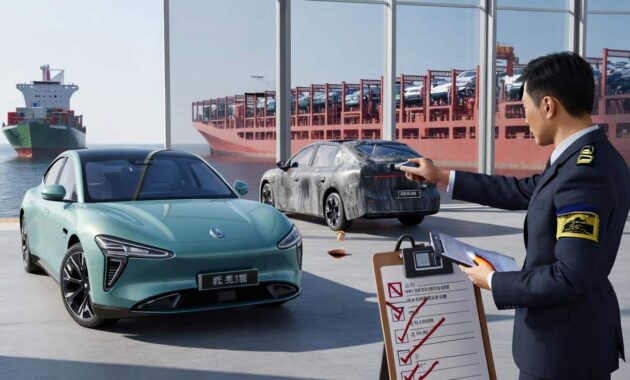
Behind the record exports and low prices, Beijing is now facing a growing backlash: complaints about shoddy electric cars, missing spare parts and ghost-like after-sales networks. That combination has not only angered regulators in Europe, including France, but has also started to damage the image China wants for its electric vehicle (EV) champions. So the government is tightening the screw.
China decides image matters more than volume
From 1 January 2026, China plans to introduce much tougher export rules for electric vehicles, according to a framework flagged by officials and reported by Reuters. The new line from Beijing is clear: access to foreign markets will be conditional on quality, traceability and proper support for customers abroad.
China will require export licences for electric cars, and only official manufacturers and companies formally authorised by them will be allowed to ship vehicles overseas.
That sounds technical, but it changes the game. Until now, a loose network of intermediaries could buy EVs in China and send them abroad with little oversight. Under the new regime, brands will carry direct responsibility for what leaves the country, and for what happens to those cars once they reach Europe, the Middle East or Africa.
For Beijing, this is about more than paperwork. Chinese officials want their domestic champions to be spoken of in the same breath as Toyota, Volkswagen or Hyundai, not as purveyors of disposable bargain-basement cars. That means raising the floor on quality and ending some of the more dubious practices in the export trade.
A crackdown on the EV “wild west” exporters
The move responds to a specific and growing problem. Independent traders – often small, fast-moving operators – have been exploiting loopholes around EV exports. A typical trick has been to ship brand-new electric cars while declaring them as “used” vehicles to slip through lighter regulations or avoid certain checks and taxes.
These cars then land in foreign markets, including parts of Europe and North Africa, without any official importer to look after them. That means no reliable service network, no guaranteed warranty, and in some cases, no supply of certified spare parts at all.
Buyers were being left with slick-looking EVs that became very expensive bricks the first time something serious went wrong.
For end users, the consequences can be stark: long repair delays, improvised fixes using non-standard parts, or cars abandoned when a key battery component fails. For established brands, the fallout is reputational. Even if the vehicle itself was correctly built, the lack of after-sales support turns a technical success into a commercial liability.
➡️ No bleach or ammonia needed: the simple painter-approved method to eliminate damp at home for good
➡️ “More free time, fewer jobs”: the missing piece in these predictions people ignore (income)
There is a financial angle as well. These grey exporters often undercut official importers on price, forcing legitimate dealers – and sometimes the manufacturers themselves – into a margin-destroying race to the bottom. Beijing now sees this as a threat to the long-term health of the sector.
Quality before quantity as a national strategy
Chinese policymakers are signalling a shift: better to export fewer vehicles at higher standards than ship as many as possible, regardless of what happens next. Regulators want carmakers to adopt rigorous, standardised processes similar to long-established global brands.
The goal is to associate “made in China” cars with reliability and structured service, not just with low prices and aggressive discounts.
This policy comes at a sensitive time. The European Union has launched anti-subsidy probes into Chinese EVs, and several Western governments are either raising tariffs or debating them. Against that backdrop, China is betting that higher perceived quality and robust customer support will help its brands withstand political pressure and justify their presence on foreign roads.
What will change for Chinese brands and buyers abroad?
The upcoming licensing system is likely to reshape how Chinese cars reach countries like France, Germany or the UK. Several concrete shifts can be expected:
- Fewer small intermediaries sending cars abroad without brand backing.
- More official import agreements with clear responsibilities for recalls and warranties.
- Stricter documentation on where cars come from, how they were built and how they will be supported.
- Gradual phase-out of models that cannot meet reliability or support requirements.
For French and European customers tempted by the low sticker price of many Chinese EVs, the landscape may look different by 2026. Discounts may be less spectacular, but there should be clearer guarantees on service, software updates and spare parts availability.
France’s scepticism is a key concern
France has become one of the loudest critics of Chinese EV imports, arguing that heavy state support and loose export practices distort competition. French officials have pointed to examples of vehicles sold at strikingly low prices, backed by little in the way of local infrastructure.
Consumer sentiment has followed. While some French drivers are impressed by the tech-packed cabins and bold designs of new Chinese models, others remain wary. Stories of EVs lacking certified service centres or waiting months for replacement batteries have made headlines and spread quickly on social media.
Beijing understands that this perception can stick. A wave of poor experiences today risks closing doors tomorrow, just as Chinese makers push high-end models and plan factories in Europe. The new export controls are, in part, an attempt to reassure sceptical markets that the “cheap and cheerful” era is coming to an end.
How this fits with China’s bigger EV ambitions
China is not walking away from aggressive EV exports. Officials still see massive potential: many countries are tightening emissions rules; the cost of batteries produced in China remains highly competitive; and Chinese brands are fast at rolling out new models and software updates.
Instead, Beijing is trying to shift the narrative from quantity to credibility. If Chinese EVs are seen as robust, repairable and well-supported, political arguments about “unfair imports” become harder to sustain. That point matters as trade tensions expand beyond simple tariff fights to include supply-chain security and national industrial strategies.
| Before 2026 | From 2026 onwards |
|---|---|
| Loose oversight of EV exports | Mandatory export licences for EVs |
| Many grey-market intermediaries | Only official makers and authorised firms can export |
| Patchy after-sales networks abroad | Stronger pressure to ensure service and spare parts |
| Race to the lowest price | Greater focus on sustainable margins and brand image |
What this means for drivers and dealers in practice
For buyers in France, the UK or other European markets, the shift should eventually translate into a more predictable ownership experience when choosing a Chinese EV. Instead of relying on a small importer with a mobile phone number and a rented lot, customers are more likely to interact with structured dealer networks backed by long-term contracts with manufacturers.
That can change the risk calculation. A car that is cheaper by a few thousand euros looks less attractive if there is a real chance of being stranded without parts in three years’ time. With Beijing pressing brands to guarantee support, the gap between the “headline price” and the “real cost of ownership” may shrink.
Dealers, too, will feel the change. Smaller importers who built a business on parallel imports could struggle. Larger groups able to sign official agreements, meet training standards, and stock strategic parts will find themselves in a stronger position, both commercially and legally.
Key concepts buyers should know
Several technical terms sit behind this policy shift, and they are worth keeping in mind when evaluating any imported EV:
- Export licence: an official authorisation that allows a company to ship vehicles abroad and carries clear legal responsibilities.
- After-sales service: everything that happens after the sale, from basic maintenance to recalls, software updates and repairs after accidents or failures.
- Spare parts supply: the network and logistics system that ensures critical components – especially batteries, electronic modules and body parts – can be delivered quickly where needed.
- Grey import: a vehicle brought into a country outside official distribution channels, often cheaper but with uncertain support.
When considering a Chinese-brand EV in the coming years, asking direct questions about these topics will matter: Who is the official importer? Where is the nearest authorised repair centre? How long are parts expected to take? Are software updates guaranteed for a set number of years?
As China clamps down on low-quality exports, brands that can answer those questions clearly stand to gain trust. Those that cannot may find that the doors of markets like France are no longer as open as they were during the freewheeling early phase of the EV boom.
Originally posted 2026-03-09 05:43:00.