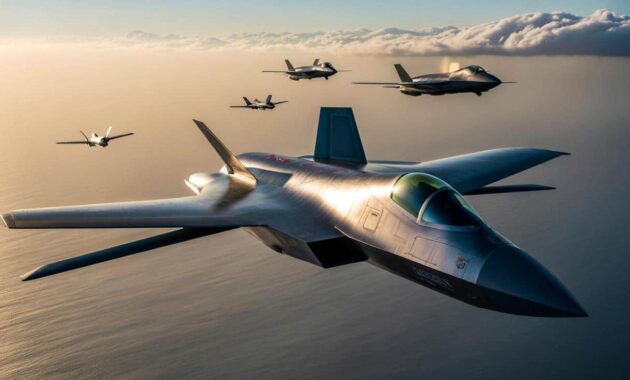
In recent months, China has quietly flown what appear to be next‑generation stealth fighters with radical tailless designs, sparking concern in Washington that Beijing could be edging ahead in the race for sixth‑generation air combat dominance.
China’s mysterious tailless fighters raise eyebrows
The first sightings came in December, when two sleek, tailless jets took off from a heavily guarded airfield in China’s Sichuan province. The images, shared on Chinese social media and amplified by state‑linked outlets, showed aircraft with smooth blended wings, almost no protruding surfaces, and shapes optimised to scatter radar waves.
For military analysts, that tailless profile is a calling card of sixth‑generation fighters designed to be harder to detect, harder to track and tougher to kill.
Beijing offered no formal announcement. No grand unveiling, no press conference. The aircraft simply appeared, flew, and vanished again into hangars. That silence may be deliberate. By letting the world see just enough to worry, China can send a strategic signal without revealing genuine capabilities or shortcomings.
Chinese commentators have loosely labelled the new jets as part of a “J‑XX” family, separate from the already‑operational J‑20. Their exact designation, engines and onboard systems remain unconfirmed.
A quiet show of strength aimed at Washington
A few days after the first public flights, an official Chinese publication, China Academy, went a step further. It suggested that the new fighters were not just prototypes, but already in “mass production” and potentially entering operational units, citing visible serial numbers on the fuselages as evidence.
That language served a clear purpose: to claim that China is not merely catching up, but overtaking the United States in the next big leap of air combat technology.
Chinese media have openly argued that Beijing could be as much as ten years ahead of Washington in fielding a true sixth‑generation fighter.
In a contest where perception shapes policy, such claims matter. If allies begin to doubt US aerial supremacy, calls for regional balancing, larger defence budgets or hedging towards Beijing may grow louder.
➡️ Space sovereignty: can France still keep up with SpaceX and China?
➡️ The psychological reason eye contact feels intense for some personalities
➡️ Swalwell says he’ll strip driver’s licenses from ICE officers who wear masks
➡️ I kept turning up the heat and still felt cold : experts explain this common home problem
➡️ Why chefs sometimes add butter to coffee-based desserts for deeper flavor
What Beijing says these new jets can do
State media and military commentators in China have painted an ambitious picture of the new aircraft’s performance. While much of it remains unverified, the list of advertised features reads like a wish‑list for future air forces:
- Hypersonic‑capable propulsion, potentially exceeding 6,100 km/h under specific conditions
- Highly advanced stealth shaping and radar‑absorbent materials
- Onboard electrical power close to 1 megawatt to feed sensors and energy‑hungry systems
- Integrated artificial intelligence for semi‑autonomous or autonomous combat functions
- Network‑centric warfare capabilities to link fighters, drones, satellites and ground assets into a single combat web
If even part of this wish‑list is already flying, the implications are serious. High electrical power could support directed‑energy weapons, such as powerful jammers or future laser systems. AI co‑pilots could manage data overload, letting human pilots focus on high‑level decisions instead of sensor micromanagement.
How China’s claims stack up against the US program
While neither side reveals full details, publicly available statements and leaks allow a rough comparison between China’s new designs and the US Next Generation Air Dominance (NGAD) project, often associated with a future F‑47‑style fighter.
| Feature | China (J‑XX family) | United States (NGAD / F‑47‑type) |
| Target entry into service | 2025–2027 (unconfirmed) | 2028–2030 (estimated) |
| Top speed focus | Mach 5+ claims in some profiles | Mach 2–3 with emphasis on range and survivability |
| Teaming with drones (“loyal wingman”) | Concepts in active development | Flight‑testing of collaborative drones underway |
| Advanced electrical power | Reported experimental high‑power systems | Demonstrated in various test programs |
| Hypersonic weapons | Claimed integration | Confirmed testing and limited deployment |
The contrast is striking. China’s messaging leans heavily on speed and headline‑grabbing performance numbers. The US narrative, when officials speak at all, stresses integration, survivability and the aircraft’s role as a command node for a swarm of other systems.
Why US officials remain sceptical of claims of Chinese “lead”
Western experts caution against taking Chinese state media at face value. Aircraft can look extremely futuristic while still struggling with engines, sensors or software integration.
Building a prototype that flies is one achievement; creating a reliable, combat‑ready fleet with trained crews, robust maintenance and secure data links is another level entirely.
US leaders have hinted that NGAD has already flown in secret, with one former Air Force acquisition chief revealing in 2020 that a prototype had completed test flights after a remarkably fast development cycle. Those tests likely occurred at remote ranges in the American Southwest, far from prying smartphones.
Washington’s strategy hinges on keeping actual capabilities ambiguous. By refusing to put its new flagship fighter on public display, the Pentagon denies rivals a clear picture of radar signatures, engine acoustics and heat profiles.
A contest of images as much as engines
For Beijing, highly public test flights and bold performance claims deliver more than just technical milestones. They send a message to domestic audiences that China is no longer trailing Western powers, and to foreign observers that US dominance in the skies is no longer guaranteed.
At the same time, Chinese engineers still face the hard problem of integrating advanced engines, stealth materials, long‑range sensors, data fusion and secure software into one reliable package. That integration edge is where many analysts argue Washington still holds a lead.
The true battleground is not just the airframe, but the invisible architecture of networks, algorithms and logistics that keeps a modern fighter lethal day after day.
US airpower relies on a vast ecosystem of satellites, tankers, early‑warning aircraft and secure communications. Replicating that system is far harder than rolling a visually striking prototype out of a hangar.
What “sixth‑generation” really means
The term “sixth‑generation fighter” is more marketing label than scientific category, and different countries define it differently. Still, most experts agree on a few core attributes:
- Extreme stealth against radar, infrared and even some electronic sensors
- Deep integration with drones, sometimes controlling entire autonomous formations
- Massive data‑fusion capabilities acting as an airborne command centre
- High electrical power for advanced sensors and, eventually, energy weapons
- AI‑assisted decision‑making for both pilots and unmanned teammates
A key shift is that future fighters are less about “dogfighting” in tight turns and more about who can detect, decide and fire first from long range while staying hidden in a crowded electronic environment.
Possible scenarios that worry US planners
Defence planners in Washington run war‑games where Chinese sixth‑generation fighters and drones work together over the Western Pacific. In those scenarios, tailless stealth jets could push forward as sensor nodes, with swarms of cheaper drones fanning out ahead, hunting US carriers or bases.
If these aircraft can coordinate long‑range hypersonic missiles, they could attempt to overwhelm American and allied air defences through sheer speed and numbers. That prospect is already driving new US spending on missile warning systems, hardened bases and dispersed operations across smaller islands.
Key risks and side effects of the new arms race
This race for dominance brings its own dangers. Rapid deployment of AI‑driven systems raises the chance of miscalculation in a crisis, especially if autonomous drones misinterpret radar tracks or electronic signals near contested borders.
The cost is another issue. Both China and the United States are pouring enormous funds into aircraft that may be obsolete faster than previous generations, as cyber threats, anti‑satellite weapons and new sensors evolve. Smaller nations watching from the sidelines risk being locked out of cutting‑edge technology, deepening dependency on one of the major powers.
For readers, a few terms matter. “Stealth” does not mean invisible; it means pushing detection ranges so far back that the aircraft can strike first. “Hypersonic” typically refers to speeds above Mach 5, but such speeds are difficult to sustain for long without sacrificing range or stealth. And “loyal wingman” drones are semi‑autonomous aircraft that fly alongside a crewed jet, carrying extra missiles, jammers or sensors, and taking the brunt of enemy fire if needed.
As China tests its tailless fighters more frequently, satellite images and open‑source tracking will likely reveal fresh details. At the same time, the US NGAD program will remain mostly in the shadows, leaving the public story lopsided: bold Chinese footage on one side, tense silence on the other, and a nervous set of allies trying to guess who really holds the advantage in the skies above them.
Originally posted 2026-03-09 02:36:00.