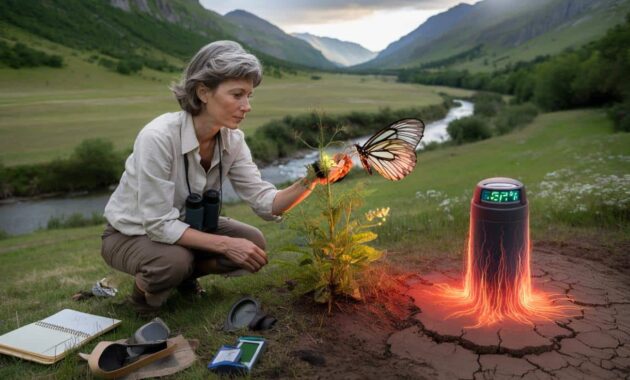
In a quiet valley in the French Pyrenees, a US ecologist tracks butterflies, hybrid bears and invisible migrations reshaping life.
From a remote CNRS research station in southern France, Camille Parmesan – a scientist who fled both Trump’s America and post‑Brexit Britain – is watching the living world rearrange itself under climate pressure, species by species and gene by gene.
From Texas to Ariège: when a scientist becomes a refugee
Parmesan built her reputation in the United States, showing that climate change was already forcing wild animals to shift their ranges. Her early work on Edith’s checkerspot butterfly was among the first hard proofs that global warming was disrupting a wild species’ survival.
That work eventually contributed to the Nobel Peace Prize awarded to the IPCC team she worked with. Yet her own life has become a case study in how politics can derail climate research.
She left the US in 2016 as climate denial hardened under Donald Trump. She then relocated again, quitting the UK after Brexit, worried about funding cuts and a hostile mood around international collaboration. Today she runs the CNRS Theoretical and Experimental Ecology Station in Moulis, a small village in Ariège, where a global network of scientists study how ecosystems cope with a heating planet.
As laws and politics shift, some researchers now move across borders not for career ambition, but simply to keep doing climate science.
The butterfly that proved climate change was already here
How a pickup truck and a notebook rewrote the science
Parmesan’s breakthrough did not come from supercomputers. It started with a pickup truck, a tent, a butterfly net, strong reading glasses and a paper notebook.
Before going into the field, she spent a full year in US, Canadian and European museums, poring over drawers of pinned butterflies. For each specimen of Edith’s checkerspot, she copied by hand tiny labels: the exact place, the date, sometimes even “one mile from Parsons Road, 19 June 1952”.
Because the species lives in small, sedentary populations, those old labels became a time machine. They showed where the butterfly used to live and when adults were active.
Then came the brutal part: visiting each of those sites during the short flying season, about a month long and different at every altitude. Parmesan and colleagues had to guess the right week, then search for adults, eggs, tiny silk webs spun by young caterpillars and bite marks on the host plants’ leaves.
➡️ How to keep mice seeking shelter out of your home: the smell they hate that makes them run away
➡️ Goodbye balayage: “melting,” the new coloring technique that makes gray hair almost unnoticeable
➡️ I tried this skillet apple crumble and now I make it year-round
➡️ Why chefs often taste sauces repeatedly while cooking
➡️ Goodbye hair dye : the new trend to cover gray hair and look younger
They checked habitat quality in detail: were there enough healthy host plants, enough nectar sources for adults? Sites obviously damaged by farming or pollution were excluded. She wanted to isolate the climate signal from other human impacts.
On large sites, she sometimes inspected more than 900 individual plants before deciding the butterfly was really gone.
The pattern that emerged was striking. Populations at the warm, southern and low‑altitude edge of the range were disappearing. At cooler, higher or more northern locations, new populations appeared. The butterfly was not just fluctuating randomly; it was tracking rising temperatures across the landscape.
New behaviours, new threats: when the ground hits 78°C
Decades later, when Parmesan returns to those same meadows, she is seeing behaviours no one thought to measure in the 1980s. One detail turns out to be critical: the height at which females lay their eggs.
Now, the eggs are laid slightly higher above the ground. That small change is a life‑or‑death adaptation. Recent measurements showed surface temperatures reaching 78°C at ground level on scorching days. A caterpillar that falls onto that surface can simply cook.
Butterflies themselves sometimes land, then instantly take off, unable to keep their feet on the overheated soil. They seek shade in taller vegetation, or even on human observers.
Parmesan argues that many young biologists underestimate this kind of careful watching. Lab genetics, big datasets and models matter, but without long, slow observation of living animals in their habitats, crucial shifts like egg‑laying height can be missed.
Rethinking conservation: from strict reserves to climate portfolios
Why protecting only current habitats is a losing bet
Conservationists often focus on saving the places where a species lives today. Parmesan’s work suggests that, under rapid warming, that strategy alone fails in most future scenarios.
In one project, her team used standard bioclimatic models to simulate about 700 possible climate futures for 22 species. They tested different conservation strategies against each scenario.
In most modelled futures, a species simply was not present at its current site. Only a tiny fraction – about 1–2% of scenarios – kept it there.
So they borrowed ideas from water management and economics, fields used to planning under deep uncertainty. With modern computing power, they could ask: what if we protect current sites plus areas where the species shows up in 30% of futures? Or 50%? Or 70%?
By comparing these options, they identified “robust” sets of sites – combinations that gave decent outcomes across many different futures, rather than perfect outcomes in just one.
- Protect current habitats where species still live
- Add areas where models predict frequent future presence
- Favour large, diverse landscapes (mountains, valleys, varied microclimates)
- Create corridors linking these areas so species can move
- Mix strict reserves with semi‑natural, lightly used land
The message: hanging on only to present‑day hotspots is not enough. Species will leave, others will arrive, and a site can remain rich in life while hosting a very different cast of characters.
Corridors, gardens and taxes: giving species safe passage
Parmesan stresses that movement is now as critical as protection. Between protected areas, many landscapes are lethal. Crossing vast wheat fields, for instance, can be deadly for small animals or insects, from exposure, pesticides or simple lack of food and shelter.
She argues for semi‑natural “corridors” that thread through intensive farmland and cities. Rivers are obvious anchors: leaving broad, wild buffer strips on both banks lets plants and animals move along watercourses with far lower risk.
These corridors do not need to be perfect habitat. They just need not kill organisms attempting to migrate.
Normal back gardens can also act as stepping stones, especially if parts are left unmown, weedy and slightly messy.
She mentions nettles and brambles as surprisingly useful structures for insects and small animals. Road verges can play a similar role if not mown too short or drenched in herbicides. Public policy could nudge landowners through tax breaks or other incentives for leaving strips of land undeveloped and semi‑wild.
Hybrid bears and the new genetics of survival
From “pizzlies” to genetic insurance
One of the most unsettling shifts Parmesan tracks is rising hybridisation. As species move, they meet others they were long separated from. In the Arctic, shrinking sea ice is pushing polar bears onto land, where they encounter brown bears and grizzlies. Some pairings produce fertile offspring nicknamed “pizzlies”.
Classic conservation thinking saw hybrids as a problem. The goal was to keep species “pure”, preserving distinct behaviours, diets, appearances and gene pools. Hybrids were often viewed as weak and less fit, and some managers actively removed them.
Parmesan argues that climate change flips this logic. Species are now mixing so widely that blocking hybridisation becomes almost impossible. More importantly, those hybrid genes might be exactly what allows future populations to adapt.
She suggests shifting the goal from preserving every named species to preserving as many different genes as possible.
Evidence from polar bears illustrates the point. Fossil and genetic records suggest that in past warm periods, polar bears and grizzlies interbred. Polar bear fossils then nearly vanish for stretches of time, hinting at very low numbers. When the climate cooled again, polar bear‑like animals reappeared quickly – faster than you would expect if they had to evolve from scratch.
The likely explanation is that crucial “polar bear” genes hid for a while inside grizzly populations, then re‑combined under the right conditions. From this perspective, killing hybrids or trying to stop all mixing could actually reduce the raw material needed for rapid evolution in a hotter future.
Why adaptation has limits in a fast‑heating climate
Climate space and hard physiological walls
For non‑specialists, it can be confusing: nature seems wildly adaptable, yet biodiversity is collapsing. Parmesan makes a clear distinction.
Every species has a “climate space” – a combination of temperatures, rainfall and humidity in which its body can function. There is some wiggle room, but at the edges of that space, individuals die. Those physiological limits are much stricter than most people assume.
Species often cope better with other human disturbances. Some urban birds adapt to noise, light and pollutants, for example. That is partly because many populations already contain genetic variants that can tolerate those stresses.
For a rapidly shifting climate, such pre‑existing variation is often lacking. Two processes can generate new variants:
| Process | How it works | Typical timescale |
|---|---|---|
| Mutation | Random DNA changes create new traits | Hundreds of thousands to millions of years for major shifts |
| Hybridisation | Mixing genes from different populations or species | Can act within dozens of generations |
Past ice age cycles show that when climates moved relatively “slowly” over tens of thousands of years, species mostly tracked their preferred conditions by shifting their ranges, not by evolving into new climate‑tolerant forms on the spot. During much older, extremely hot phases like the Eocene, many species simply vanished because they could not move or adapt fast enough.
Against that backdrop, the current century‑scale warming looks brutally fast. Expecting species to just “adapt” in place is, in Parmesan’s view, wishful thinking.
On the brink but not gone: the case of Quino checkerspot
Parmesan highlights one endangered butterfly that shows why giving up too early can be a mistake. The Quino checkerspot, a subspecies of Edith’s checkerspot in southern California, has been hammered by both urbanisation and climate change.
Sprawl from San Diego and Los Angeles has chewed up much of its lowland habitat. Hotter, drier conditions mean its minute host plant dries out too quickly for caterpillars to feed. By the early 2000s, about 70% of known populations had disappeared.
Parmesan and her husband, biologist Michael C. Singer, joined efforts to plan habitat protection. They argued against focusing only on remaining low‑altitude sites. Instead, they pushed to include higher‑elevation areas where the butterfly was not yet present but where suitable host plants grew and future climates looked more favourable.
Species that look doomed on paper may still carry enough genetic tricks to persist – if given somewhere new to go.
The Quino story shows how conservation can buy time. Protecting a realistic “portfolio” of sites, including future refuges, lets battered populations survive until greenhouse gas emissions are stabilised and temperatures level off.
Climate change, disease and human health: a quiet shift
Parmesan also points to diseases as one of the most underestimated biological impacts of warming, especially in northern regions once thought safe from tropical infections.
In the Arctic, thawing permafrost and new insect ranges are bringing unfamiliar pathogens to sparsely populated areas, often affecting Indigenous communities who already face limited healthcare access.
In Europe, tiger mosquitoes are now established in parts of France and capable of carrying viruses like dengue or chikungunya. Leishmaniasis, a parasitic disease spread by sandflies, already has one species present in France; models suggest several more could arrive soon. Tick‑borne illnesses are expanding northward as winters soften.
Many of these shifts are slow and patchy, so they rarely break into headlines. Yet they are already changing medical risk maps, with climate as a central driver.
Talking climate in a divided world
Parmesan’s personal life underlines another dimension of the crisis: communication in families and communities deeply split over climate politics.
She has relatives who support Donald Trump and reject mainstream climate science. For her, the only workable family rule is a long‑standing one: avoid politics and religion at gatherings. When climate does surface, conversations quickly become tense, reinforcing the pact of silence. She openly admits she chooses not to push them, unwilling to jeopardise those bonds.
At the same time, she has worked productively with people whose beliefs are very different from her own. While still in Texas, she collaborated with the US National Association of Evangelicals on a series of videos about climate impacts on biodiversity. For them, species are part of God’s creation; for her, they are fellow occupants of a planet humans have no right to trash. Shared concern, not shared theology, made the project succeed.
Her experience hints at a practical approach: climate action can move forward when people connect on overlapping values – care for nature, public health, local livelihoods – even if they never agree on everything else.