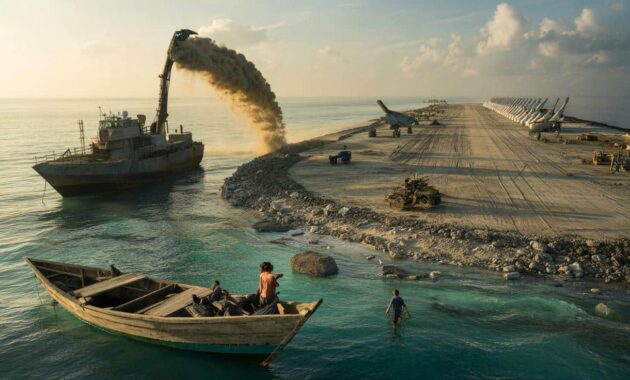
The sea was a sheet of glass when the first barges arrived. Local fishermen in the Spratly Islands remember the sound more than the sight: the grind of engines, the clank of steel, the dull echo of rocks and rebar sliding into turquoise water. For decades, these had been sleepy reefs, half-hidden at high tide, marked only by waves breaking white over coral heads. Then came the concrete. Endless grey slurry, pumped day and night, slowly smothering what had been living reef and shallow lagoon.
Then came the flags, the antennas, the radars.
From the deck of a wooden boat, you can actually watch the map change in real time. One year, a reef. The next, a runway.
The ocean doesn’t forget that kind of shock.
From hidden reefs to hard runways
Stand on the edge of Fiery Cross Reef at sunrise and it no longer feels like you’re on a reef at all. There’s a concrete runway stretching nearly the length of the island, hangars lined up like giant white teeth, a harbor carved into what used to be lagoon. Patrol boats idle at piers that didn’t exist ten years ago.
The air tastes of diesel and dust, not salt and seaweed. Where waves once smashed against coral, they now lick at a straight grey wall. Satellite images used to show a pale blue ring in the middle of the South China Sea here. Today, they show a familiar, unsettling shape: a forward military base.
The story behind that transformation is measured in millions of tons of concrete and dredged sand. Starting around 2013, China began sending fleets of dredgers and construction ships to half-submerged reefs across the Spratly chain. Mischief Reef, Subi Reef, Fiery Cross Reef – names that used to mean little outside naval circles – suddenly turned into vast, geometric scars on satellite photos.
At Mischief Reef alone, analysts estimate more than 5 million tons of sand, rock, and concrete were dumped to create a platform big enough for a 3,000-meter runway and deepwater harbor. What had been a speck barely visible at high tide became a man-made island larger than many small towns, complete with radar domes, fuel depots, and anti-aircraft batteries.
This wasn’t random coastal engineering. It was a calculated way to fix political claims in place by literally pouring them in stone. International law treats naturally formed islands and man-made structures very differently. Natural islands can generate exclusive economic zones, artificial ones cannot. By turning disputed reefs into permanent, heavily armed outposts, Beijing bet that facts on the water would matter more than legal definitions in a courtroom.
Concrete turned a fuzzy nine-dash line on a map into solid piers, hangars, and barracks. Once those are built, they’re very hard to roll back.
➡️ Restoring sight without major surgery: the quiet revolution behind a new clear eye gel
➡️ How lemon and salt can restore wooden cutting boards
➡️ Heating: the 19°C rule is over, here’s what experts now recommend
➡️ “I underestimated how fast $3 a day becomes $1,095 a year”
How a reef becomes a fortress
The basic method is brutally simple. First, you send the dredgers. These hulking machines claw sand and coral from the seabed and pump the slurry onto the shallow reef at high pressure. Over months, the reef grows above the waterline, forming an artificial island. Then come the trucks, the cranes, the rebar, the cement mixers spinning day and night. Layers of concrete cap the new land, locking it into a hard shell that can carry runways, radar towers, and heavy weapons.
Viewed from a satellite, you can almost trace each stage like a time-lapse construction tutorial, except the canvas is international waters.
The mistakes that rival claimants made were quieter, more human. For years, Vietnam and the Philippines left many of their own tiny outposts as little more than rusting ships or shacks on stilts. Manila was famously guarding one reef with a grounded, decaying World War II-era ship and a handful of marines. While officials argued over budgets and legal strategies, China sent in those dredgers and concrete barges, working around the clock.
We’ve all been there, that moment when you realize you’ve been treating a slow change like background noise, and then suddenly it’s permanent. The Philippines filed diplomatic protests; China poured more concrete. Vietnam built a few piers; China rolled out full airstrips.
*Let’s be honest: nobody really reads technical maritime law every single day.* Yet that dry legal language is what this concrete is silently challenging.
“On paper, these are artificial islands that don’t change who owns what,” a Southeast Asian diplomat told me over coffee in Manila. “But when a runway appears, then missiles, then warships, who’s going to argue that on the spot? The fisherman in a wooden boat? The coast guard in a 30-year-old cutter?”
- Step one: Turn water into land with dredgers and sand.
- Step two: Cap it with concrete, piers, and breakwaters.
- Step three: Add radar, runways, shelters, and living quarters.
- Step four: Rotate in coast guard, then navy, then air force units.
- End result: A disputed speck becomes a permanent military footprint.
What this means for the sea – and for everyone watching
The South China Sea has always been a busy crossroads, but today it feels like a crowded, tense hallway with everyone’s shoulders brushing. Tankers, fishing boats, coast guard cutters, navy frigates, survey ships – they all crisscross the same lanes, often within sight of those new concrete islands. On a normal day, a Filipino fisherman might have to steer between a Chinese coast guard vessel, a Vietnamese trawler, and a US destroyer conducting a “freedom of navigation” sail-by.
Each new reef-turned-base adds another set of eyes, radars, and guns to that mix. The margin for misunderstanding keeps shrinking.
For Beijing, these outposts are described as “defensive” and “necessary” to protect sovereignty and sea lanes. For neighbors like the Philippines, Vietnam, and Malaysia, they feel like a slow-motion encirclement. Crews report being blasted with water cannons, shadowed for hours, or told over radio to leave waters they’ve fished for generations. One Filipino captain described the first time he saw the gleaming radar domes on Subi Reef: “Before, that was just a white line of waves. Now it’s like a small city watching you.”
There’s a quiet psychological weight to knowing the horizon itself might be tracking you.
The rest of the world isn’t watching out of pure curiosity. A third of global shipping passes through these waters. Energy companies eye the seabed for gas and oil. The United States, Australia, Japan, and European navies keep showing up, sailing close to those new islands to signal they don’t recognize them as sovereign territory.
The strange thing is how ordinary it all looks up close: concrete blocks, fences, office buildings, storage tanks. Yet each slab poured into those reefs over the past decade has layered new risks onto one of the world’s most important waterways. The question hanging over the turquoise water now is simple, and unsettling.
What happens when a place built on poured concrete and contested claims is finally tested in a real crisis?
| Key point | Detail | Value for the reader |
|---|---|---|
| Concrete as strategy | China used massive land reclamation and construction to turn reefs into artificial islands with runways and ports. | Helps you understand how physical infrastructure can reshape geopolitical realities. |
| Legal vs. “facts on the water” | Artificial islands don’t change maritime rights on paper, but they alter power dynamics at sea. | Clarifies why the gap between law and practice matters for regional tensions. |
| Impact on daily life and security | Fishermen, shipping routes, and foreign navies now operate under the shadow of fortified outposts. | Shows how distant disputes can affect trade, prices, and long-term global stability. |
FAQ:
- Question 1What exactly did China build on these disputed reefs?Runways long enough for military aircraft, deepwater harbors, radar and communication facilities, housing, fuel storage, and defensive systems such as anti-aircraft and anti-ship missile platforms.
- Question 2Are these new islands legal under international law?The construction of artificial islands is allowed, but it does not automatically grant new territorial waters or exclusive economic zones, especially in disputed areas under the UN Convention on the Law of the Sea.
- Question 3Why do other countries in the region object so strongly?They see the buildup as a way to enforce sweeping maritime claims, restrict access to traditional fishing grounds, and shift the military balance in a heavily contested sea.
- Question 4How has the environment been affected by all this concrete?Dredging and land reclamation have destroyed coral reefs, disturbed marine habitats, and clouded waters, threatening fisheries and biodiversity that coastal communities rely on.
- Question 5Could this really spark a larger conflict?The risk is less about a planned war and more about miscalculation: a collision, an accidental shot, or a misread radio message near these heavily fortified outposts that escalates faster than anyone expects.