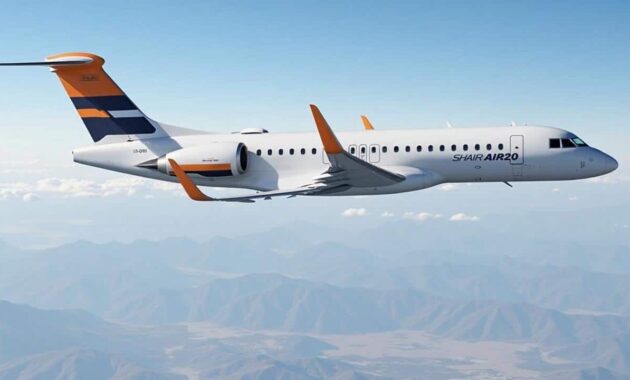
Airbus is weighing a bold stretch of its smallest jet, a move that could quietly redraw the most lucrative corner of short‑haul flying.
The European manufacturer is sounding out airlines about a longer “A220-500”, a so‑called super A220 aimed straight at the heart of the 150–180 seat market that keeps global carriers profitable.
The quiet rise of a “super A220”
For months, hints have slipped out of Toulouse and Montreal. No launch, no official green light, just a steady drumbeat: Airbus is studying a larger variant of its A220 family, previously known as the Bombardier CSeries.
Today, the A220-300 typically seats around 130–150 passengers. Above it sits the A320neo, usually configured with 150–180 seats. In between, there is a gap that several airlines describe as awkward and imperfectly served.
Unfilled space between the current A220-300 and the A320neo could be where Airbus makes its next big move.
The proposed A220-500 would stretch the existing airframe to carry roughly 150–180 passengers. That capacity band is pure gold for airlines, matching high‑frequency domestic shuttles and busy European and Asian trunk routes.
What makes the idea attractive is not just the extra rows. A longer A220 should remain lighter than an A320, with a modern carbon-heavy structure, efficient geared turbofan engines and a cabin that already wins high marks from passengers.
Why a few tonnes matter so much
Commercial aviation economics are unforgiving. Every extra tonne of aircraft weight means more fuel burn, higher airport charges and tighter performance margins from hot-and-high airports or short runways.
The A220 has built a reputation for low fuel consumption and quiet cabin acoustics. Airlines such as Swiss, airBaltic and Delta have reported strong performance in service, both financially and operationally.
On many routes, shaving just a few percent off trip cost can turn a marginal route into a money‑maker.
➡️ According to psychology, these phrases you say without thinking reveal a deep lack of confidence
➡️ Military radar: Ireland opens negotiations with France
➡️ Drying shower screens with a tea towel: why removing moisture stops cloudy residue
➡️ Goodbye air fryer: new kitchen gadget goes beyond frying with 9 different cooking methods
➡️ Paris and Berlin weigh scrapping fighter jet plan to prioritise ‘combat cloud’
A stretched A220 tuned for 150–180 seats could offer:
- Lower operating weight than an A320neo on similar distances
- Fuel burn per seat that undercuts many current single‑aisles
- Cabin comfort closer to a widebody than a traditional 737
- Enough range to handle most European, US domestic and intra‑Asian missions
The technology is largely proven. The airframe is flying, the engines are in service, and airlines know the cockpit and maintenance routines. The question turning in Airbus’s mind is not “can we build it?” but “can we build it fast enough without breaking everything else?”
From Canadian gamble to Airbus cornerstone
Bombardier’s ambitious project finds a new home
The A220 story began at Bombardier in Canada as the CSeries, an ambitious attempt to leapfrog ageing regional jets and bite into the lower end of the Airbus and Boeing ranges. The CS100 flew in 2013, the larger CS300 in 2015, and Swiss became launch operator in 2016.
The programme then hit severe turbulence. Costs ballooned. A trade dispute in the US threatened access to a crucial market. Bombardier looked for a partner and, in 2017, Airbus stepped in, taking a 50.01% share.
By 2018, the CSeries had become the A220-100 and A220-300. Airbus opened a second final assembly line in Mobile, Alabama, alongside the Canadian base in Mirabel, near Montreal. In 2020, Airbus bought out Bombardier’s remaining stake, leaving the Quebec government as minority partner.
What began as a risky bet for Bombardier has turned into a strategic bridgehead for Airbus in the lower single‑aisle market.
An industrial headache as much as a product decision
Production lines already running hot
On paper, stretching the A220 looks straightforward. In reality, it touches almost every nerve in Airbus’s industrial system.
The A220 is still ramping up in Mirabel and Mobile, while the A320neo family remains the company’s cash engine, with more than 600 deliveries a year. In 2025, Airbus shipped 793 commercial aircraft, including 93 A220s and 607 A320-family jets. The order backlog sits north of 8,700 aircraft.
Adding a larger A220 means:
- New tools and jigs for the lengthened fuselage sections
- More capacity at both final assembly sites
- Extra pressure on an already stretched supplier base
- Engineering teams diverted from other upgrades and clean‑sheet ideas
Airbus managers know that one mis‑step can echo for years. Late parts deliveries or over‑optimistic ramp‑up plans risk delays and penalties across multiple programmes, not just the A220.
A slow squeeze on Boeing’s 737
The battle for the 150–180 seat sweet spot
Behind the spreadsheets sits a familiar opponent. Boeing dominates much of the 150–180 seat segment with the 737‑8, the heart of its 737 MAX family. Many fleets rely on this category for the bulk of their domestic and short‑haul flying.
Airbus already holds a lead in overall single‑aisle market share thanks to the A320neo, A321neo and long‑range A321XLR. Dropping a lighter, ultra‑efficient A220‑500 just below the A320neo would give airlines yet another Airbus option in the space Boeing guards fiercely.
If Airbus can offer two attractive choices in Boeing’s core size band, it narrows the room for the 737 MAX to stand out.
The idea is not a headline‑grabbing knockout punch. It is closer to a slow encirclement, filling every profitable niche with a tailored Airbus product so that airlines tempted by Boeing have to work harder to justify that decision to shareholders.
Timing: the invisible variable
For now, Airbus plays it cautious. Executives are sounding out airlines, studying industrial capacity and watching engine manufacturers, who are themselves wrestling with reliability and maintenance challenges.
The current context helps. The A220 has reached operational maturity, and performance figures match the brochures. Airlines want extra seats, but they remain wary of stepping up to aircraft that demand larger crews, more fuel and higher airport charges.
A launch decision in the next year or two could see an entry into service near the end of the decade, depending on how deeply Airbus chooses to tweak structure and systems. A more conservative stretch would be faster and cheaper; a more ambitious rework could unlock better economics but add risk.
Another big jet on the sketchpad: the A350‑2000
The A220‑500 is not the only project whispering through Airbus corridors. Analysts say the company is also studying an A350‑2000, a longer‑range, higher‑capacity version of its A350‑1000 designed to carry roughly 440–460 passengers.
That aircraft would pitch against Boeing’s future 777‑10 and directly target carriers such as Emirates, which push for more capacity on dense, long‑haul routes. Early scenarios speak of a fuselage stretch of 5–6 metres, reinforced landing gear and a boosted Rolls‑Royce Trent XWB engine variant.
The strategy would mirror the A220 approach: build on an existing platform instead of starting from scratch, in order to spread development costs and avoid another financial saga like the A380.
How the A220‑500 would fit into Airbus’s line‑up
Airbus already fields a dense catalogue of aircraft. A “super A220” would plug a very specific gap between current models:
| Size band | Current Airbus options | Potential A220‑500 role |
| 120–150 seats | A220‑100 / A220‑300 / A319neo | Not involved |
| 150–180 seats | A320neo | Lower‑weight alternative with strong efficiency on short and medium routes |
| 180–220 seats | A321neo / A321XLR | Feeds traffic upward into larger single‑aisles |
| 220+ seats | A330neo / A350 family | Not involved |
For airlines, that variety means more chances to fine‑tune capacity to demand, rather than flying half‑empty larger jets or turning passengers away on oversold flights.
What this means for travellers and ticket prices
If the A220‑500 goes ahead, passengers may hardly notice the type name on the door, but they will feel some changes. Cabins could offer wider seats than some 737 layouts, bigger windows, lower cabin noise and better humidity.
On the economic side, if the aircraft delivers lower costs per seat, airlines get more room to run thinner routes year‑round instead of only in peak season. That tends to support more frequencies, better schedules and, in competitive markets, pressure to keep fares in check.
Some jargon, decoded
Two expressions keep surfacing in this debate: “single‑aisle” and “backlog”.
Single‑aisle jets are aircraft with one central aisle in the cabin, typically seating 100–240 passengers. They handle most flights under six hours worldwide and form the workhorses of domestic and regional networks.
Backlog refers to the total number of aircraft ordered but not yet delivered. Airbus’s backlog above 8,700 aircraft equates to many years of production locked in. That gives visibility on revenue but also makes every new programme decision sensitive, since any disruption can cascade across thousands of deliveries.
Scenario: how an airline might use a super A220
Picture a European carrier flying from a secondary hub to several large cities three times a day with 150‑seat aircraft that are often full. With a super A220, it could add 20–30 seats yet keep trip costs close to today’s level.
On peak days, that extra capacity absorbs demand without needing a fourth daily rotation or a switch to a heavier jet. On off‑peak days, the lighter structure still keeps unit costs sharp enough to avoid large losses. Over a year, that flexibility can tilt a network plan from “barely adequate” to robustly profitable.
That kind of quiet arithmetic, repeated across dozens of airlines and thousands of routes, is what may ultimately decide whether Airbus pulls the trigger on this next stretch of the A220 family.