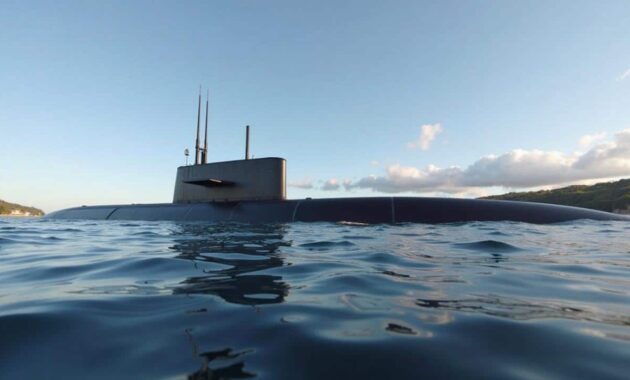
Australia ripped up a historic submarine deal with France to bet big on the United States.
Now that bet suddenly looks shaky.
The AUKUS pact was meant to turbocharge Australia’s navy and reshape security in the Indo-Pacific. Instead, political doubts in Washington raise a stark question: after ditching the French “contract of the century”, could Canberra be left with nothing in the water?
From “contract of the century” to brutal rupture
Back in 2016, Australia and France sealed a landmark agreement worth around €56 billion. French shipbuilder Naval Group was chosen to deliver 12 conventionally powered attack submarines based on the Barracuda/Suffren design, with deliveries planned from the early 2030s.
For Paris, this was hailed as the “contract of the century”. For Canberra, it was meant to be the backbone of a long-term maritime strategy across the Pacific and Indian oceans.
Then, in 2021, everything flipped. The Australian government under Scott Morrison tore up the French deal and turned to Washington and London. The move triggered a major diplomatic crisis with France and raised eyebrows across Europe.
Australia walked away from 12 French submarines, only to sign up for a nuclear fleet that might never fully arrive.
The new plan, part of the AUKUS alliance between Australia, the UK and the US, promised access to highly sensitive nuclear propulsion technology. For Canberra, this seemed like a faster, more powerful path to counter China’s growing naval presence.
AUKUS: a €208 billion gamble under review
Under the AUKUS framework, Australia would initially purchase at least three – and up to five – US-built Virginia-class nuclear-powered attack submarines, with deliveries pencilled in from the early 2030s.
Beyond that, London and Canberra committed to jointly design and build a new generation of nuclear-powered submarines, often referred to as SSN-AUKUS, to be produced in the UK and Australia over several decades.
The long-term cost of this alliance has been estimated at around €208 billion over 30 years, covering design, construction, infrastructure, training and nuclear stewardship.
➡️ Mid‑air takeover: Norwegian military seizes control of bomb dropped by US fighter jet
➡️ France hails its “big comeback” in a key nuclear sector with €1 billion turbine deal in Poland
➡️ This hairdresser reveals the secret to spacing out colour appointments
➡️ Fine hair after 50: a hairstylist reveals the tricks that really work on her clients
- 2016: France–Australia deal for 12 conventional submarines
- 2021: Deal cancelled, AUKUS announced with US and UK
- Early 2030s: Target date for first Virginia-class submarines
- 2040s and beyond: Co-built UK–Australian nuclear subs planned
The political sales pitch was clear: by the mid‑century, Australia would operate one of the most advanced submarine fleets in the region, tightly integrated with US and British forces and directly aimed at countering China’s naval and missile build-up.
Washington wobble: could the US hold back its subs?
The obstacle is now less technical and more political. In Washington, a growing number of voices are asking whether the US can spare any of its precious nuclear-powered attack submarines for export while tensions sharpen with China, especially around Taiwan.
US shipyards are already under pressure to maintain and expand America’s own submarine fleet. Delays, capacity limits and budget fights in Congress all affect how many boats can be built and how quickly.
When America worries about having “fewer submarines in the right place at the right time”, Australia’s place in the queue is at risk.
Former senior Pentagon official Elbridge Colby has publicly expressed doubts about the practicality of sending US submarines to Australia, arguing that the United States might need every available hull for a potential crisis with China.
In early 2025, US lawmakers went further. A congressional assessment suggested that Australia should consider pouring money into “other military capabilities” rather than betting everything on the AUKUS submarine timeline.
Why Taiwan changes everything
The scenario worrying US planners is simple: if China launches an assault or blockade against Taiwan, the US Navy will need maximum undersea strength in the Western Pacific. Virginia-class submarines are central to that plan, used for intelligence, strike missions and hunting Chinese warships.
Sending several of those boats to Australia at the same time could be seen in Washington as a luxury the US can no longer afford. That creates a brutal trade-off between alliance promises and US national priorities.
| US priority | Impact on AUKUS |
|---|---|
| Deterring China near Taiwan | Pressure to keep more submarines in US hands |
| Modernising its own fleet | Shipyard capacity diverted from export to domestic needs |
| Balancing defence budgets | Congress questions large, long-term export commitments |
The nightmare scenario for Canberra: no French deal, no US subs
For Australia, the strategic risk is stark. After scrapping the French contract, the Royal Australian Navy still operates ageing Collins-class submarines that will need replacement.
If the US ultimately delays or scales back deliveries, Canberra could find itself with a widening capability gap in the 2030s and 2040s. That would mean fewer boats in the water just as regional tensions rise.
The country that walked away from 12 French submarines may end up, for a time, with almost no credible replacement.
Australian officials argue that AUKUS is still on track and stress that industrial cooperation, technology transfer and training are already under way. Yet the repeated hints from Washington cause unease inside Australia’s defence community.
Strategists in Canberra now talk more openly about backup options: stretching the life of the Collins-class fleet, buying more advanced missiles, investing in undersea drones or leaning harder on US forces based on Australian soil.
Why submarines matter so much to Australia
Australia is a maritime nation surrounded by vast sea lanes. Submarines give it a discreet way to monitor rivals, protect trade routes and support allied operations without constant visibility.
Nuclear-powered submarines, unlike conventional ones, can stay submerged for months, travel long distances at speed and operate far from home bases. For a country with Australia’s geography, that endurance is a major advantage.
Yet nuclear propulsion comes with complex demands: specialized shipyards, nuclear safety infrastructure, strict training pipelines and long-term political commitment. That makes sudden policy shifts in partner countries particularly destabilizing.
Key terms and what they actually mean
Two military acronyms sit at the heart of this story: AUKUS and SSN.
- AUKUS: A security partnership between Australia, the United Kingdom and the United States, focusing on advanced defence technologies, including nuclear-powered submarines, cyber, AI and undersea capabilities.
- SSN: Short for “nuclear-powered attack submarine”. These boats are armed with torpedoes and missiles but carry nuclear reactors only for propulsion, not nuclear weapons by default.
Australia has pledged not to acquire nuclear weapons and to keep its programme under strict safeguards, which means the submarines are about range and stealth, not about building a nuclear arsenal.
What happens if the plan collapses?
If Washington quietly downgrades or freezes the Virginia-class component of AUKUS, Canberra will face a set of difficult choices and time pressure.
One scenario is a rushed search for stopgap measures: buying more advanced conventional submarines from another partner, accelerating unmanned undersea systems, or leaning even more heavily on US and UK patrols from Australian bases.
Another scenario is political: a future Australian government could reconsider a closer industrial relationship with European shipyards, including French companies that were previously cut out. The diplomatic scars are still fresh, though, and any return would be complicated and likely more expensive.
For now, the AUKUS agreement officially stands. But as US lawmakers question costs and strategy, Australia finds itself painfully exposed to decisions taken in Washington, far from Canberra and even further from the waters it wants to secure.
Originally posted 2026-03-07 13:31:00.