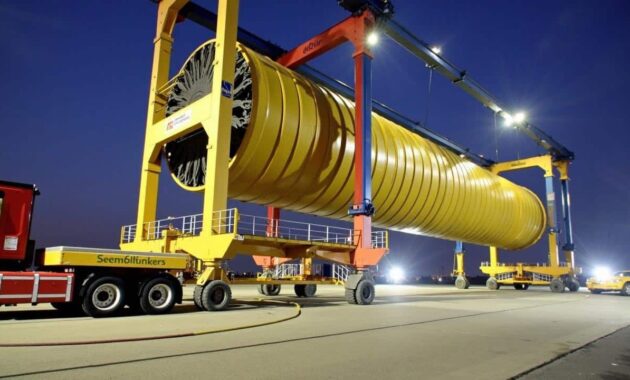
Under grey January skies, a massive steel cylinder crept through the English countryside, forcing traffic to a stunned standstill.
The strange convoy, moving at walking pace through rural Somerset, was carrying one of the most critical pieces of equipment ever delivered to a UK power station: the pressure vessel for the second reactor at Hinkley Point C.
The 500-tonne “steel baby” finally arrives
On 12 January 2026, after a journey of more than 1,000 kilometres by road, river and sea, the reactor pressure vessel for Hinkley Point C’s Unit 2 finally reached the construction site on the Bristol Channel coast.
The component was built by French nuclear specialist Framatome at its Saint-Marcel plant in eastern France. Weighing around 500 tonnes and stretching 13 metres in length, the vessel will sit at the very heart of the new EPR (European Pressurised Reactor) unit.
Laid vertically inside the reactor building, this single piece of forged steel will contain the fuel, channel the control rods, and guide the water that removes the intense heat from the core.
Without this vessel, nothing else can truly start. Almost every other system in the reactor is designed around it.
An epic 1,000 km journey across France and the Channel
The route from the Saône-et-Loire region of France to the Somerset coast shows how complex modern nuclear logistics have become.
- Departure from Framatome’s Saint-Marcel factory in eastern France
- Transport across France to a seaport, then shipping across the English Channel
- Arrival at Avonmouth, near Bristol, on a specialist vessel
- Transfer onto a barge for the trip up the River Parrett to Combwich
- Final 6.4 km overland to Hinkley Point C, at just a few kilometres per hour
The last stretch, from the small port of Combwich to the construction site, took six hours for just 6.4 km. The vessel sat on a multi-axle self-propelled trailer, crawling past hedgerows and villages under the watch of engineers, police escorts and curious residents lining the roadside.
Nothing about this kind of move is improvised. Every bend, camber and bridge is surveyed months in advance. Street furniture is sometimes removed. Temporary road reinforcements can be installed. Timing is choreographed to avoid disrupting local life more than necessary.
The sheer scale of the transport operation underlines how dependent high-end nuclear projects are on heavy industry, engineering logistics and international cooperation.
➡️ Vitamin B7 Becomes A Key Piece In Understanding Cancer Resistance
➡️ New anti-obesity drugs: stopping injections causes much faster weight regain than expected
➡️ Making A “Shampoo Sandwich” Is The Best Way To Wash Your Hair, According To Hairdressers
➡️ Hairstyles After 60: This Fringe Is The Stars’ Secret To Softening The Face
➡️ 10 years younger effect”: the best short haircuts to wear after 50
A central piece in every sense
The pressure vessel in an EPR is not just another large component. It is the core of the core.
In a pressurised water reactor like the EPR, water flows through the vessel and around the fuel assemblies, cooling them while carrying heat to steam generators. The vessel must withstand pressures of around 155 bar and operating temperatures close to 320°C, day after day, for decades.
Engineers design this steel monolith to last for at least 80 years. Once installed and surrounded by concrete, piping and shielding, replacing it would mean practically rebuilding the reactor. That is not a realistic option.
For Hinkley Point C, the arrival of this second vessel marks a symbolic turning point. The first vessel, delivered in 2023, was installed in the Unit 1 reactor building at the end of 2024. Since then, work on Unit 1 has shifted from huge civil structures to fine-grained tasks: pipework, cabling, control systems and safety equipment.
Building faster with experience
Unit 2 learns from Unit 1
EDF Energy, the company leading the Hinkley Point C project, says that construction of Unit 2 is progressing 20–30% faster than Unit 1. The reason is straightforward: learning by doing.
Teams have adjusted methods, increased the use of prefabricated modules to almost 60%, and refined the sequence of tasks on site. Components that once needed complex assembly on the exposed Somerset headland are increasingly built under controlled conditions elsewhere and delivered ready to install.
This “first-of-a-kind, then fleet-of-a-kind” effect is common on large industrial projects. The first unit suffers delays, design tweaks and practical lessons. The second unit benefits from those painful experiences and waste is reduced.
What looked like a one-off mega-project in 2018 is now slowly turning into a repeatable industrial process, at least for this specific reactor design.
A high-stakes project for UK energy security
Costs, delays and political pressure
Hinkley Point C has had a rough ride since construction began in 2018. Deadlines have slipped several times, with first electricity now aimed for around 2030. Cost estimates, in 2015 money, have risen to between £31 billion and £34 billion.
Those numbers have drawn criticism, especially during a period of rising bills and public concern about inflation. Yet within government and the nuclear industry, Hinkley Point C is still seen as strategically vital.
Nuclear currently supplies around 15% of UK electricity. Most of the existing fleet, built in the 1970s and 1980s, is due to shut down by the end of this decade. Without replacement capacity, Britain would face a large gap in reliable, low-carbon power, especially on windless winter evenings.
Hinkley Point C’s two EPR units, followed by the planned Sizewell C project in Suffolk, are intended to anchor the UK’s long-term baseload. At the same time, ministers talk up future small modular reactors (SMRs), which could be built in factories and deployed more flexibly.
Where EPR reactors stand globally in 2026
The EPR design has had a complex history in Europe, but its most convincing early success came from China.
| Status | Location | Units | Output (per unit) | Main operator | Key dates |
| In operation | Taishan, China | 2 | 1,660 MWe | CGNPC | 2018–2019 |
| In operation | Olkiluoto 3, Finland | 1 | 1,600 MWe | TVO | 2023 |
| In operation | Flamanville 3, France | 1 | 1,650 MWe | EDF | 2024 (grid connection) |
| Under construction | Hinkley Point C, UK | 2 | 1,670 MWe | EDF Energy | From late 2018 |
| Planned (EPR2) | France (Penly and others) | 6–14 | ~1,650 MWe | EDF | Beyond 2035 |
China’s Taishan units, commissioned in 2018 and 2019, demonstrated that the design can work in commercial conditions. They have largely operated stably, giving confidence to European regulators and operators.
Finland’s Olkiluoto 3 and France’s Flamanville 3, both long delayed, are now feeding power into their national grids. These operational references matter for UK regulators, who can base safety assessments and licensing decisions on real-world performance rather than only modelling.
What a reactor pressure vessel actually does
For anyone not used to nuclear jargon, the pressure vessel can sound abstract. In practice, it performs several crucial roles at once.
- Holds the fuel assemblies where fission takes place
- Contains highly pressurised water that cools the fuel
- Guides control rods that can slow or stop the nuclear reaction
- Forms part of the primary safety barrier around the radioactive core
The steel must be extremely pure and carefully forged to avoid microscopic flaws. Over time, neutron radiation can make the metal more brittle, so the design includes allowances for ageing and regular monitoring.
Designers add a margin: the vessel is built to handle stresses well beyond those seen in normal operation, including rapid changes in temperature and pressure during shutdowns or emergency situations.
Risks, benefits and what comes next
Nuclear projects like Hinkley Point C concentrate a lot of risk into a small number of sites: construction overruns, technical glitches, political backlash. At the same time, once running, each unit can deliver gigawatts of low-carbon electricity for many decades with relatively stable operating costs.
From a climate perspective, Hinkley Point C’s two reactors are expected to generate enough power for around six million homes. That reduces the need for gas-fired plants and cuts exposure to volatile fossil fuel prices. Yet the upfront investment is so large that governments need to lock in long-term financing models and price guarantees.
For residents of Somerset, the arrival of the 500-tonne vessel is both a spectacle and a reminder. Beyond the slow-moving convoy and flashing escort vehicles, a long-term shift in Britain’s energy system is being assembled piece by enormous piece, and this steel colossus is one of the few parts that truly cannot be replaced once the concrete sets around it.
Originally posted 2026-03-07 18:10:00.