For nearly five decades, Voyager 1 has been racing away from the Sun, crossing one invisible frontier after another. Now the probe is reaching a point where traditional units, like kilometres or even hours of light travel, no longer feel meaningful. That shift does not change its path, but it completely reshapes the way we describe, plan and imagine its journey.
When distance slips beyond human imagination
Launched in 1977, Voyager 1 was designed to visit Jupiter and Saturn, then keep going if it survived. It did far more than that. After photographing the giant planets and their moons, the spacecraft headed outward on a trajectory that would eventually carry it into interstellar space.
For most of that time, scientists talked about its position using kilometres. The numbers were large, but still manageable: millions, then billions. People could at least pretend to picture it.
That era is ending. By the end of 2026, Voyager 1 will be around 26 billion kilometres from Earth. For most of us, the word “billion” has already lost any real sense of scale. Add tens of billions to that and the figure stops helping altogether.
At tens of billions of kilometres, distance becomes so huge that the raw number stops telling a meaningful story.
Faced with that problem, mission teams turn to something more concrete than kilometres: time. Specifically, the time light itself takes to cross the gap between Earth and the spacecraft.
From kilometres to days of light
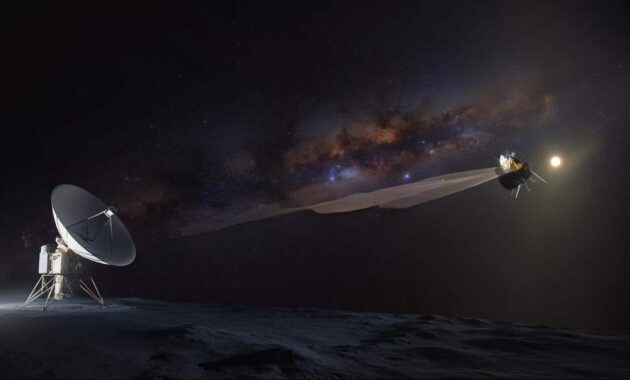
Radio signals move at the speed of light. As Voyager 1 drifts away, each command from Earth takes longer to reach it. That delay has now become the clearest way to describe how far it has gone.
Until recently, mission updates often used “light-hours”: the time needed for light to travel from one point to another. That term still works for spacecraft around Mars or Jupiter. With Voyager 1, the gap is stretching so far that a new step is needed.
Around late 2026, a signal leaving an antenna on Earth will take roughly 24 hours to reach Voyager 1. The return signal will take another 24 hours to come back. One simple instruction will effectively span two days of waiting.
➡️ A lightweight cardboard technique protects crops and boosts garden harvests more than expected
➡️ Turkey goes toe-to-toe with France as it unveils the ideal partner for its next-gen Kaan fighter
➡️ Tensions between the EU and United States: what alternatives to the American F-35 fighter jet?
➡️ Sheets shouldn’t be changed monthly or every two weeks : an expert gives the exact frequency
Voyager 1 is on track to become the first human-made object for which a single message takes a full day to arrive.
At that stage, using “light-days” makes more sense than piling up digits in kilometres or endlessly adding decimal places to light-hours. A single light-day is easier to grasp than “26,000,000,000 kilometres”, even if both describe the same gulf.
A new kind of record for a human artefact
The shift to light-days is not just a mathematical convenience. It marks a historical moment. Humanity has sent one object so far that people on the ground must think in whole days just to talk to it.
Teams at NASA’s Jet Propulsion Laboratory already work with this huge delay. They cannot “joystick” Voyager 1 in real time. Commands are planned very carefully, checked and rechecked, then sent out across a vast, silent gap. Only much later do engineers learn whether the spacecraft responded as expected.
- Launch year: 1977
- Approximate distance by end of 2026: 26 billion km
- One-way communication delay: about 24 hours
- Communication medium: radio waves travelling at light speed
How the light-day changes mission control
Once a spacecraft is a light-day away, every decision slows down. There is no way around it. Physics sets the limit, and no antenna, rocket or software can beat the speed of light.
That delay forces autonomy on the spacecraft. Voyager 1, built with 1970s electronics, already manages many functions on its own. It can adjust some settings, protect itself in certain fault conditions and switch between systems without waiting for Earth to tell it what to do.
For ground teams, this turns each interaction into a kind of correspondence by post. They send a series of instructions, then wait. If something unexpected happens, they only learn about it after the fact. Any fix arrives long after the original problem began.
Every command to Voyager 1 becomes a careful bet placed today on the state of a spacecraft that will answer tomorrow.
This is a preview of how future deep-space missions will have to operate. Craft heading to the outer reaches of the Solar System, or orbiting distant icy moons, will need far greater autonomy. Human operators will act more like supervisors than pilots.
What this says about our sense of cosmic scale
Switching to light-days also exposes a deeper psychological issue: our brains are not built to handle cosmic distances. We evolved to judge the gap between a tree and a river, not between one star and the next.
Terms such as “astronomical unit” (the average distance between Earth and the Sun) and “light-year” were invented to tame that scale. A light-day fits between those units, sitting roughly at the level of the outer Solar System. It is a bridge between human timescales and interstellar emptiness.
| Unit | What it represents | Approximate value |
|---|---|---|
| Astronomical unit (AU) | Average Earth–Sun distance | About 150 million km |
| Light-minute | Distance light travels in 60 seconds | Roughly 18 million km |
| Light-hour | Distance light travels in 60 minutes | About 1.08 billion km |
| Light-day | Distance light travels in 24 hours | Around 26 billion km |
When mission managers say “Voyager 1 is a light-day away”, they are not just choosing a nicer number. They are anchoring that distance in our daily experience of time. A day is something everyone feels. Linking that with the speed of light gives a more visceral sense of separation than any string of zeroes.
Why deep space forces new ways of thinking
Voyager 1’s situation highlights challenges facing the next generation of missions. Projects aiming for the outer Solar System, interstellar probes or even crewed flights to Mars must reckon with delays that make constant supervision impossible.
Engineers are already working on systems that can operate semi-independently for long stretches: smarter onboard software, fault detection, and decision-making tools that do not need instant human input. The experience of running Voyager with a one-day communication lag is a kind of long-term rehearsal for those future efforts.
For the public, the light-day milestone can shift expectations too. Science fiction often shows starships chatting in real time across the galaxy. Voyager 1 reminds us that, with current physics, every extra step into deep space lengthens the wait, not just the journey.
Key terms and what they actually mean
Several expressions used around Voyager 1 can sound abstract. A few are worth unpacking:
- Interstellar space: the region between stars, beyond the main influence of the Sun’s solar wind, where the spacecraft moves through gas and magnetic fields linked to the wider galaxy.
- Heliosphere: a vast bubble carved out by the solar wind around the Solar System. Voyager 1 crossed its outer boundary, the heliopause, in the 2010s.
- Light-day: the distance light travels in 24 hours at 300,000 km per second, used as both a time and distance reference.
Thinking in these terms changes the sort of scenarios engineers plan for. For instance, if a fault shuts down a key instrument, by the time the error signal reaches Earth, the situation on board may already have evolved. Any solution must be robust enough to work on a spacecraft that is effectively acting on yesterday’s news.
Looking ahead, similar limits will shape human ambitions. A crew on Mars would face communication delays of several minutes each way, depending on orbital positions. Remote control surgery, real-time mission advice, instant problem solving: all become unrealistic. The experience gathered with distant probes like Voyager 1 feeds into training and simulation work for such missions, where crews and machines must cope with isolation, autonomy and slow feedback.
Voyager 1’s shift into the light-day regime is not just a curiosity for space enthusiasts. It is a signal that human technology is stretching the map to scales where time and distance blend together. Our units, our strategies and even our storytelling have to adjust, one delayed signal at a time.