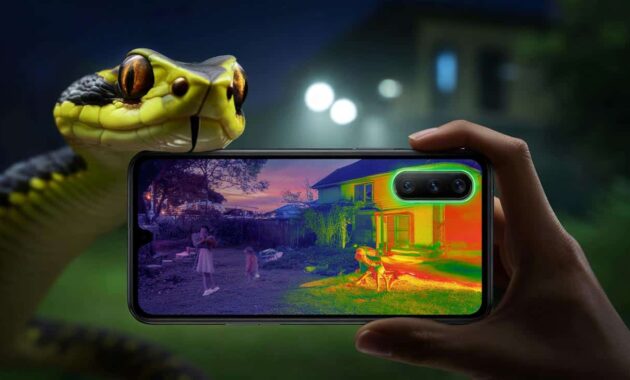
Researchers in China say they are getting close to exactly that, with a tiny sensor inspired by snake vision that turns invisible infrared radiation into sharp 4K video, without the bulky cooling systems that kept this tech locked in labs and military gear.
From pit vipers to pixels: why snakes fascinate engineers
Certain snakes have a secret weapon when hunting at night. Beyond normal eyesight, they sense the heat given off by prey, detecting infrared radiation through organs placed between their eyes and nostrils.
These so‑called “pit organs” act like natural thermal cameras. A thin membrane suspended inside a cavity warms up slightly when hit by infrared waves from a mouse or bird. Temperature variations across this membrane are translated into electrical signals and sent to the brain.
The snake then combines this heat map with what its eyes see. The result is a kind of merged, hybrid image: visible light plus temperature, all in real time.
Engineers have now copied this biological trick, building an artificial “snake eye” that can be printed on top of a standard camera chip.
The team from the Beijing Institute of Technology and the Changchun Institute of Optics used this principle as a blueprint. Instead of a living membrane, they created ultra‑thin layers of semiconductor materials that react to infrared radiation and convert it into an electrical signal, then into visible light.
A tiny infrared machine that sits on a normal camera chip
Thermal cameras today are usually big, expensive and kept very cold. The cooling is there for a reason: when a sensor warms up, it produces random electrical noise that can drown out the faint infrared signals it is supposed to measure.
To bypass that problem, the Chinese group stacked nanometre‑scale materials in a precise order to separate useful signals from noise. At the heart of their device are mercury telluride (HgTe) quantum dots — tiny crystals whose properties can be tuned by changing their size.
These quantum dots are particularly good at soaking up infrared radiation in a wide band, from the so‑called short‑wave infrared (SWIR) up into the mid‑wave infrared (MWIR), reaching wavelengths around 4.5 micrometres. That is far beyond normal phone cameras, which stop around 0.7 micrometres.
➡️ Next round of Arctic cold arrives this weekend
➡️ Italian climbers find fossils of sea turtles fleeing an earthquake 80 million years ago
➡️ 9 phrases self-centered people commonly use in everyday conversations, according to psychology
➡️ Japan decries Chinese export restrictions that could cripple defenses
➡️ Workers in this role often earn more by becoming specialists rather than managers
Blocking fake signals without freezing the sensor
Infrared detection at room temperature faces a major headache: “dark currents”. These are signals produced not by incoming light, but simply by the sensor’s own warmth, mimicking the real thing.
To deal with that, the researchers added an insulating barrier made from zinc oxide and a conductive polymer known as P3HT. This layer acts a bit like a gatekeeper.
- Real signals generated by absorbed infrared light pass through.
- False signals caused by heat inside the device are largely blocked.
This design reduces noise without resorting to heavy cooling hardware. It means the whole structure can operate near room temperature, which is vital if it is ever to slip inside a smartphone.
Turning heat into green light
The other clever move sits above the quantum dots: a light‑emitting conversion layer. Instead of sending a faint electrical current straight into complicated readout electronics, the system uses phosphorescent materials, including an iridium‑based compound, to turn that current into visible green light.
The sensor effectively “repaints” infrared scenes in visible green, so an ordinary camera can record them in 4K.
In technical terms, the device reaches a photon‑to‑photon conversion efficiency of more than 6% in the near infrared. That is high enough to produce a bright, stable image that today’s CMOS chips — the same type used in phone cameras — can capture without major modification.
4K infrared video without cryogenics
Perhaps the most striking claim in the study, published in the journal Light: Science & Applications, is the resolution. The infrared upconversion system is integrated on a 4K CMOS sensor with 3840 × 2160 pixels.
High‑resolution infrared imaging has traditionally relied on cooled sensors built from exotic materials. Those systems can cost tens of thousands of pounds or dollars and are mostly found in defence, aerospace or specialist industry.
Lab tests on the new prototype show that it can produce detailed images even when the incoming infrared signal is extremely weak. Performance holds up across both SWIR and MWIR, with measured brightness levels around 6388 candelas per square metre in the SWIR range and 1311 cd/m² in mid‑wave infrared.
The device also boasts strong dynamic range — 38 decibels for SWIR and 33 dB for MWIR. In practical terms, that means it can show very dark and very bright areas in the same scene without losing detail or blowing out highlights.
At its most sensitive, the sensor can pick up power levels close to 10⁻¹⁰ watts per square centimetre — similar to starlight.
That level of sensitivity opens the door to imaging in almost total darkness, through some kinds of smoke or fog, and even through objects that look opaque under normal light, such as silicon wafers or certain chemical samples.
What changes when your camera sees beyond visible light
By bolting this structure onto a conventional CMOS chip, the research group extends the “visible” range for cameras from the human window of 0.4–0.7 micrometres to roughly 0.4–4.5 micrometres.
That extra reach transforms what a device can do in tough conditions. Short‑wave and mid‑wave infrared can penetrate haze and certain aerosols more effectively than visible light. Hot objects, like engines or living bodies, stand out sharply against cooler backgrounds.
Industrial and professional uses first
The earliest adopters are likely to be industries that already rely on thermal imaging, but want higher resolution or lower cost.
- Inspection and maintenance: Locating overheating components in power plants, factories or data centres.
- Construction: Detecting poor insulation, hidden leaks or structural defects via subtle temperature differences.
- Agriculture: Monitoring crop stress and soil moisture, which change thermal patterns before problems are visible.
- Food safety: Checking packaging, cold chain breaks or contamination through minor shifts in temperature and humidity.
In transport, an infrared‑equipped camera could help cars, drones or robots see pedestrians, animals and obstacles in heavy fog or at night, where ordinary sensors fail or get confused by glare.
Medical imaging is another clear candidate. Compact infrared cameras could flag local inflammation, blood circulation issues or abnormal tissue without touching the skin, offering a non‑invasive, quick‑scan tool in clinics and ambulances.
How this could end up in your next smartphone
None of this means your next handset will definitely have “snake vision”. But the design deliberately leans on manufacturing techniques already used for camera modules and display technologies, such as layered thin films and quantum dots.
The authors argue that mass production should be possible without building entirely new factories, one of the biggest hurdles for any sensor innovation.
Cost matters. Current consumer “thermal cameras” or smartphone add‑ons often use relatively low‑resolution microbolometer arrays. They can show blobs of heat, not fine‑grained 4K views. If the snake‑inspired system can be deposited directly on mainstream CMOS chips in volume, the price per unit could drop sharply.
Once that happens, manufacturers could start offering phones with a dedicated infrared mode. Imagine pointing your camera at a wall to locate hot water pipes, checking if your window frames leak heat, or scanning the garden at night to see animals you’d normally miss.
What infrared actually shows you
Infrared imaging does not see “through” everything. It mainly records how different parts of a scene emit or reflect heat‑related radiation.
A few points help frame realistic expectations:
- Warm living beings stand out clearly against cooler backgrounds.
- Some materials, like thin plastic bags, can be transparent in infrared, even when they look opaque to your eyes.
- Thick metals or dense walls typically block infrared, just as they block visible light.
- Glass behaves very differently: some types are transparent in visible light but almost black in certain infrared bands.
Any phone app using such a sensor would need smart software to colour‑code temperatures and calibrate readings, so users can interpret what they see without specialist training.
Benefits, risks and what regulators might care about
On the positive side, putting high‑resolution infrared in pockets could boost home safety and energy efficiency. People could spot overloaded sockets, bad insulation, or overheating electronics before they fail. Search‑and‑rescue teams might gain affordable gear with better performance in smoke or darkness.
On the flip side, always‑on heat vision raises privacy questions. A camera able to distinguish bodies through light clothing or blinds under some conditions, or track individuals by their thermal signature, will attract attention from regulators and civil rights groups.
There are also technical risks. Quantum dot materials like HgTe involve heavy metals, which need careful handling and recycling. Manufacturers will have to balance performance with environmental rules and public perception about toxic substances in consumer devices.
Key terms that help decode the hype
| Term | What it means for users |
|---|---|
| Short‑wave infrared (SWIR) | Band just beyond visible light; useful for seeing through haze and inspecting materials. |
| Mid‑wave infrared (MWIR) | Stronger link to heat emission; human bodies and engines glow brightly in this range. |
| Quantum dots | Nano‑sized crystals that can be tuned to absorb or emit specific colours or wavelengths. |
| CMOS sensor | The standard chip inside most cameras; cheap, stable and easy to integrate in phones. |
| Dynamic range | How well a camera copes when a scene has both very dark and very bright areas. |
If this snake‑inspired research lives up to its promise in mass production, the next leap in smartphone photography may not be sharper sunsets or prettier portraits, but the quiet ability to see heat signatures in 4K — just like a viper tracking its next meal in the dark.