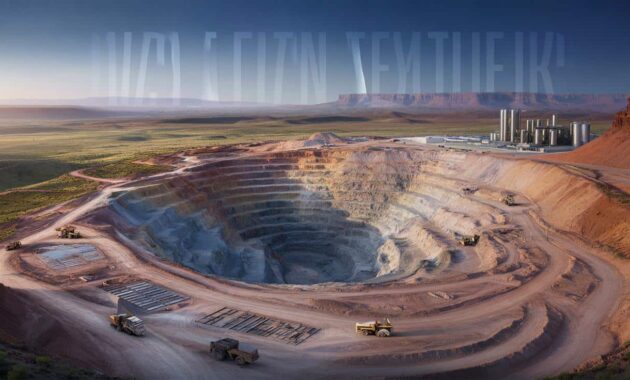
Far from Silicon Valley’s glass towers, a little-known corner of Utah called Silicon Ridge is suddenly on the radar of governments, investors and tech giants. Beneath its clay-rich soil, geologists say they have pinpointed one of the most promising deposits of critical metals in North America — with a potential raw value topping €120 billion.
A Utah clay deposit that could reset the rare earths race
Silicon Ridge sits in a dry, sparsely populated area of the state, better known for ranches and red rock mesas than high-tech metals. Yet recent drilling campaigns show that the soils here are not ordinary clays. They are “ionic clays”, a rare type of deposit where minerals act like a sponge, trapping valuable elements over millions of years.
This geological quirk matters for one simple reason: the clays are loaded with rare earths and other strategic metals used in electric cars, wind turbines, guided missiles and artificial intelligence hardware.
On just a small portion of the site, early estimates point to tens of billions of euros in in-ground metal value, with room to grow.
The project is led by Ionic Mineral Technologies, a US company that has spent the last few years quietly building a detailed picture of what lies under the surface. The team has drilled 106 boreholes, logged more than 10,000 metres of core and dug 35 test trenches to map the mineralised layers.
The headline figure emerging from that work is striking: an average grade of around 2,700 parts per million (ppm) in critical metals. For context, many of China’s best-known rare earth clay deposits range between 500 and 2,000 ppm. That puts Silicon Ridge at the upper end of the scale.
A cocktail of 16 high-tech metals in one site
Unlike mines that focus on a single commodity, this Utah deposit looks more like a buffet tailored for the 21st-century economy. On roughly 260 hectares of ground that have been studied in detail so far, geologists have identified at least 16 strategic elements.
What’s in the ground at Silicon Ridge
- Lithium – a key ingredient in batteries for electric vehicles and grid storage
- Gallium – used in advanced chips, power electronics and some 5G components
- Germanium – vital for fibre optics, infrared systems and satellite sensors
- Tungsten – goes into cutting tools, high-temperature alloys and defence systems
- Vanadium – used in specialty steels and emerging flow-battery technologies
- Light and heavy rare earths – including elements needed for powerful permanent magnets
This mix lines up almost perfectly with US industrial priorities. Electric vehicle makers need lithium and magnet rare earths. Defence contractors rely on heavy rare earths and tungsten. AI data centres want secure supplies of gallium and other chip-related metals. Having all of these in one district reduces the need to ship ore or concentrates across the globe.
The combination of battery metals, magnet materials and microchip elements in a single clay deposit is highly unusual outside China.
➡️ The quick trick for removing onion smell from hands using stainless steel
➡️ According to psychology, this daily habit is a subtle sign of mental overload
➡️ This simple rug move as winter nears boosts warmth and saves energy
➡️ Netflix: one of the greatest action-adventure films ever, you have only 2 days left to watch it
➡️ 14 Yoga Poses That Help Open Tight Hips and Improve Mobility
That uniqueness also increases the appeal for investors. A mine that can feed multiple supply chains at once tends to be more resilient to price swings in any single metal. If demand for one element dips, others may keep supporting the project’s economics.
A gentler extraction method than classic hard-rock mining
Ion-exchange instead of blast-and-blast
One of the biggest criticisms of rare earth production revolves around pollution. Traditional hard-rock deposits often require blasting, crushing and roasting at high temperatures, followed by aggressive acid treatments. The environmental footprint can be heavy and long-lasting.
Silicon Ridge promises a different approach. Because the metals sit loosely bound to clay particles, Ionic Mineral Technologies plans to use an ion-exchange process at relatively low temperature. In plain language, a chemical solution passes through the clay, swaps harmless ions for valuable metal ions and carries them into a recovery circuit.
The company says this route avoids high-temperature furnaces and strong acids, trimming both carbon emissions and local contamination risks. Internal studies suggest recovery rates could reach around 95% of the metals present in the ore. If that number holds in commercial operation, the project would combine high yield with a more manageable footprint.
By swapping harsh acids and roasting kilns for lower-temperature ion-exchange, the Utah project aims to cut both emissions and local pollution.
Permits for the mine site and a processing plant have already been granted, according to the company. The name “Silicon Ridge” is a nod to Silicon Valley, but the value here comes from geology, not software code.
Challenging China’s grip on critical minerals
A strategic response to export controls
China currently controls over 70% of global heavy rare earth production and around 80% of the broader rare earth market. It also holds powerful positions in gallium and germanium output. Beijing has used this leverage in the past by tightening export rules, jolting supply chains in the US, Europe and Japan.
Washington views that dependence as a strategic vulnerability. Critical metals shape everything from F-35 fighters and radar systems to offshore wind farms and next-generation semiconductors. Any disruption can ripple through the economy and the military at the same time.
The Pentagon and several US agencies have therefore pushed for a domestic mine-to-magnet supply chain. Silicon Ridge fits squarely into that push. Utah lawmakers describe the project as a turning point for industrial independence, and the state’s political leadership has openly aligned itself with the mine’s development plans.
To accelerate the shift from drilling to production, Ionic Mineral Technologies has teamed up with a major investment bank. That alliance suggests a significant capital raise is in the works, aimed at building processing facilities and possibly downstream capacity for specialised products, not just raw concentrates.
How much is the mine really worth?
From ppm to billions of euros
Turning concentration data into money involves a bit of arithmetic. The clays at Silicon Ridge carry around 2,700 ppm of critical metals, which works out to about 0.27% of the rock by mass. Across the 12 million tonnes of material already defined, that equates to roughly 32,400 tonnes of recoverable metals.
Based on 2024–2025 price ranges for heavy rare earths, gallium, germanium and lithium, analysts estimate an average value of about €1,400 per kilogram for the combined basket of metals. Even with conservative assumptions and discounts, the portion of the deposit that has been drilled to a modern standard points to €45–65 billion in gross in-ground value.
Current drilling only covers about 11% of the prospective area, so the deposit’s overall potential rises above €120 billion at today’s prices.
Those numbers remain indicative. They do not yet account fully for mining costs, recovery losses, environmental management or future price shifts. A formal economic study is expected in the first half of 2026, which will give a clearer picture of profitability, payback time and sensitivity to market movements.
What rare earths fetch on today’s market
| Element | Approx. price (€ / kg) | Comment |
| Neodymium (metal) | ~140–150 | Key magnet material, price around $149/kg at the end of 2025 |
| Dysprosium (oxides) | ~420–450 | Crucial for high-temperature magnets, prices near $453/kg |
| Terbium (oxides) | ~780–980 | Used in magnets and lighting, around $785/kg in late 2025 |
| Yttrium (oxides) | ~25–30 | Goes into phosphors and ceramics, around $25–30/kg |
| Scandium (high purity) | ~3,200–3,300 | Ultra-high value alloying metal, traded at several thousand euros per kg |
These figures show why a dense, multi-metal deposit attracts so much attention. A modest rise in demand for high-value elements such as terbium or scandium can add billions to a project’s theoretical value.
Key terms and risks readers should know
What “ionic clays” actually are
The term “ionic clay” refers to weathered rock where rare earths and other metals attach loosely to clay particles instead of forming tough, crystalline minerals. This structure lets companies use gentle leaching solutions to pull out metals, instead of blasting and roasting. China’s southern provinces host the best-known examples; Utah’s Silicon Ridge now joins a small club of similar deposits worldwide.
Because these clays often sit close to the surface, mining them usually means shallow open pits rather than deep underground networks. That reduces some technical risks but raises questions about land use, dust and water management, especially in dry regions.
What could go wrong from here
For all the hype, projects like this face real uncertainties. Metal prices move quickly as new supply hits the market or demand slows. Environmental approvals can tighten if local communities push back. The chemistry that works in a lab may deliver lower recoveries at industrial scale, cutting margins.
There is also a geopolitical angle. As the US and its allies rush to build their own supply chains, China could respond by flooding the market with cheaper material, putting pressure on new mines. Investors in Silicon Ridge will have to factor in these strategic manoeuvres, not just geology and engineering.
Still, if the Utah project manages to reach commercial production with high recoveries and tighter environmental controls, it could offer a template: a way to secure critical metals without repeating some of the dirtiest chapters of mining history. For buyers from battery makers to defence contractors, that balance between security of supply and local impact may become just as valuable as the metals themselves.