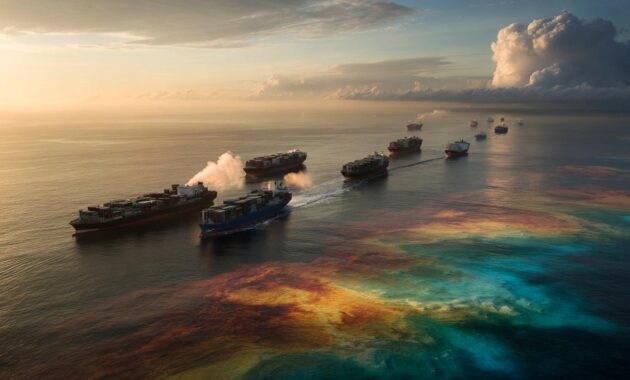
From shipping lanes to greenhouse gases, multiple forces have quietly converged over the past few years, pushing the Atlantic’s surface into record-breaking territory and reshaping how researchers view ocean heat.
An alarming heat jump in just a few years
For decades, scientists have tracked a steady, worrying rise in ocean temperatures driven by human-made greenhouse gas emissions. That was expected. What nobody saw coming was the sudden leap recorded since around 2020, particularly in the North Atlantic.
Satellites and ocean buoys show that 2023 smashed previous temperature records for the Atlantic’s surface. The curve for that year stands clearly above all past data. Early readings for 2024 suggest that the trend is not fading.
The recent Atlantic heat spike is not a gentle continuation of global warming; it looks like a step change.
That abrupt jump has triggered a wave of questions. Climate models had anticipated warming, but not this sharply and not this fast. A French climate specialist, working with colleagues in Europe and North America, has been probing why the Atlantic in particular has gone into overdrive.
Greenhouse gases are not the only driver
The first explanation is the obvious one: carbon dioxide, methane and other greenhouse gases trap more heat in the atmosphere, and the oceans absorb more than 90% of this excess energy. As global emissions have continued to rise, the long-term trend of ocean warming has strengthened.
Yet when researchers compared the recent surge to model simulations that include only greenhouse gases and natural climate variability, something did not match. The observed heat spike was too strong and too rapid. That gap led the French researcher to look closely at another human influence: air pollution from large ships.
Cleaner ships, hotter seas
On 1 January 2020, a major international rule quietly took effect: the International Maritime Organization (IMO) drastically cut the amount of sulphur allowed in ship fuel. This regulation was aimed at health and acid rain, not climate, and it worked fast. Within months, sulphur emissions from the world’s largest cargo and tanker vessels plunged, especially over the main shipping routes criss-crossing the Atlantic and other oceans.
Since 2020, sulphur pollution from ocean-going ships has dropped by around 80% above major shipping lanes.
➡️ To slow the desert, China bets on a “Great Green Wall” of tens of billions of trees
➡️ Scientists explain why the brain resists rest even when the body is exhausted
➡️ It Took China Just 2 Seconds To Smash This Hyperloop World Record That Could Redefine Future Trains
For decades, exhaust from these ships released sulphur dioxide that formed tiny particles, or aerosols, in the air. Those particles acted like miniature mirrors, reflecting part of the Sun’s radiation back into space. The result was a slight cooling effect, masking some of the warming caused by greenhouse gases.
Once those sulphur emissions fell, that reflective shield weakened. The French scientist’s analysis suggests this sudden “unmasking” of hidden warming has been a key factor behind the Atlantic’s recent overheating.
How ship pollution cooled the ocean surface
The mechanism is relatively simple:
- Ship exhaust produced sulphur-rich aerosols in the marine atmosphere.
- These aerosols brightened certain clouds and increased their reflectivity.
- More sunlight was bounced back into space, slightly cooling the ocean surface below.
- When sulphur emissions were slashed, clouds dimmed and the surface absorbed more solar energy.
According to recent modelling work, the loss of this cooling effect in the North Atlantic can translate into an additional warming of several tenths of a degree at the surface, on top of existing global warming. That may sound modest, but in climate terms it is huge, particularly when concentrated in a region already sensitive to heat changes.
A perfect storm of warming forces
The French researcher emphasises that the Atlantic heatwave is not caused by one factor alone. Instead, multiple elements have lined up in a kind of “perfect storm” for ocean warming.
| Factor | Effect on the Atlantic |
|---|---|
| Rising greenhouse gases | Long-term build-up of heat stored in the ocean |
| Reduced ship sulphur pollution | Loss of cooling aerosols, stronger solar heating of the surface |
| Natural climate cycles | Short-term boosts to warming through atmospheric and ocean circulation shifts |
| Recent El Niño conditions | Changes in global weather patterns that can reinforce North Atlantic heat |
Over the last few years, these forces have acted together rather than separately. The underlying greenhouse gas trend raised the baseline. The IMO rule removed a layer of artificial cooling. Natural oscillations and recent El Niño conditions then pushed the system over a tipping threshold for marine heatwaves.
The Atlantic has become a laboratory where decades of hidden warming are suddenly showing their full face.
Why marine heatwaves matter on land
Ocean warming might sound distant, but the Atlantic’s fever has very direct impacts on people, economies and ecosystems.
Warmer water carries less oxygen and stresses marine life. Fish species shift their range, sometimes moving northwards in search of cooler conditions. Coral communities and deep-sea ecosystems face more frequent and intense heat stress, with knock-on effects on biodiversity.
On land, the Atlantic plays a central role in shaping European and North American weather. Hotter surface waters can charge up storms, reinforce humid heat on nearby coasts, and influence jet stream patterns. Some studies link the recent Atlantic anomalies to stronger rain events in parts of Europe and to unusual blocking patterns that lock in heatwaves.
There is also a concern for Atlantic hurricanes. Warmer surface waters provide more energy for tropical cyclones. While many factors control any single storm, a hotter Atlantic means that more of them have fuel available to intensify quickly.
What the new findings mean for climate policy
The French researcher’s work raises a sharp question: did cleaning up ship fuel “cause” the extra warming? The answer is more nuanced. The sulphur cut did not create new heat. It simply allowed existing greenhouse-driven warming to show itself more clearly and more rapidly.
That points to a tricky climate trade-off. Aerosol pollution, whether from ships or factories, is terrible for human health and ecosystems. Yet it has been masking part of global warming for decades. As countries reduce air pollution, the short-term effect can be a faster rise in temperatures unless greenhouse gas emissions fall at the same time.
Clearing the air without cutting carbon is like taking the shade off a lamp while turning the dimmer up.
This insight is pushing some scientists to argue for earlier and deeper cuts in CO₂ and methane, to avoid a sudden rush of “unmasked” warming as air gets cleaner worldwide.
Key terms behind the Atlantic’s overheating
A few technical ideas help make sense of what is happening in the Atlantic:
- Marine heatwave: a period of unusually high sea-surface temperature lasting days to months, defined relative to local historical norms.
- Aerosols: tiny particles in the atmosphere, natural or human-made, that affect clouds and sunlight. They can cool or warm the planet depending on their type.
- Energy imbalance: the difference between solar energy absorbed by Earth and heat radiated back into space. A positive imbalance means the planet is gaining heat, much of it stored in the oceans.
Climate models tested by the French team simulate what the Atlantic would look like with and without ship aerosols. In runs where sulphur emissions stay high, the recent heat spike is weaker and delayed. When the IMO rules are included, the simulated warming pattern aligns more closely with real measurements, strengthening the case that cleaner ship fuel has accelerated the visible warming.
Scenarios for the next decade
Researchers are now running scenarios to estimate how the Atlantic might behave over the coming ten years. If greenhouse gas emissions continue at current levels and aerosol pollution from other sources is also reduced, further abrupt jumps in ocean temperature cannot be ruled out.
One simulated pathway shows the North Atlantic swinging between intense marine heatwaves and slightly cooler phases as natural variability interacts with the long-term trend. Coastal communities relying on fisheries or tourism could face more volatile conditions, switching quickly from favourable years to stressful ones.
Another scenario assumes rapid cuts in greenhouse gases starting this decade. In that case, the Atlantic continues warming for some time, because the ocean is slow to respond, but the rate of change gradually eases. Marine heatwaves still occur, yet they are less frequent and slightly less intense than in the high-emissions pathway.
These projections are not exact predictions, but they give governments and industries a sense of the range of futures to prepare for. Ports, shipping companies, coastal planners and insurance firms are all watching the Atlantic numbers more closely than ever.
Originally posted 2026-03-09 08:21:00.