Just off the grey waters of northern France, a new industrial giant is quietly wiring itself into the mainland grid.
The offshore wind farm rising between Dieppe and Le Tréport has just cleared one of its most delicate milestones: the delivery of two huge high-voltage cables laid on the seabed, turning an engineering project into a future power plant for hundreds of thousands of people.
The offshore “monster” taking shape in the Channel
The Dieppe–Le Tréport offshore wind farm sits in the English Channel, off the Normandy and Hauts-de-France coasts, in waters busy with fishing boats and shipping lanes.
Once fully operational, it is expected to supply electricity equivalent to the consumption of around 850,000 people, roughly the population of a large European city.
The project entered its full construction phase in January 2024, after years of environmental studies, public debates and legal hurdles.
By the end of 2026, 62 turbines will stand on the seabed, spread across a sizable section of the Channel.
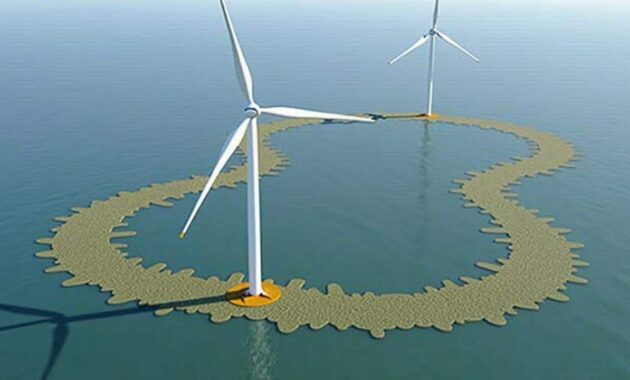
Each unit is mounted on a fixed foundation driven into the seafloor, then surrounded by rock “armour” to prevent currents from eroding the sediment around the piles.
Instead of a coal stack on the horizon, the region will see a forest of towers, turning North Sea gusts into grid-ready power.
At the centre of the array sits an offshore electrical substation, installed in July 2025.
This structure acts like a brain and a hub, collecting electricity from every turbine, stepping up the voltage, and sending it back to shore through export cables.
➡️ Nuclear energy: how PWRs, EPRs and SMRs work, costs, safety and the future of civil nuclear power
The total planned capacity is 496 megawatts, placing Dieppe–Le Tréport in the same league as other first-generation French offshore wind farms such as Saint-Nazaire and Saint-Brieuc.
Two 225 kV “electric motorways” on the seabed
The latest milestone concerns the invisible infrastructure: the export cables.
French cable specialist Nexans has officially handed over to grid operator RTE two 225 kilovolt HVAC circuits, which link the offshore substation to land-based facilities.
In practice, these are two parallel “electric motorways” that must withstand salt water, currents, temperature swings and the mechanical stress of the seabed for decades.
The system required four years of design, manufacturing and installation, from factory floor to seabed laying operations involving specialised cable-laying vessels.
These cables function like an oversized extension lead between the wind at sea and the plug on the wall at home.
Once ashore, the electricity is transferred into the national transmission grid, allowing power produced off Normandy to flow across France, depending on demand.
Nexans, the low‑profile giant behind long‑distance power flows
Nexans is far from a household name, yet it sits behind a large share of long-distance electricity links in Europe and beyond.
The group traces its roots to the late 19th century, through the historic Câbles de Lyon and later Alcatel Câble.
Rebranded as Nexans at the start of the 2000s, it has since narrowed its focus on one speciality: moving electrons safely and reliably over long distances, whether under the sea or underground.
With about 28,500 employees and revenues above €7 billion in 2024, the company has become a key supplier for high-voltage submarine cables, interconnectors and offshore wind projects.
At Dieppe–Le Tréport, Nexans did more than supply product; it delivered a complete export cable system designed to operate for several decades.
From construction site to long‑term life cycle
The formal handover of the two export circuits to RTE marks a change of phase for the project.
The system now shifts from intensive construction towards long-term operation, with a strong focus on reliability and maintenance.
Nexans will remain involved through an IMR (inspection, maintenance and repair) organisation.
This team tracks the health of the cables, uses inspections and data to anticipate potential issues, and stands ready to intervene if a fault occurs, for example after an anchor drag or a trawling incident.
Such long-term contracts matter because a cable failure can cut off hundreds of megawatts in a single event and require complex marine repair campaigns.
France’s offshore front line is filling up
France holds the second-largest offshore wind potential in Europe, just behind the UK, thanks to extensive coastlines and strong, consistent winds at sea.
Offshore turbines tend to run at higher “capacity factors” than those on land, often close to 45%, since wind at sea is steadier and less turbulent.
That makes them particularly attractive for a country aiming for carbon neutrality by 2050, with electricity needs forecast to reach around 645 terawatt-hours per year.
By mid‑century, offshore wind could provide roughly a quarter of France’s electricity, alongside nuclear and other renewables.
The government’s roadmap foresees about 45 gigawatts of offshore wind installed by 2050, compared with only a few gigawatts today.
Current and planned French offshore sites include:
- Saint‑Nazaire (Atlantic): already in service, around 480 MW
- Fécamp and Courseulles‑sur‑Mer (Channel): fixed-bottom projects due mid‑decade
- Saint‑Brieuc (Brittany): another fixed-bottom farm in the 500 MW range
- Dieppe–Le Tréport and Yeu–Noirmoutier: both aiming for 2026 commissioning
- Larger zones in the Channel, Atlantic and Mediterranean: mixing fixed-bottom and floating wind from 2035 onwards
Further south and in deeper waters, especially in the Mediterranean, France is turning to floating wind turbines, anchored by mooring lines rather than resting directly on the seabed.
How Dieppe–Le Tréport fits into the national map
The Dieppe–Le Tréport project belongs to this first generation of fixed-bottom wind farms.
Its 496 MW capacity will add to the country’s coastal cluster of projects and should supply electricity equivalent to around 850,000 residents’ annual consumption.
Investment is estimated at about €2.7 billion, spanning turbines, foundations, cables, onshore substations and a new operations base in the port of Dieppe.
The local base will host technicians, spare parts, small vessels and control teams managing day‑to‑day operations and weather windows for maintenance visits.
What those big numbers mean in everyday terms
Offshore wind output can look abstract, so it helps to translate it into daily use.
A 496 MW farm running at a 45% capacity factor would generate roughly 2 terawatt-hours per year.
That can cover, as announced, the equivalent of 850,000 people’s electricity use, excluding major industrial demand.
In practical terms, the farm can power homes, public buildings, commercial sites and a growing share of electric vehicles and heat pumps.
During windy winter periods, it may offset gas‑fired generation, cutting both imports and emissions.
Key terms worth unpacking
Some technical expressions used in offshore wind can cause confusion:
- HVAC 225 kV: high-voltage alternating current at 225,000 volts. Higher voltage reduces losses over long distances.
- Submarine export cable: the link between the offshore substation and the shore-based grid, distinct from smaller “array” cables between turbines.
- Fixed-bottom vs floating: fixed-bottom turbines sit on piles or gravity bases; floating ones use platforms moored in deeper water.
- Capacity factor: the ratio between actual output over a year and the theoretical maximum if turbines ran at full power 24/7.
Risks, benefits and what comes next
Offshore wind farms bring clear climate benefits: lifecycle emissions typically range between 13 and 19 grams of CO₂ equivalent per kilowatt-hour, far below fossil power plants.
The sector also supports thousands of jobs across turbine manufacturing, ports, vessels, cable factories and long-term operations and maintenance.
At the same time, projects must address impacts on marine life, fishing activities and coastal landscapes.
French authorities have set up large-scale public debates, such as the “la mer en débat” process, to map priority zones and define conditions for development between 2035 and 2040.
For residents along the Normandy coast, the arrival of this offshore “monster” off Dieppe and Le Tréport brings a mix of questions and opportunities, from new industrial activity in the ports to changing views on the horizon.
As the final turbines go up and the last connections are made, the twin cables now resting on the seabed will determine whether this ambitious bet on offshore wind quietly delivers what it promises: reliable, low‑carbon electricity feeding into everyday sockets across France.