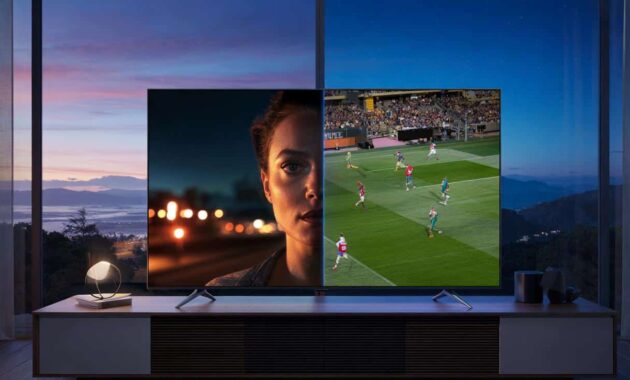
After years of headlines about 8K and ever-higher resolutions, the TV industry is pivoting. The 2026 line-up focuses less on squeezing in extra pixels and more on squeezing better light, colour and motion out of the pixels already there. For viewers, that shift could have a far bigger impact on everyday picture quality than any jump from 4K to 8K.
Why the industry is moving on from 8K
Manufacturers have spent years pushing 8K as the next big thing. In living rooms, the promise never really landed.
On show floors, 8K demos looked stunning. Back at home, sitting a couple of metres from the sofa, the difference compared with a good 4K set was often subtle, even on huge screens. The human eye struggles to resolve that many extra details at normal viewing distances.
There was also the content problem. Native 8K films and shows are almost non‑existent. Most of what people actually watched was 4K or even HD, upscaled by the TV. That made the pitch harder to justify for buyers staring at a high price tag and a familiar Netflix catalogue.
The industry has realised that what viewers really notice is not more pixels, but better pixels.
Contrast, peak brightness, colour accuracy and motion handling are far easier to see than a jump from 4K to 8K. Dark scenes with crushed shadows, sports full of blur, or washed‑out highlights on sunny days break immersion instantly. This is where 2026 TVs are aiming to make the biggest leap.
HDR steps into the spotlight
High Dynamic Range (HDR) is not new, but the way it is being handled in 2026 models is changing dramatically. Instead of static settings, the next generation treats HDR as a flexible, scene‑by‑scene system that reacts to content and room conditions.
Two rival formats define this new battle: Dolby Vision 2 and HDR10+ Advanced. Both seek to pull much richer performance out of 4K panels without touching the resolution spec itself.
The race is no longer about how many pixels a TV has, but how intelligently those pixels are driven.
➡️ If your spider plant has dry brown tips, it’s time to rethink watering
➡️ The everyday driving habit that increases winter risk
➡️ The everyday reason your recovery feels incomplete
➡️ Abandoned In Adulthood, This Habit Could Quietly Extend Your Well‑Being
➡️ Phalanx technique: the simple finger trick for perfectly cooked, never‑sticky rice
Dolby Vision 2: smarter tone mapping and motion control
Dolby’s new standard takes a creator‑first approach. Dolby Vision 2 works with what the TV can genuinely do, instead of forcing a one‑size‑fits‑all grade.
The key advance is a two‑way tone‑mapping system. Rather than the source just sending out a maximum brightness map and hoping the display copes, the TV feeds back its capabilities. It tells the source how bright it can get, how deep its blacks are, and how finely it can handle colour.
That allows each scene to be optimised differently on a compact living‑room OLED versus a high‑brightness Mini LED in a sunny lounge. The same movie can look tailored on both, instead of compromised for the lowest common denominator.
Dolby Vision 2 also reaches into motion. A feature branded “Authentic Motion” lets content creators specify how much motion smoothing, if any, should be allowed frame by frame. The goal is to kill that glossy “soap opera effect” without sacrificing clarity when it is genuinely needed, such as in fast camera pans.
For the first time, motion settings can be baked into the HDR metadata instead of left entirely to aggressive TV algorithms.
Early hands‑on impressions at CES 2026 pointed to punchier colours, more controlled highlights and movement closer to what directors intended.
HDR10+ Advanced: Samsung’s AI‑driven answer
On the other side, HDR10+ Advanced, led by Samsung and partners, takes a more open and automated path. The format remains licence‑free, which appeals to manufacturers looking to avoid Dolby fees.
Here, artificial intelligence runs the show. The TV analyses what type of content is playing – drama, football, live concert, video game – and adjusts HDR behaviour dynamically. Brightness, local dimming and colour mapping shift in real time to keep detail visible without washing out the image.
There is a new “HDR10+ Bright” mode designed for very luminous sets, particularly high‑end Mini LED models hitting 4000 to 5000 nits peak brightness. That allows specular highlights like sunlight, sparks or reflections to stay controlled instead of blasting into eye‑searing white.
Motion is handled by a system dubbed “Intelligent FRC” (frame rate control). Rather than blanket motion interpolation, it relies on metadata inside the content to decide when to generate extra frames. That helps avoid artefacts and keeps action crisp only where it makes sense.
Samsung is betting on a TV that figures everything out for you, with minimal manual tweaking and no licence costs.
What this means for 2026 TV ranges
The shift to these upgraded HDR formats has clear hardware implications. A cheap entry‑level 4K panel will not suddenly support everything via firmware.
Dolby Vision 2 in its full implementation targets high‑spec televisions. Sets need powerful processors and panels capable of up to 12‑bit colour depth, translating to more than 68 billion possible shades. No mass‑market TV sold before 2026 can reach that full spec, so buyers wanting the complete feature set will be steered to fresh models.
HDR10+ Advanced also expects sophisticated backlighting. The format is optimised for Mini LED and high‑end QLED panels with thousands of local dimming zones, enabling tight control over bright and dark areas on screen.
Several brands have already nailed their colours to the mast:
- Philips plans to offer Dolby Vision 2 on multiple 2026 OLED models.
- Hisense is aligning with Dolby Vision 2 for its top‑tier sets.
- Samsung is focusing on HDR10+ Advanced and shows no sign of adding Dolby Vision support.
This split is likely to be mirrored by content providers. Amazon’s Prime Video has already voiced support for HDR10+ Advanced. Canal+ is working with Dolby Vision 2. Streaming giants such as Netflix and Disney+ are expected to follow once more content is mastered for the new standards, but that rollout could take months or years rather than weeks.
Should you upgrade your TV in 2026?
Owners of recent 4K sets do not need to panic. TVs launched in 2024 and 2025 that support current HDR10+ and Dolby Vision remain highly capable. For many households, the leap to the 2026 formats will feel incremental rather than transformative, especially without a large library of compatible content.
For most people, a solid 4K HDR set bought recently will stay relevant for years, even as Dolby Vision 2 and HDR10+ Advanced roll out.
Where things get interesting is at the high end. Shoppers planning to spend serious money on a new flagship TV will face a fresh choice. HDR format support will sit alongside panel type and size as a core buying criterion.
In practice, the market is heading towards a dual‑ecosystem model. Some brands and services will lean into Dolby Vision 2’s creator‑friendly approach. Others will line up behind HDR10+ Advanced and its open, automated philosophy. Consumers may find that their preferred streaming service nudges them toward one camp or the other.
Key differences at a glance
| Feature | Dolby Vision 2 | HDR10+ Advanced |
|---|---|---|
| Business model | Proprietary, licensed format | Open, licence‑free standard |
| Target hardware | High‑end OLED / Mini LED, 12‑bit capable | High‑brightness Mini LED / QLED with strong local dimming |
| Tone mapping | Two‑way TV–source communication for tailored scenes | AI‑driven adjustments based on content type |
| Motion handling | “Authentic Motion” with creator‑defined smoothing | “Intelligent FRC” adding frames only when metadata suggests |
| Positioning | Focus on artistic fidelity and control | Focus on automation and wide manufacturer adoption |
What HDR, nits and bits actually mean
For anyone feeling lost in jargon, a few terms are worth unpacking. HDR, or High Dynamic Range, simply means a TV can show brighter highlights and deeper shadows in the same frame. Think of a sunset where you can see both the glowing sky and the details in someone’s face in front of it, rather than one area blowing out into grey.
Nits measure brightness. A standard budget TV might reach around 300–400 nits. High‑end Mini LED sets advertised around 2000–3000 nits can keep HDR highlights visible even in a bright, sunlit room. HDR10+ Advanced’s “Bright” profile expects TVs capable of far higher peaks, up to 4000–5000 nits.
Bit depth refers to how many shades of each colour a display can represent. Most current TVs use 10‑bit panels, which already allow over a billion colours. Dolby Vision 2’s push towards 12‑bit aims to reduce banding in smooth gradients, like blue skies or gentle lighting transitions.
Real‑world scenarios for 2026 TVs
Picture a Sunday afternoon Premier League match on a 2026 Mini LED set. With HDR10+ Advanced, the TV detects live sport, cranks up brightness, tightens local dimming to keep players’ shirts crisp against the pitch, and tunes motion processing to keep the ball sharp without turning the stadium into a soap opera‑style video.
Switch to a Dolby Vision 2‑graded movie at night. The room is dim, so the TV and source communicate to lower peak brightness, deepen black levels and follow the director’s chosen motion settings. Shadowy scenes retain fine detail instead of dissolving into muddy grey, and camera pans look cinematic rather than hyper‑smooth.
For gamers, both formats could matter even more. Fast response times, reduced input lag, and HDR that adapts to dark dungeons and blinding explosions on the fly can change how a title feels. As consoles and PCs start to support these enhanced formats, gaming monitors may begin to borrow the same tricks from 2026 TVs.
Risks and trade‑offs for buyers
The main risk is fragmentation. A household that owns a TV with only Dolby Vision 2 support might not benefit from HDR10+ Advanced content mastered primarily for Samsung’s platform, and vice versa. Standard HDR10 remains the common baseline, but the best picture will depend on this format tug‑of‑war.
There is also the usual early‑adopter question. First‑wave sets often carry a price premium and may not support every planned feature on day one. Firmware updates tend to fill gaps, but buyers looking for value might prefer waiting a year while the formats bed in and more content arrives.
On the upside, the pivot away from resolution wars should help mid‑range models, too. Even if they never get full Dolby Vision 2 or HDR10+ Advanced, the underlying processing advances around tone mapping and motion are likely to trickle down, bringing cleaner HDR and more consistent pictures to cheaper 4K TVs.